
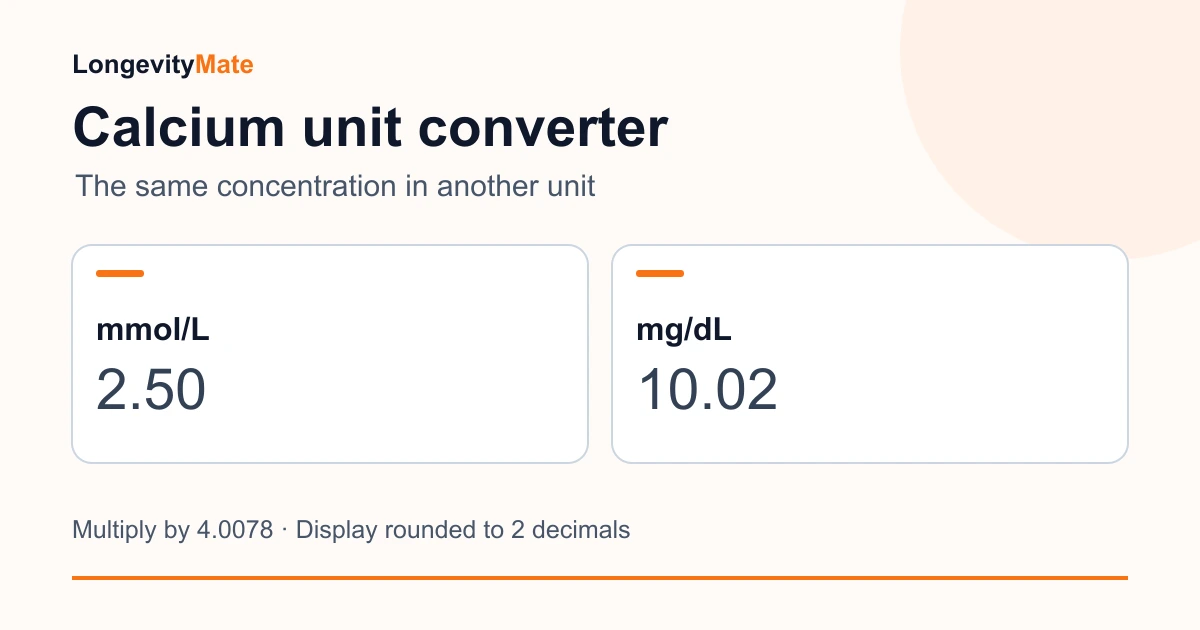
What this result means
To convert calcium from mmol/L to mg/dL, multiply by 4.0078. To convert mg/dL to mmol/L, divide by 4.0078. This factor uses a calcium reference molar mass of 40.078 g/mol; the displayed result is rounded to two decimal places. [1][2]
How to convert calcium units
Where the 4.0078 factor comes from
NIST lists calcium’s relative atomic mass as 40.078. Using the corresponding reference molar mass, one millimole of calcium has a mass of 40.078 milligrams. There are ten decilitres in one litre, so 40.078 mg/L becomes 4.0078 mg/dL. [1][2]
The converter stores 4.0078 as the fraction 20039/5000 and uses 5000/20039 in reverse. This avoids rounding the reverse multiplier before doing the calculation. It provides exact arithmetic for the selected reference value, not an exact physical measurement. [1][2]
Total and ionised calcium stay different
Total calcium includes calcium attached to proteins and calcium that is not attached. Ionised calcium measures the free portion. Changing concentration units cannot determine how much calcium is in either portion. Keep the measurement type attached to the converted answer. [3]
For example, converting a total calcium result from mmol/L to mg/dL still produces a total calcium result. This tool has no albumin input and does not calculate corrected calcium or infer an ionised result. [3]
Rounding and small values
The displayed answer has two decimal places. Halfway values round upward in magnitude, and a positive answer below the display resolution is shown with a less-than sign instead of being labelled zero. A true zero displays 0.00.
Keep the original result for records or further calculations. Repeatedly converting an already rounded answer can lose precision. More digits in the multiplier do not make the original laboratory test more accurate. [1][2]
What the input accepts
Enter a non-negative number using a decimal point, such as 2.50. Do not add units, a comma, a fraction or scientific notation. Blank entries and negative values are rejected. The technical upper bound is unrelated to medical interpretation.
If a report says less than a value, do not enter that limit as though it were an exact result. Preserve the inequality and ask the issuing laboratory how it should be represented in the other unit.
Why this is not a calcium dose converter
Keep the report beside the answer
Use the report’s own reference interval, specimen and measurement type when discussing a result. A conversion does not establish whether the concentration is low, high or appropriate for a particular person. Total calcium and ionised calcium answer different testing questions. [3]
Your calculation stays on this page
No account is needed. Calculation values are not added to the page URL or shared link. The Share action uses the clean calculator address; it does not send another person your entered calcium number. Reset or reload clears the entry.
Formula and assumptions
- Version
- Calcium amount and mass concentration conversion, calcium-mmol-mgdl-40-078-v1
- Rounding
- Use 20039/5000 or its exact reciprocal 5000/20039; round once to two decimals, with halfway ties upward. Show very small positive answers with a less-than sign. The reference molar mass and original measurement are not physically exact.
Who this is for — and when not to use it
Intended use
Neutral arithmetic for an existing calcium concentration reported in mmol/L or mg/dL. Convert only the units of the same original measurement.
Not intended for
No reference ranges, diagnosis, albumin correction, total-to-ionised conversion, supplement or medicine dosing, calcium-salt conversion, dietary assessment or personal treatment decisions.
Exclusions
- Albumin-adjusted or corrected calcium calculations
- Inferring ionised calcium from total calcium or the reverse
- Calcium carbonate, citrate, elemental supplement amounts, medicine doses and intake recommendations
- Clinical cutoffs, low or high classifications, symptoms, urgent-care or treatment decisions
- Changing the specimen type, laboratory method or measurement accuracy
Evidence sources
- 1. Calcium: Atomic Data — National Institute of Standards and Technology. Accessed Sep 12, 2026.
- 2. Guide for the Use of the International System of Units: SI Prefixes — National Institute of Standards and Technology. Accessed Sep 12, 2026.
- 3. Calcium Blood Test — MedlinePlus. Accessed Sep 12, 2026.