
What this result means
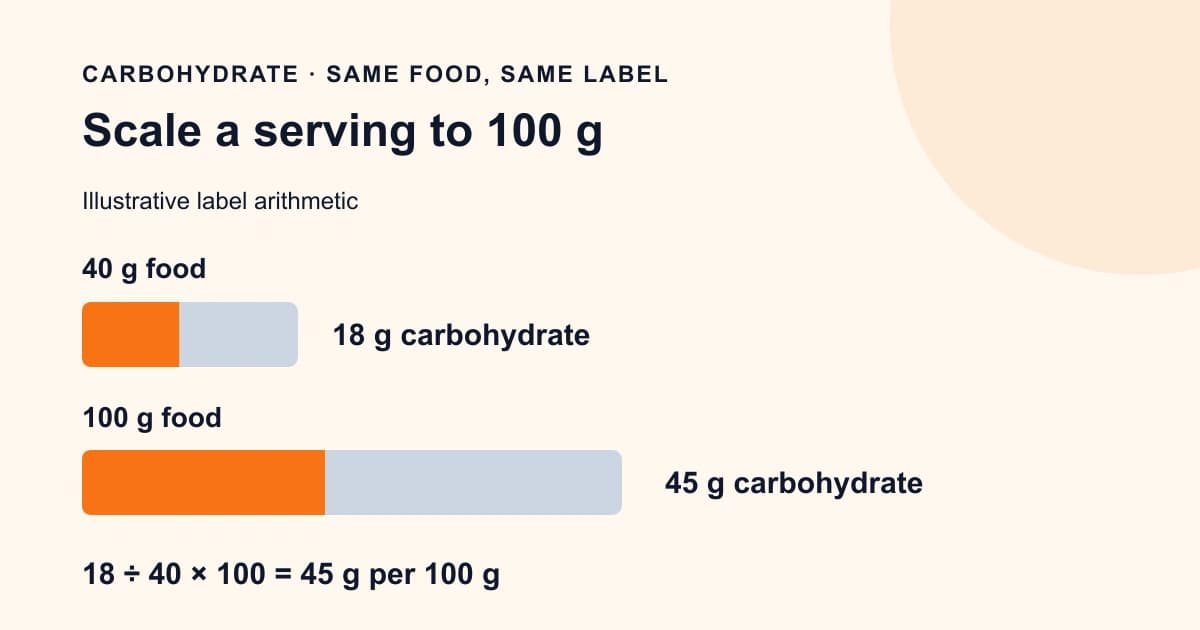
Carbohydrate per 100 g = labeled carbohydrate grams ÷ matching serving weight in grams × 100. An illustrative label with 18 g carbohydrate in a 40 g serving gives 45.00 g per 100 g. Use carbohydrate, not the separate sugars line. [1]
Match the serving and the label column
FDA explains that listed nutrient amounts refer to the stated serving; some packages show both per-serving and per-container columns. Use the carbohydrate and gram weight from the same column. A serving size describes the label basis, not an instruction for how much you should eat. [2]
Use carbohydrate, not sugars or net carbs
On a U.S. Nutrition Facts label, total carbohydrate includes dietary fiber, total sugars and sugar alcohols. Copy that total carbohydrate entry for this calculation. Do not add the sugars again or subtract fiber to turn it into a different measure. [1]
Compare the same food state and label definition
FSANZ explains that nutrition panels show per-serving and per-100 g or per-100 mL values for comparison. Its carbohydrate explanation includes starches and sugars. Check the market’s label basis and the food’s stated preparation before comparing values; this tool preserves the amount you enter. [3]
Dry powder and the same product prepared with water have different food masses. This calculator cannot infer the water added or change one preparation state into another. A gram weight and carbohydrate amount from different states do not form a valid pair.
An illustrative calculation
If a label states 18 g carbohydrate per 40 g of food, 18 ÷ 40 × 100 = 45.00 g per 100 g. Doubling both entries to 36 g and 80 g gives the same result. The diagram’s orange carbohydrate portion and slate remainder show that scaling; they are illustrative quantities, not a real product label.
Keep the original label precision
For an exact halfway example, 1.01 g ÷ 200 g × 100 = 0.505, displayed as 0.51 g per 100 g. A stated zero produces 0.00. A very small positive entry can also round to 0.00. The result cannot recover detail lost when the original label or scale was rounded.
Enter plain numbers and share the clean page
Enter decimal-point numbers in grams. Carbohydrate accepts 0 to 1,000; serving weight accepts 0.1 to 1,000. Carbohydrate cannot exceed serving weight. These software limits are not dietary limits. Blank entries, unit text, fractions, scientific notation and comma separators are rejected.
The calculation runs in your browser without an account. Reset or reload clears the entries. Share uses the page address without input values or results. The optional recently-used list stores a tool identifier, rather than the food values you entered.
Formula and assumptions
- Formula
- Carbohydrate per 100 g = carbohydrate per serving (g) ÷ matching serving weight (g) × 100 [2][3]
- Version
- Labeled carbohydrate concentration, labelled-carbohydrate-over-serving-mass-v1
- Rounding
- Calculate using exact decimal fractions, then round once to two decimals; nonnegative halfway values round upward. Carbohydrate grams cannot exceed the matching food mass.
- Worked example
- Illustrative label: 18 g carbohydrate in a 40 g serving gives 18 ÷ 40 × 100 = 45.00 g per 100 g. Use the matching food weight and carbohydrate entry; the result rescales that label without assigning a health rating.
Who this is for — and when not to use it
Intended use
Rescale a known labeled carbohydrate amount to the same food mass of 100 g. Compare like-for-like label entries with matching units, carbohydrate definitions and preparation state.
Not intended for
Set carbohydrate intake, diagnose or manage diabetes, or calculate insulin or medicine doses. Calculate net carbohydrates, glycemic index, energy, sugars or fiber from another nutrient entry. Infer an unlisted nutrient, convert food volume into mass or adjust for cooking and water changes.
Exclusions
- Missing carbohydrate amount, missing serving grams or zero serving weight.
- Volume-only labels, unmatched label columns or unknown food preparation state.
- Carbohydrate grams greater than the total mass of the matching serving.
Evidence sources
- 1. Total carbohydrate: Interactive Nutrition Facts Label — U.S. Food and Drug Administration, October 2021. Accessed Oct 10, 2026.
- 2. Serving size on the Nutrition Facts label — U.S. Food and Drug Administration. Accessed Oct 10, 2026.
- 3. Nutrition information panels — Food Standards Australia New Zealand. Accessed Oct 10, 2026.