
What this result means
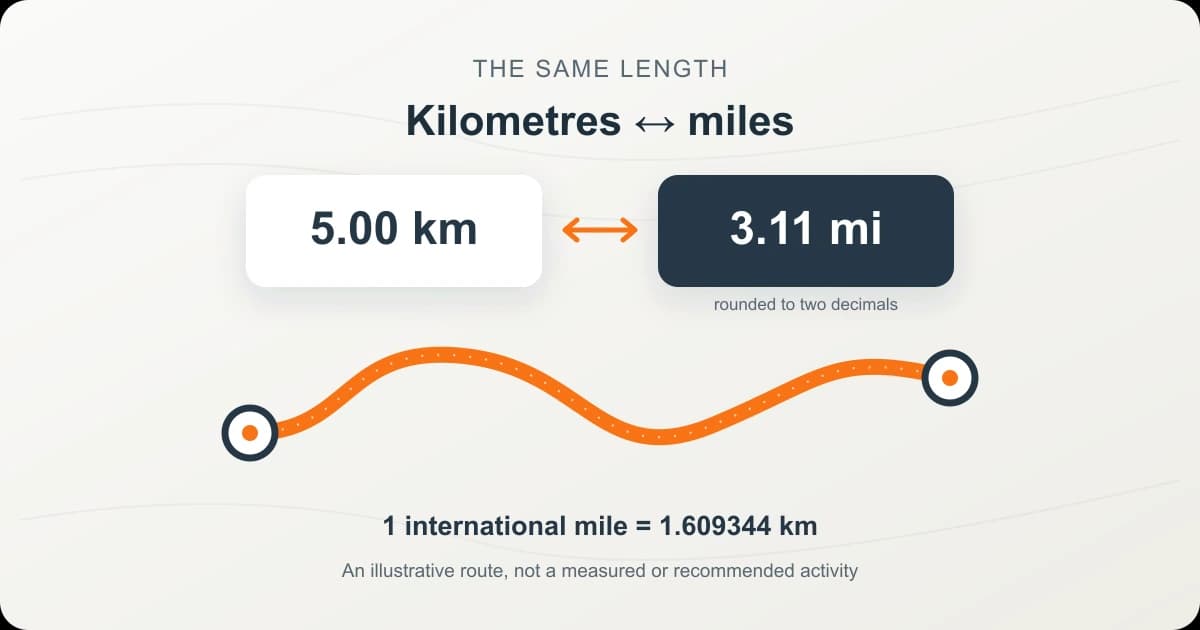
One international mile is exactly 1.609344 kilometres. Multiply miles by 1.609344 to get kilometres, or divide kilometres by 1.609344 to get miles. This converter rounds the result once to two decimals. [1][2]
An exact factor for a known length
Check which kind of mile you have
Rounding can prevent an exact round trip
For example, 5.00 kilometres displays as 3.11 miles. If you enter that rounded 3.11-mile result in the other direction, the display becomes 5.01 kilometres. The difference comes from rounding the intermediate value, rather than a change in length. Keep the original measurement when converting again.
A genuine zero displays 0.00. A positive result below the display resolution shows less than 0.01. More decimal places in a converted result do not mean the original route or device was measured more accurately.
Distance and pace are different questions
This tool restates an existing length. It does not infer distance from steps, calculate how long a trip takes, or turn a distance into an exercise recommendation. If your original value is in kilometres per hour, it is a speed rather than the length this page accepts.
Enter the number alone
Choose the input unit and enter a nonnegative number with a decimal point. Blank, negative, above-limit, unit-text, inequality, comma, fraction, scientific-notation and non-finite entries are rejected. The maximum is a software input limit, without a health meaning.
Share the page without sharing your entry
No account is required. Values remain in browser memory. Reset or reload clears the entry, and Share uses the clean page address. The optional recently-used list keeps a tool identifier, rather than your distance.
Formula and assumptions
- Formula
- kilometres = international miles × 1.609344. international miles = kilometres ÷ 1.609344. [1][2][3]
- Version
- International mile and kilometre conversion, international-mile-km-1-609344-v1
- Rounding
- Use 25146/15625 and its exact reciprocal 15625/25146; round once to two decimals with halfway ties upward. Tiny positive results display a less-than sign.
- Worked example
- Example: 5.00 km ÷ 1.609344 = 3.106855961… mi, displayed as 3.11 mi. In the other direction, 1.00 mi × 1.609344 = 1.609344 km, displayed as 1.61 km. These are arithmetic examples, not recommended activity distances. [1]
Who this is for — and when not to use it
Intended use
Convert a known length between kilometres and international miles. Compare the units on a route, distance record or written measurement.
Not intended for
Convert nautical miles or historic U.S. survey miles. Estimate distance from steps, time, speed or personal stride length. Estimate calories, exercise benefit, pace or a personal activity target.
Exclusions
- Different quantities such as speed, area or volume.
- Nautical miles, historical survey-based units, inequalities or nonnumeric entries.
Evidence sources
- 1. Revised unit conversion factors: international foot-based mile — National Institute of Standards and Technology. Accessed Oct 8, 2026.
- 2. NIST SP 811: Guide for the Use of the International System of Units — National Institute of Standards and Technology. Accessed Oct 8, 2026.
- 3. SI prefixes: kilo means one thousand — International Bureau of Weights and Measures (BIPM). Accessed Oct 8, 2026.