
What this result means
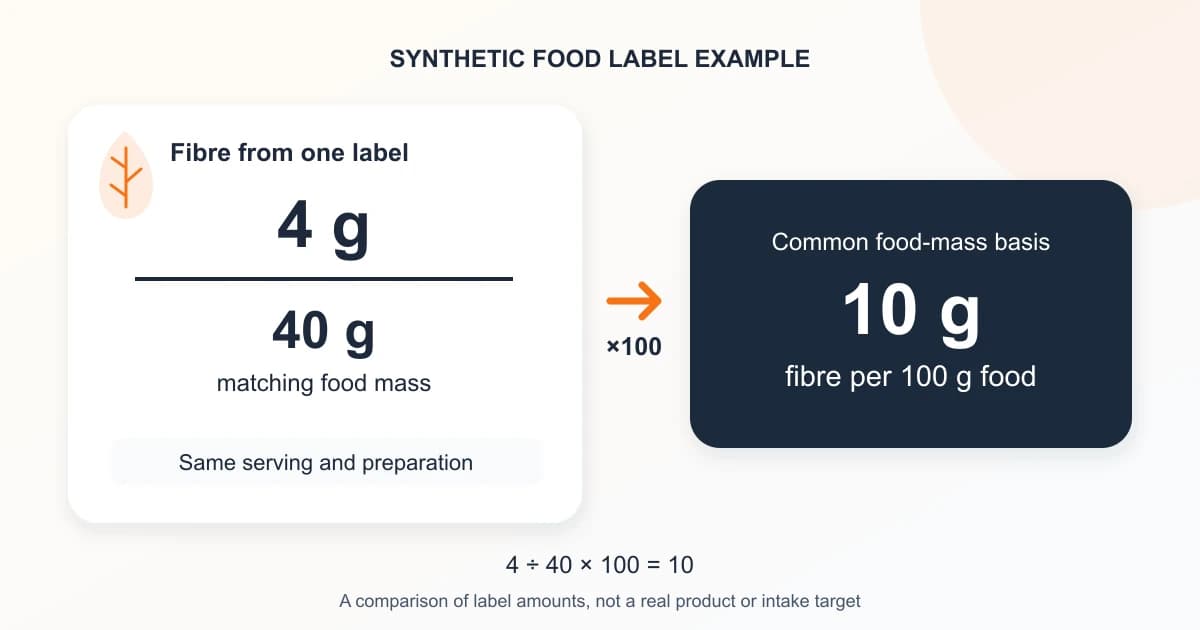
Divide dietary fibre in a serving (g) by the matching serving mass (g), then multiply by 100. An invented label with 4 g fibre in 40 g food gives 10.00 g per 100 g. Use the dietary fibre amount, not carbohydrate or % Daily Value. This compares labels and sets no personal intake goal. [1][2]
Start with the matching label entries
Find the dietary fibre gram amount and the food mass for that same serving. If the fibre value describes a whole container, its denominator must be that container’s food mass. A missing fibre line is unknown here, not zero. [1][2]
Use total dietary fibre. Do not enter carbohydrate or % Daily Value and do not add soluble and insoluble amounts on top of an already stated total. Read the original label wording before copying the figures. [2]
Keep food mass and preparation state consistent
This calculation uses grams of food, not volume. Millilitres cannot replace grams without reliable density information. Keep numerator and denominator both prepared or both unprepared; added water changes the food-mass basis. [1]
A printed per-100-g value avoids reconstructing a ratio from rounded per-serving entries. When comparing similar foods, still consider what amount you actually eat; this result describes concentration, not the amount in your own portion. [1][2]
Serving size can change the apparent order
Invented Food A: 4 g fibre in 40 g gives 10.00 g per 100 g. Invented Food B: 5 g in 100 g gives 5.00 g per 100 g. B has more fibre in its stated serving, while A has more on a common mass basis. These examples are not real products.
Fibre per 100 calories uses food energy as the denominator and answers a different question. Fibre per 100 g uses food mass. A food can rank differently on the two bases; neither figure is a whole-food health score.
Rounding and consistency checks
An exact synthetic value of 2.01 g fibre in 200 g food is 1.005 g per 100 g and displays as 1.01. Tiny positive results can display as 0.00. Printed label precision still limits the calculation.
Doubling both matching entries leaves the ratio unchanged: 4 g in 40 g and 8 g in 80 g both yield 10.00 g per 100 g. A changed ratio after scaling is a reason to check which figures you paired.
Entry safeguards and privacy
Serving mass must be positive. Fibre cannot exceed the matching whole food’s mass, so such an entry pair is rejected. These safeguards do not detect every transcription error or certify a product. No personal intake goal or medical interpretation is calculated.
The arithmetic runs in your browser. Numeric inputs and results do not enter the shared page address or analytics details. Reset clears the entries; sharing keeps the page address, not your calculation.
Formula and assumptions
- Version
- Dietary fibre per 100 grams of food, fiber-per-100g-v1
- Rounding
- Calculate with exact decimal fractions, then round once to two decimal places; nonnegative exact halfway values round up.
- Worked example
- Invented label: 4 g dietary fibre ÷ 40 g serving mass × 100 = 10.00 g fibre per 100 g food.
Who this is for — and when not to use it
Intended use
Neutral food-label arithmetic comparing stated dietary fibre with matching food mass.
Not intended for
No personal daily fibre target, clinical diet, supplement dose, food-health score, disease-risk estimate, % Daily Value calculation or grams-to-millilitres conversion.
Exclusions
- Missing fibre information or guessing a missing value as zero
- Using carbohydrate or % Daily Value as grams of fibre
- Adding soluble or insoluble subtypes to an already stated total
- Mixing servings, container amounts or preparation states
- Substituting millilitres for grams without reliable density
- Zero serving mass or fibre mass above the matching food mass
- Using the result as a personal dietary target
Evidence sources
- 1. Nutrition information panels — Food Standards Australia New Zealand. Accessed Oct 2, 2026.
- 2. How to Understand and Use the Nutrition Facts Label — U.S. Food and Drug Administration. Accessed Oct 2, 2026.