
What this result means
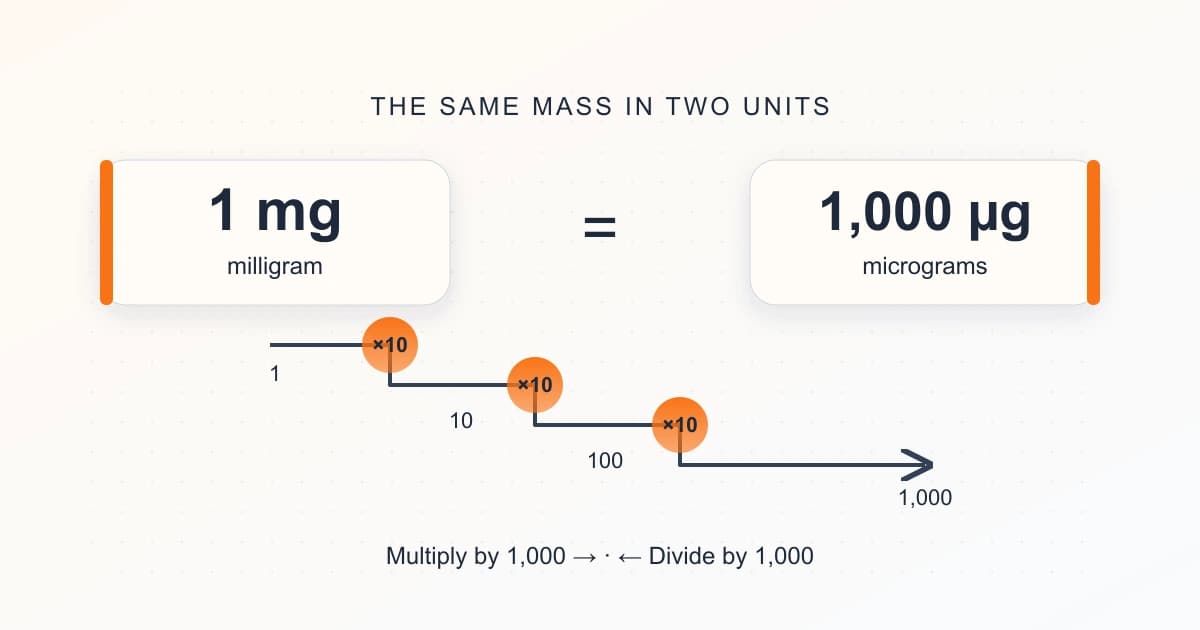
One milligram (mg) is exactly 1,000 micrograms (µg). Multiply milligrams by 1,000 to get micrograms; divide micrograms by 1,000 to get milligrams. “mcg” is another common written form of microgram. This tool changes the unit of a known mass, not its amount or suitability. [1][3]
Why the factor is exactly 1,000
NIST lists milli as 10^-3 and micro as 10^-6. A milligram is therefore 0.001 gram and a microgram is 0.000001 gram. Dividing those definitions gives 10^-3 ÷ 10^-6 = 1,000. The artwork’s three steps of ten show that same factor. [1]
NIST describes gram and kilogram as units of mass. This converter uses mass throughout; a change from mg to µg does not change the substance, its measured amount or the basis of a label. [2]
Check the complete unit before entering a number
The symbol µ denotes micro. When a label writes mcg, read the full unit name to confirm it means micrograms. Milligrams and micrograms differ by a factor of 1,000, so overlooking the prefix can create a substantial unit error. [3]
Units such as mg/mL, µg/L and mg per serving include a denominator. This tool accepts a mass, not a concentration or an instruction. IU is not an accepted mass unit here and is not covered by the 1,000 ratio. Keep those quantities in their original context.
Examples that keep the amount unchanged
An illustrative labelled mass of 0.5 mg equals 500 µg. A labelled mass of 250 µg equals 0.25 mg. These are arithmetic examples, not proposed doses or intake targets. The image’s 1 mg = 1,000 µg describes the unit definition rather than a product or personal measurement.
As a cross-check, 1,000 µg converts to 1 mg, and 1 mg converts back to 1,000 µg before rounding. Keep the same ingredient and label basis when comparing quantities.
Six display decimals do not add measurement accuracy
The converter rounds once at the end. For example, 0.0005 µg is exactly 0.0000005 mg, a halfway value that displays as 0.000001 mg. A smaller positive result below that rounding threshold displays as less than 0.000001 mg.
If a label already rounded its original number, conversion cannot recover the missing detail. Keep the original measurement when accuracy matters. The extra display places describe arithmetic; they are not evidence that a household scale or ingredient label measured that precisely.
Enter a plain number; keep private values in the browser
Each direction accepts starting values from 0 to 1,000,000. These are software bounds, not health limits. Use decimal-point notation. Blank entries, negatives, unit text, inequalities, fractions, scientific notation, comma separators and nonfinite numbers are rejected. Changing direction clears the old entry so it cannot silently acquire a different unit.
Calculation runs in the browser without an account. Reset or reload clears entries. Share uses the page address without input values or results. The optional recently-used list stores the tool identifier, not the mass entered.
Formula and assumptions
- Version
- SI milligram and microgram conversion, si-milli-micro-exact-1000-v1
- Rounding
- Keep the exact integer ratio 1000/1 or 1/1000; round once to six decimal places with nonnegative halfway ties upward. Display precision is not measurement accuracy.
- Worked example
- For an illustrative labelled mass: 0.5 mg × 1,000 = 500 µg. In reverse, 250 µg ÷ 1,000 = 0.25 mg. The amount stays the same; neither example recommends taking that amount.
Who this is for — and when not to use it
Intended use
Convert a known mass between milligrams and micrograms. Restate the same labelled ingredient amount in another mass unit.
Not intended for
Choose or approve a medicine or supplement dose, nutrient target or food amount. Convert IU, a biological-activity unit, into mass without substance-specific information. Calculate a volume, concentration, blood-level interpretation or ingredient potency.
Exclusions
- Unclear units, activity units, volume-only quantities or a concentration without its denominator.
- Negative mass, unit text or values beyond the stated software bounds.
Evidence sources
- 1. NIST Guide to the SI: SI units and prefixes — National Institute of Standards and Technology. Accessed Oct 12, 2026.
- 2. SI Units: Mass — National Institute of Standards and Technology. Accessed Oct 12, 2026.
- 3. Daily Value on the Nutrition and Supplement Facts Labels: units — U.S. Food and Drug Administration. Accessed Oct 12, 2026.