
What this result means
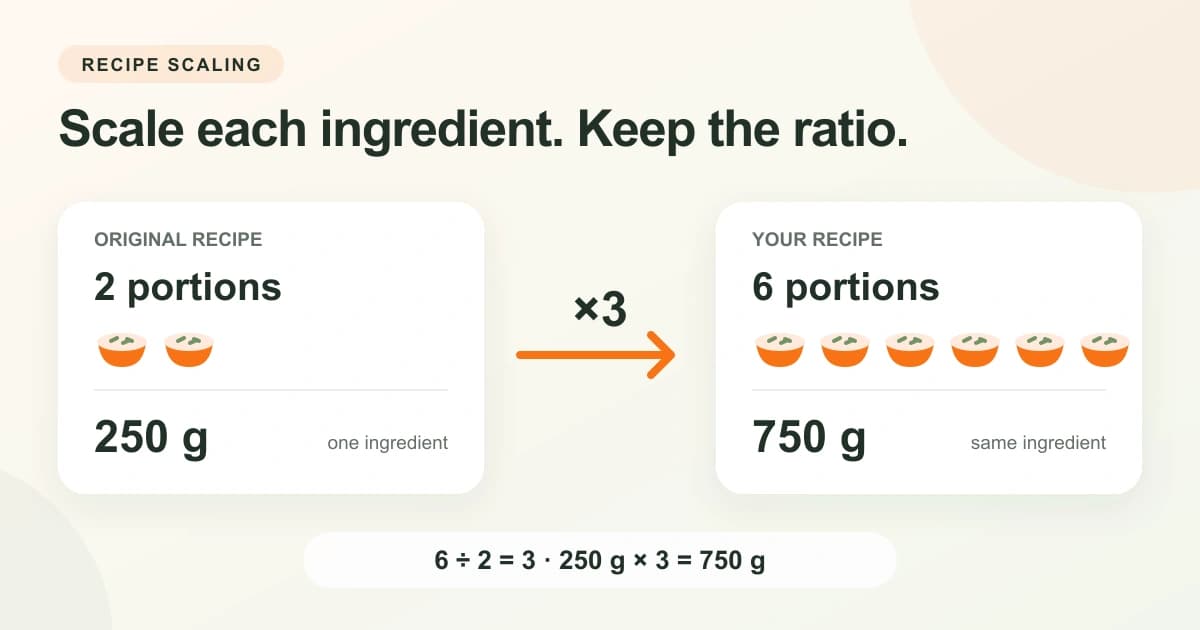
Enter the recipe's original servings, the servings you want and one ingredient quantity. The calculator divides desired servings by original servings, then multiplies the ingredient by that exact ratio. [1]
What the scaled quantity means
The answer is the amount of one ingredient after applying the desired-to-original serving ratio. Keep the ingredient unit unchanged. [1]
The multiplier shows the same relationship for every ingredient. A multiplier of 1.5 means multiply each original quantity by 1.5; a multiplier of 0.5 means halve it. [1]
How to scale the whole recipe
Repeat the calculation for each ingredient to use the exact serving ratio. The displayed multiplier is rounded to six decimal places, so using that displayed number for another calculation can introduce a small rounding error. [1]
Keep dimensional units consistent. If an ingredient is written in grams, its scaled answer is grams; if it is written in cups, its answer is cups. This tool makes no density conversion.
What may not scale perfectly
Recipe standardization guidance notes that herbs and spices, thickeners, leavening agents and liquids may not change proportionately. Use the arithmetic as a starting point, then test the prepared recipe and apply recipe-specific judgement. [2]
Changing the batch size can also change pan depth, heating, mixing and cooking time. Follow the source recipe where possible and check the finished food rather than assuming time and temperature scale with servings. [2]
Keep food safety separate from the arithmetic
The calculator does not decide whether food is safely cooked or stored. For meat, poultry, seafood and eggs, follow reliable instructions and use a food thermometer where appropriate; appearance alone is not a reliable safety check. [3]
If scaling changes container size, cooling time or storage conditions, use applicable local food-safety guidance rather than this result. [3]
Important limitations
The calculator accepts decimal quantities, not written fractions such as 1/2 or 1 1/2. Convert the fraction to a decimal first and keep the original unit outside the field.
It does not calculate calories, nutrients, allergens, dietary suitability or an appropriate portion for a person. Those require ingredient data and individual context that are not collected here.
Formula and assumptions
- Formula
- Multiplier M = desired servings ÷ original servings. Scaled ingredient quantity Q2 = original quantity Q1 × M. [1]
- Version
- Recipe serving-ratio scaling, recipe-serving-ratio-v1
- Rounding
- Keep the serving ratio exact until the final calculation. Round displayed values once to six decimal places, with halfway ties upward. A positive quantity that rounds to zero shows <0.000001; 0.0000005 rounds to 0.000001.
- Worked example
- Example: a recipe makes 4 servings and uses 1.5 cups of an ingredient. For 6 servings, the multiplier is 6 ÷ 4 = 1.5. The scaled quantity is 1.5 × 1.5 = 2.25 cups. [1]
Who this is for — and when not to use it
Intended use
Neutral arithmetic for scaling one numeric ingredient quantity from an existing recipe yield to another whole-number yield while preserving the original unit.
Not intended for
Not a nutrition calculator, healthy-serving recommendation, meal plan, unit converter, density converter, allergy check, food-safety decision, cooking-time calculator or medical or dietary tool.
Exclusions
- Recipes without a known original serving yield
- Fractional serving-count inputs; this version uses whole recipe yields from 1 to 1,000
- Fractions or units typed into the quantity field; enter a decimal number only
- Conversion between cups, spoons, grams, ounces, millilitres or other units
- Nutrition, calorie, macronutrient, allergy or personalized portion calculation
- Automatic adjustment of pan size, cooking time, cooking temperature or equipment
- Assuming herbs, spices, leavening agents, thickening agents, eggs or liquids always scale perfectly
- Food-safety temperatures, storage times or suitability decisions
Evidence sources
- 1. Adjusting standardized recipes — Institute of Child Nutrition, The University of Mississippi. Accessed Sep 6, 2026.
- 2. Step-by-step recipe standardization guide for the Child and Adult Care Food Program — Institute of Child Nutrition, The University of Mississippi. Accessed Sep 6, 2026.
- 3. Safe food handling — United States Food and Drug Administration. Accessed Sep 6, 2026.