
What this result means
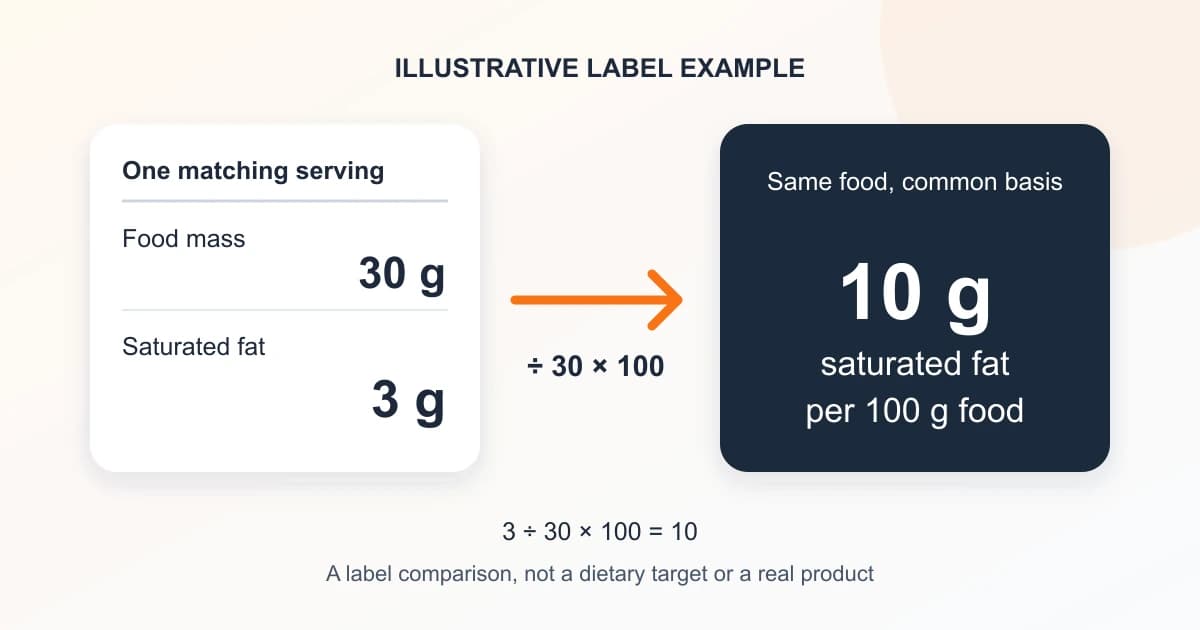
Divide saturated fat in one serving (g) by the matching food serving mass (g), then multiply by 100. An invented label with 3 g saturated fat in 30 g of food gives 10.00 g per 100 g. Use the Saturated Fat line, not Total Fat or % Daily Value. This is label arithmetic, not a personal dietary limit. [1][2]
Start with the same serving
Find the saturated-fat amount in grams and the matching serving mass in grams. If the nutrient amount is for a whole container, the denominator must be that same container’s food mass. Mixing label columns creates the wrong ratio. [1][2]
A panel expressed per 100 mL uses volume. This calculator uses mass; it cannot substitute mL for g without reliable density information. Keep both entries in the same prepared or unprepared state. [1]
Saturated fat, total fat and % Daily Value differ
Saturated fat is included within Total Fat. It is a separate nutrient line, so do not add it to Total Fat and do not enter total-fat grams here. The % Daily Value is a comparison to a label reference amount, not grams of fat in the food. [1][2][3]
For example, a label showing 8 g Total Fat, including 3 g Saturated Fat, supplies a numerator of 3 g for this tool. This invented example illustrates which line to choose; it is not a real food composition.
Serving size can change the apparent order
Invented Food A: 3 g saturated fat in 30 g food gives 10.00 g per 100 g. Invented Food B: 4 g in 50 g gives 8.00 g per 100 g. B has more saturated fat in its listed serving but less on a common mass basis. Neither ratio alone describes a whole food or diet.
The per-100-g column is useful for comparing similar products. Serving size also affects the amount in a serving. When a reliable per-100-g figure is printed, use it directly rather than reconstructing it from rounded entries. [1][2]
Keep the label’s limits visible
The calculation rounds once to two decimal places. A synthetic boundary of 2.01 g in 200 g yields 1.005 g per 100 g and displays as 1.01. Extra displayed digits do not restore precision that was rounded away on the label.
Doubling both matching entries leaves the result unchanged: 3 g in 30 g and 6 g in 60 g both yield 10.00 g per 100 g. A different result after scaling is a reason to recheck the pairing.
Check the entries and retain context
Serving mass must be positive. Saturated-fat mass cannot exceed the whole food’s mass; this tool rejects such a pair. That check cannot detect every transcription error or certify the label. The result sets no personal allowance or disease-risk category.
The arithmetic runs in your browser. Inputs and results are not put in the shared page address or analytics details. Reset clears the current entries.
Formula and assumptions
- Formula
- Saturated fat per 100 g (g) = saturated fat per serving (g) ÷ food mass per serving (g) × 100 [1][2]
- Version
- Saturated fat per 100 grams of food, saturated-fat-per-100g-v1
- Rounding
- Use exact decimal fractions from the entries and round once to two decimal places; nonnegative exact halfway values round up.
- Worked example
- Invented label: 3 g saturated fat ÷ 30 g serving mass × 100 = 10.00 g saturated fat per 100 g food.
Who this is for — and when not to use it
Intended use
Neutral food-label arithmetic for comparing saturated-fat mass in like foods on a common 100 g basis.
Not intended for
No personal saturated-fat allowance, clinical diet, cholesterol or cardiovascular risk estimate, food-health score, product endorsement, % Daily Value calculation, or conversion of grams to millilitres.
Exclusions
- Using Total Fat or % Daily Value in place of saturated-fat grams
- Mixing per-serving and per-container values
- Treating millilitres as grams without density information
- Comparing prepared and unprepared foods as if they were identical
- Entering zero serving mass or saturated-fat mass above the food mass
- Treating the output as a dietary target or clinical recommendation
Evidence sources
- 1. Nutrition information panels — Food Standards Australia New Zealand. Accessed Oct 1, 2026.
- 2. How to Understand and Use the Nutrition Facts Label — U.S. Food and Drug Administration. Accessed Oct 1, 2026.
- 3. Daily Value and Percent Daily Value on the Nutrition and Supplement Facts Labels — U.S. Food and Drug Administration. Accessed Oct 1, 2026.