
What this result means
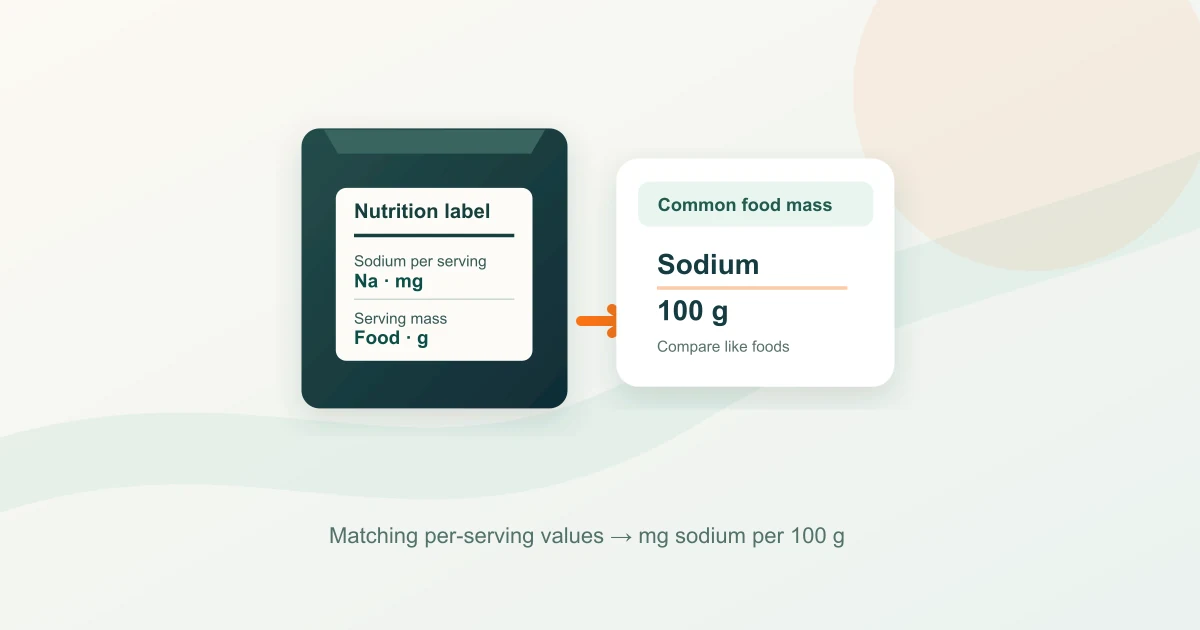
Divide sodium in milligrams per serving by the matching serving mass in grams, then multiply by 100. An invented label with 120 mg sodium in a 30 g serving gives 400.00 mg per 100 g. Compare like foods in the same prepared state; the result is arithmetic, not a personal sodium target or a health verdict. [1][2]
Copy values from the same label column
Find sodium in mg and serving weight in g for the same serving. If a package lists multiple serving or container columns, keep the numerator and denominator paired. Using sodium from a whole container with the weight of one serving produces a wrong comparison. [1][3]
This tool is for food mass in grams. A liquid labelled per 100 mL uses a volume basis and cannot be treated as per 100 g without reliable density information. Compare foods in the same prepared state. [1][2]
A common 100 g basis helps compare like foods
Invented Food A has 120 mg sodium in a 30 g serving: 120 ÷ 30 × 100 = 400.00 mg per 100 g. Invented Food B has 90 mg in a 15 g serving: 90 ÷ 15 × 100 = 600.00 mg per 100 g. B has less sodium in the listed serving, yet more per 100 g. Both facts can matter for a real choice.
Food Standards Australia New Zealand advises comparing the per-100-g sodium column of like foods. The calculator supplies that common basis when you only have matching per-serving values; it does not decide which food is healthy for you. [1][2]
Why the printed per-100-g value can differ
Labels round nutrient amounts and sometimes serving weights. A value calculated from two rounded per-serving numbers may not exactly match a per-100-g value calculated by a manufacturer from unrounded data. Prefer the labelled per-100-g column when it is available. [1][3]
Scaling a serving by the same factor should not change the ratio: 120 mg in 30 g and 240 mg in 60 g both give 400.00 mg per 100 g. Mixing values from different serving bases breaks that property.
Sodium is not the same label quantity as salt
Enter the line that says sodium in milligrams. A package may instead declare salt in grams or provide both. Salt mass cannot be entered as though it were sodium mass; use a separate conversion tool if you need to translate between them. [2][3]
This tool concerns sodium in food. It does not interpret blood sodium, choose a daily limit or tell someone with a medical condition what to eat. Those decisions require personal context and appropriate clinical advice. [2][3]
Rounding, unusual values and privacy
The calculation uses exact decimal arithmetic and rounds once to two places. For an invented arithmetic boundary, 2.01 mg in 200 g gives 1.005 mg per 100 g and displays as 1.01. The extra digits do not make a rounded food label more precise.
A serving mass of zero cannot produce a ratio. Extremely small mass or a mismatched unit can give a huge but meaningless result. Recheck the source entries if the number seems implausible.
The calculation runs in your browser. Entries and results are not placed in the shared page address or analytics details. Reset clears the values.
Formula and assumptions
- Version
- Sodium per 100 grams of food, sodium-per-100g-v1
- Rounding
- Calculate using exact decimal fractions from the entered values, then round a nonnegative result once to two decimal places; exact halfway values round up.
- Worked example
- Invented label: 120 mg sodium ÷ 30 g serving mass × 100 = 400.00 mg sodium per 100 g.
Who this is for — and when not to use it
Intended use
Neutral food-label arithmetic to compare sodium concentration of like foods on a common 100 g food-mass basis.
Not intended for
No personal sodium allowance, clinical dietary plan, blood-sodium interpretation, food safety judgement, product endorsement, salt-to-sodium conversion, or comparison of mismatched serving bases.
Exclusions
- Personal sodium targets or clinical diet prescriptions
- Using salt mass in place of sodium mass
- Using a 100 mL liquid basis as if it were 100 g
- Mixing per-serving and per-container entries
- Comparing prepared and unprepared versions as if they were the same food
- Entering zero or a missing serving mass
Evidence sources
- 1. Nutrition information panels — Food Standards Australia New Zealand. Accessed Sep 25, 2026.
- 2. Sodium: how much is in food? — Food Standards Australia New Zealand. Accessed Sep 25, 2026.
- 3. How to Understand and Use the Nutrition Facts Label — U.S. Food and Drug Administration. Accessed Sep 25, 2026.