
What this result means
To convert albumin from g/dL to g/L, multiply by 10. To convert g/L to g/dL, divide by 10. One litre contains ten decilitres, so the concentration is the same; only the volume basis changes. This tool displays two decimals and does not classify your albumin result. [1][2]
Why the factor is ten
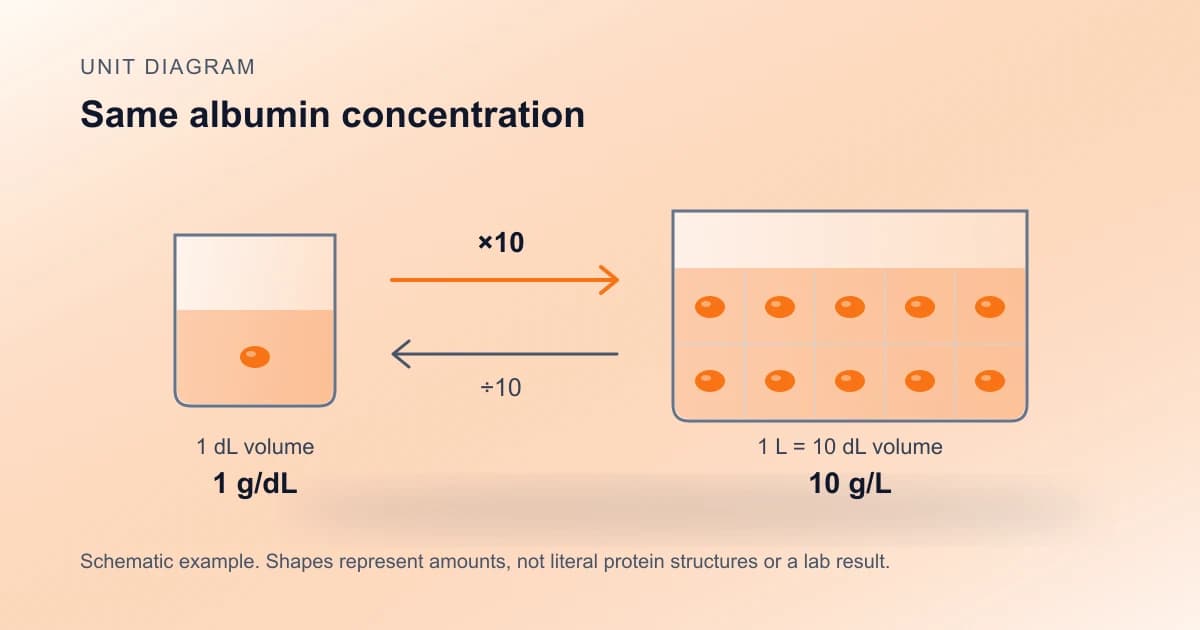
The SI prefix deci means one tenth. A decilitre is therefore one tenth of a litre, and ten decilitres make one litre. If each decilitre contains one gram of albumin, the corresponding litre contains ten grams: 1 g/dL = 10 g/L. [1][2]
The diagram shows that arithmetic with one schematic amount symbol and ten symbols. The vessels are not scaled laboratory measurements, and the shapes do not show literal albumin molecules or a patient result.
Keep the analyte and sample type the same
An albumin blood test measures albumin in blood. MedlinePlus distinguishes this from urine albumin testing and explains that results need other information. This converter is limited to the stated blood concentration units and supplies no personal interpretation. [3]
A urine albumin-to-creatinine ratio has a second quantity in its denominator. It is not g/L or g/dL. A report for total protein, or a product labelled with an infusion concentration, also answers a different question. Do not use this tool to infer a missing unit or calculate a treatment.
Two illustrative conversions
An illustrative blood albumin value of 4 g/dL becomes 4 × 10 = 40.00 g/L. A value of 35 g/L becomes 35 ÷ 10 = 3.50 g/dL. These are arithmetic examples, not reference limits or suggested targets.
The result changes the written unit, not the sample, protein or clinical meaning. Keep the original report with its units and laboratory explanation when comparing measurements.
Display rounding cannot improve the measurement
The tool preserves the exact factor during calculation, then rounds the output to two decimals. A value of 35.05 g/L becomes 3.505 g/dL and displays as 3.51 g/dL because halfway ties round upward. Positive outputs too small to display as 0.01 are shown as less than 0.01.
Converting the rounded 3.51 g/dL back gives 35.10 g/L, rather than the original 35.05. Display rounding discarded detail. Keep the original measurement instead of repeatedly converting rounded outputs.
Choose the direction before entering the number
Both directions accept values from 0 to 1,000,000 in the starting unit. These are software bounds, not plausible blood concentrations or health limits. Use plain decimal-point numbers. Blanks, negatives, unit text, inequality signs, fractions, scientific notation, comma separators and nonfinite numbers are rejected. Changing direction clears the previous entry.
The calculation runs in your browser without an account. Reset or reload clears the entry. Share uses the page address without the entered value or result. The optional recently-used list stores the tool identifier rather than your albumin value.
Formula and assumptions
- Version
- Albumin gram-per-litre and gram-per-decilitre conversion, albumin-exact-volume-factor-ten-v1
- Rounding
- Use the exact rational factors 10/1 or 1/10, then round once to two decimals with nonnegative halfway ties upward. Keep the original report when precision matters.
- Worked example
- 4 g/dL × 10 = 40.00 g/L. In the reverse direction, 35 g/L ÷ 10 = 3.50 g/dL. These illustrative values are conversions, not normal ranges or treatment targets.
Who this is for — and when not to use it
Intended use
Convert a known serum or plasma albumin concentration between g/L and g/dL. Restate units while keeping the original laboratory report and measurement context.
Not intended for
Interpret low, normal, high, optimal or dangerous albumin results. Convert urine albumin, albumin-to-creatinine ratios, concentrations in other units or a different analyte. Calculate albumin infusion quantities, medicine doses or clinical decisions.
Exclusions
- An unknown analyte or starting unit, a urine ratio, a volume-only quantity or a dose.
- Negative values, inequality signs, unit text or values beyond the software bounds.
Evidence sources
- 1. NIST Guide to the SI: SI prefixes — National Institute of Standards and Technology. Accessed Oct 11, 2026.
- 2. SI Units: Volume — National Institute of Standards and Technology. Accessed Oct 11, 2026.
- 3. Albumin blood test — MedlinePlus. Accessed Oct 11, 2026.