
What this result means
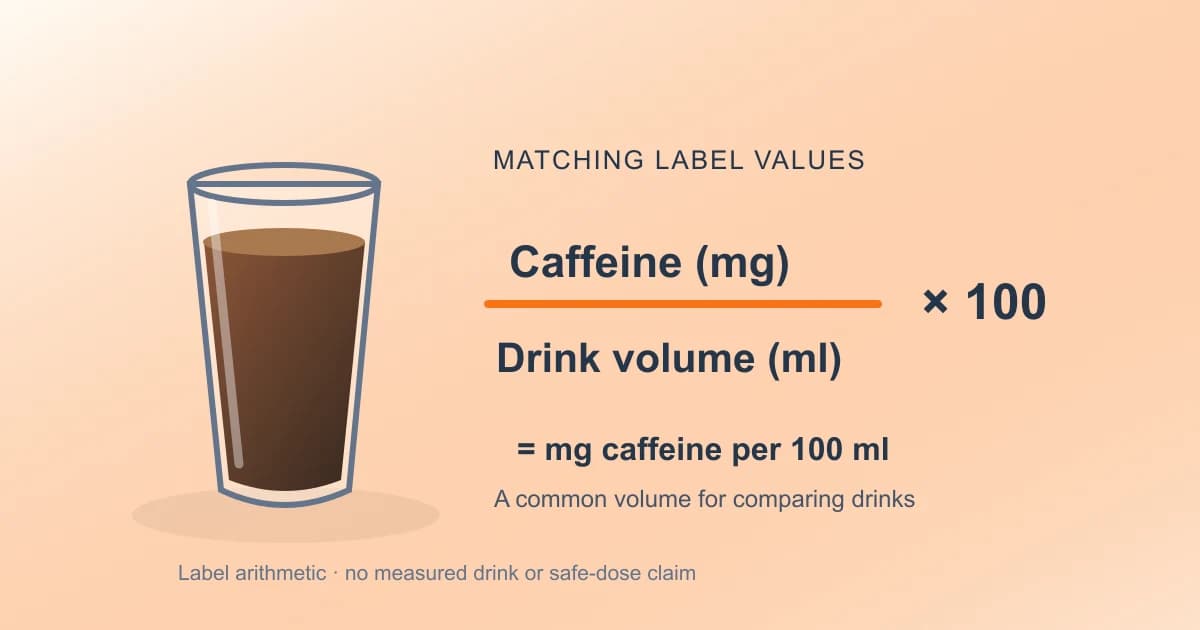
Divide the stated caffeine milligrams by the matching drink volume in millilitres, then multiply by 100. An invented label with 125 mg in 250 ml gives 50.00 mg per 100 ml. This compares concentration; it does not estimate missing caffeine values or decide a safe intake. [1][2]
Use caffeine and volume from the same label basis
A package can contain more than one serving, so check its serving information. If caffeine is stated per can, use the full can volume. If it is stated per serving, use that serving volume. A caffeine-containing ingredient alone does not supply the milligram amount this formula needs. [1][3]
Keep the same preparation state. Do not divide a concentrate amount by an unrelated ready-to-drink volume, or treat powder mass as liquid volume. A reliable calculation needs both matching values. [1][2]
Concentration and serving totals can rank differently
Invented Drink A states 80 mg in 250 ml: 80 ÷ 250 × 100 = 32.00 mg per 100 ml. Invented Drink B states 120 mg in 500 ml: 120 ÷ 500 × 100 = 24.00 mg per 100 ml. B has more caffeine in its full stated volume, while A is more concentrated. These are synthetic examples, not measured products.
Scaling both matching entries leaves the concentration unchanged: 125 mg in 250 ml and 250 mg in 500 ml both give 50.00 mg per 100 ml. This is a check of the arithmetic, not a serving recommendation.
A missing quantity is not zero
The FDA notes that many products voluntarily state caffeine quantities and that caffeine-containing ingredients may be listed without a quantity. Look for an explicit milligram amount or reliable product information; do not infer zero from an absent number. [1]
If a trustworthy mg-per-100-ml figure is already printed, read it directly. Recalculating from rounded label values may give a slightly different number. Standardized volume columns help compare similar products. [2]
Read the unit and the last rounding step
Millilitres measure volume; grams measure mass. This tool takes ml and does not convert a drink weight or a fluid-ounce number. It also does not measure caffeine chemically.
An invented pair of 2.01 mg in 200 ml gives an exact 1.005 mg per 100 ml and displays 1.01. Displaying two places does not make the label more precise. Zero caffeine is accepted when explicitly stated; zero volume is invalid.
Use the result for comparison
This result does not include how many servings you consumed. The separate caffeine intake calculator can sum stated amounts. Neither a larger concentration nor a smaller concentration determines what is safe for a particular person.
The arithmetic runs in your browser. Your input values are not placed in the share address or analytics details. Reset clears the entries.
Formula and assumptions
- Version
- Caffeine per 100 millilitres of drink, caffeine-per-100ml-v1
- Rounding
- Use exact decimal fractions from entered values, then round a nonnegative result once to two decimal places; exact halfway values round up.
- Worked example
- Invented label: 125 mg caffeine ÷ 250 ml matching drink volume × 100 = 50.00 mg caffeine per 100 ml.
Who this is for — and when not to use it
Intended use
Neutral label arithmetic for comparing stated caffeine on a common 100 ml prepared-drink basis.
Not intended for
No safe daily dose, pregnancy limit, child-use guidance, symptom advice, total-intake sum, caffeine-content estimate for unlabelled coffee, supplement dosing, powdered-caffeine instructions, mass-to-volume conversion or verification of a manufacturer claim.
Exclusions
- Missing or guessed caffeine content
- Caffeine per can paired with a one-serving volume
- Powder or concentrated supplement amounts without a matching prepared-drink label
- Entering grams or fluid ounces as millilitres
- Zero or missing drink volume
- Treating a concentration as total consumption or a safe-dose judgement
Evidence sources
- 1. Spilling the Beans: How Much Caffeine is Too Much? — U.S. Food and Drug Administration. Accessed Sep 28, 2026.
- 2. Nutrition information panels — Food Standards Australia New Zealand. Accessed Sep 28, 2026.
- 3. Serving Size on the Nutrition Facts Label — U.S. Food and Drug Administration. Accessed Sep 28, 2026.