
What this result means
Choose how many labelled sources you want to add. For each one, enter the caffeine in milligrams per serving and the number of servings. The calculator multiplies each pair and adds the results. [1][2]
What the total means
The result adds only the labelled caffeine amounts you entered. It does not compare the number with a health threshold or decide whether it is appropriate for you.
Caffeine can appear in drinks, foods, supplements and some over-the-counter products. The FDA advises considering all sources, while also noting that product amounts and container sizes vary. [1]
Match the amount to the serving
Use the caffeine amount stated for one serving and the number of those same servings used. A supplement label may separately state serving size, servings per container and amount per serving, so do not confuse those values. [2]
For a label that states 80 mg per can, one can is 1 serving and half a can is 0.5 serving. For a label that states 80 mg per half-can serving, a whole can is 2 servings.
Why this tool does not guess from a beverage name
Coffee, tea, energy drinks and other products can vary widely. A category average can be different from the product and size you actually used, so this calculator relies on your stated label rather than a hidden lookup table. [1]
Some labels list caffeine voluntarily and some products may not declare a numeric amount. If the milligrams are unknown, this tool cannot produce a reliable total. [1]
Do not use this for concentrated caffeine
Pure and highly concentrated caffeine products can be difficult to measure accurately and can cause serious harm. This calculator is not designed for powders, concentrated liquids or any product without a clear milligram-per-serving label. [3][4]
The calculator also does not provide a dose, safe limit, remaining allowance or advice about symptoms. Ask an appropriate health professional or local poison service for urgent or personal guidance. [1][3]
Privacy and limitations
The calculation runs locally in your browser. The values and result are not placed in the page URL or sent as analytics details.
Rounding is only for display. The engine keeps the entered decimals through every multiplication and addition, then rounds the final milligram total once.
Formula and assumptions
- Formula
- For each source: caffeine contribution = labelled mg per serving × servings used. Total caffeine = the sum of all selected contributions. [1][2]
- Version
- Labelled caffeine total, caffeine-label-arithmetic-v1
- Rounding
- Multiply and add with the exact entered decimals, then round the final total once to two decimal places. Exact halfway ties round upward.
- Worked example
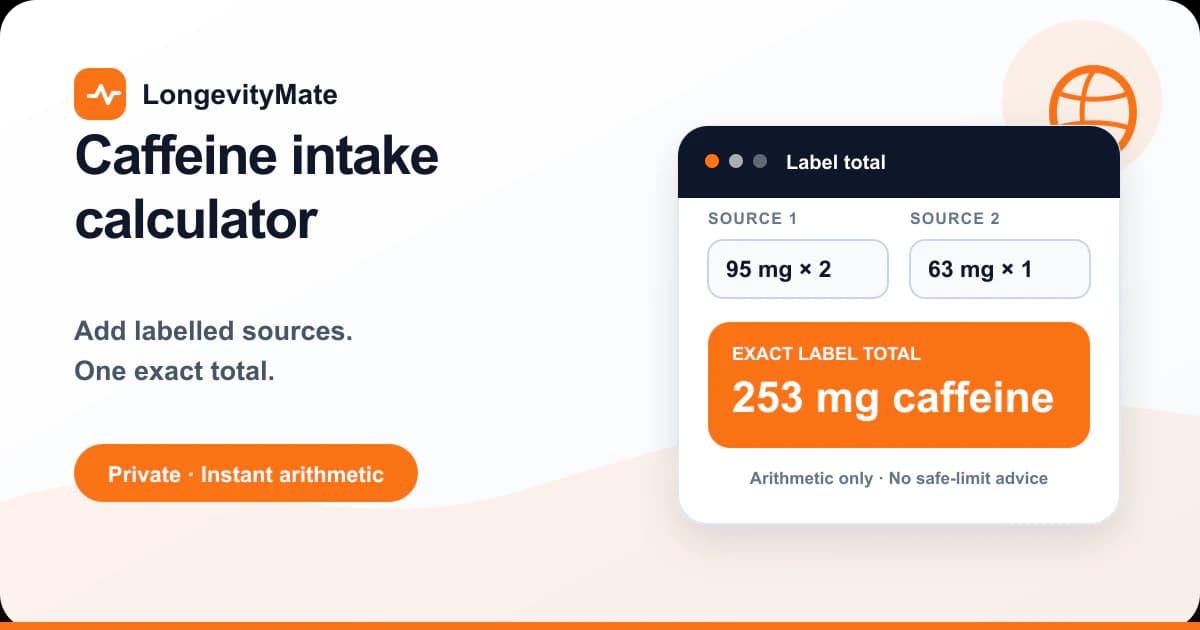
- Example: source 1 states 95 mg per serving and you use 2 servings; source 2 states 63 mg and you use 1 serving. The total is (95 × 2) + (63 × 1) = 253.00 mg caffeine.
Who this is for — and when not to use it
Intended use
Neutral arithmetic for totaling caffeine amounts from one to six products that clearly state milligrams of caffeine per serving.
Not intended for
Not a caffeine database, safe-limit checker, dose calculator, medical assessment, symptom checker, pregnancy or paediatric guide, medication tool, half-life calculator, timing or cutoff tool, or consumption recommendation.
Exclusions
- Pure or highly concentrated caffeine powders and liquids
- Products without a clearly stated caffeine amount in milligrams per serving
- Estimating unlabeled coffee, tea, chocolate, restaurant drinks or mixed products
- Safe-limit, remaining-allowance, risk, symptom or sensitivity interpretation
- Medicine, supplement or caffeine dosing and any treatment decision
- Pregnancy, breastfeeding, child or adolescent recommendations
- Caffeine timing, sleep effects, half-life, clearance or cutoff calculations
Evidence sources
- 1. Spilling the beans: how much caffeine is too much? — United States Food and Drug Administration. Accessed Aug 21, 2026.
- 2. Dietary Supplement Labeling Guide: Chapter IV — Nutrition Labeling — United States Food and Drug Administration. Accessed Aug 21, 2026.
- 3. Pure and highly concentrated caffeine — United States Food and Drug Administration. Accessed Aug 21, 2026.
- 4. Caffeine — Food Standards Australia New Zealand. Accessed Aug 21, 2026.