
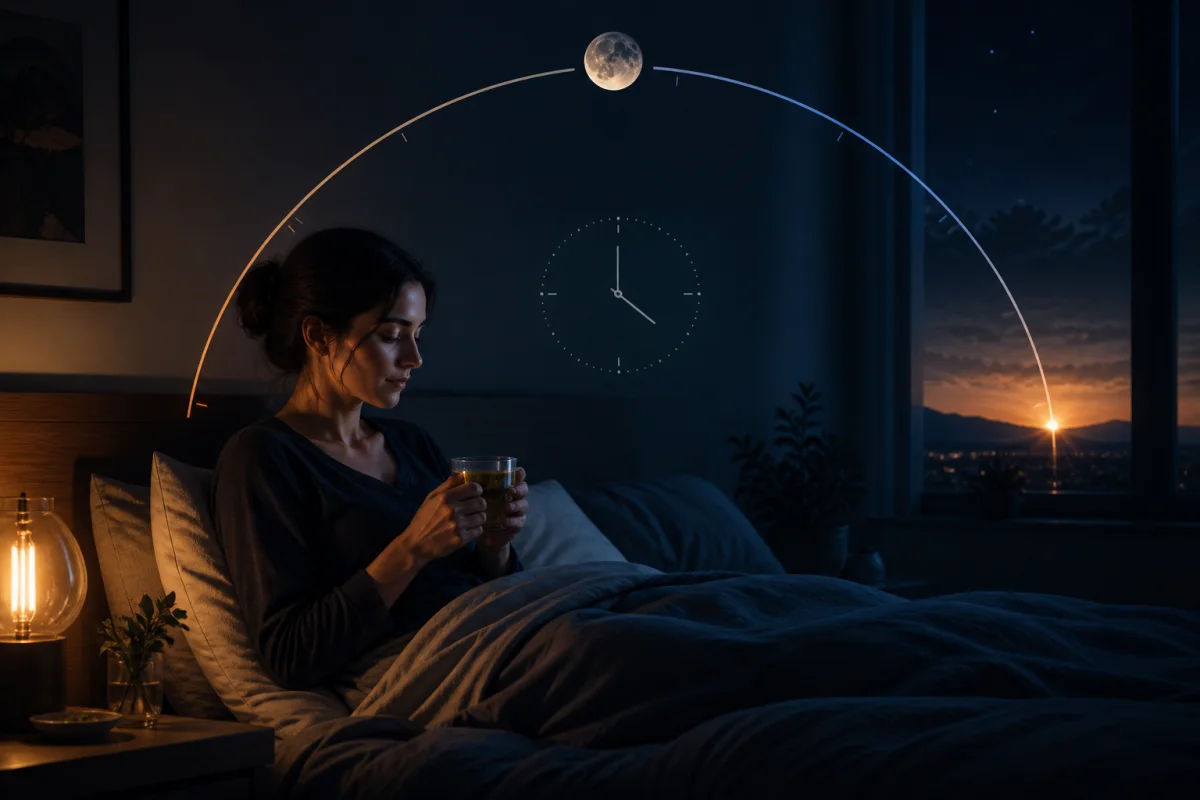
The 10 rules to remember
- Protect enough sleep opportunity before optimizing gadgets.See reference 1
- Anchor wake time more strongly than bedtime.See reference 2
- Adults should regularly obtain at least seven hours; individual need varies.See reference 3
- Use bright daytime light and reduce unnecessary bright evening light.See reference 4
- Caffeine can disrupt sleep even six hours before bed in some people.See reference 5
- Alcohol may shorten sleep onset but fragments later sleep and is not a treatment.See reference 6
- Exercise usually supports sleep; timing tolerance is individual.See reference 7
- Keep the bedroom dark, quiet and comfortably cool.See reference 8
- Do not let imperfect wearable scores create sleep anxiety.See reference 9
- Persistent insomnia deserves CBT-I or clinical evaluation, not more sleep-hygiene rules alone.See reference 10
First principles: what creates sleep
Sleep pressure rises with time awake, while the circadian clock changes when the brain promotes wakefulness or sleep. Good timing aligns these systems.See reference 1,See reference 2
Light is the strongest environmental time cue, but activity, meals and routine also shape timing. The effect of light depends on brightness, spectrum, duration and biological time.See reference 2,See reference 3
Arousal, pain, mood disorders, medicines, sleep apnoea and restless legs can overwhelm a perfect bedroom routine. Habits cannot diagnose or remove these causes.See reference 3,See reference 4
Build the routine in the right order
- Lever
- Sleep opportunity
- Simple action
- Reserve 7-9 hours
- Trial period
- 2 weeks
- What to notice
- Daytime alertnessSee reference 1
- Lever
- Timing
- Simple action
- Keep wake time within 30-60 min
- Trial period
- 2 weeks
- What to notice
- Sleepiness at nightSee reference 2
- Lever
- Light
- Simple action
- Daylight by day; dim late evening
- Trial period
- 1-2 weeks
- What to notice
- Timing and alertnessSee reference 3
- Lever
- Caffeine
- Simple action
- Move cutoff earlier
- Trial period
- 1-2 weeks
- What to notice
- Sleep onset and awakeningsSee reference 4
A practical two-week experiment
- Days
- 1-3
- Keep constant
- Wake time
- Change
- Nothing else
- Measure
- Baseline diarySee reference 1
- Days
- 4-7
- Keep constant
- Wake time
- Change
- Add daylight and caffeine cutoff
- Measure
- SleepinessSee reference 2
- Days
- 8-10
- Keep constant
- Earlier habits
- Change
- Improve room and wind-down
- Measure
- AwakeningsSee reference 3
- Days
- 11-14
- Keep constant
- Best routine
- Change
- Remove weak rules
- Measure
- Daytime functionSee reference 4
What to do across the day
- Morning: get up at the planned time and seek outdoor light.See reference 1
- Day: move regularly and avoid compensating for one poor night with a very long nap.See reference 2
- Afternoon: use an earlier caffeine cutoff when sleep is fragile.See reference 3
- Evening: lower light and stimulation without turning the routine into a test.See reference 4
- Bed: use the bed for sleep; if wide awake for a prolonged period, follow CBT-I guidance rather than clock-watching.See reference 5
- Morning review: record sleep opportunity and daytime function, not every minute of guessed sleep stage.See reference 6
What the evidence supports
- Outcome
- Sleep duration
- Best interpretation
- Enough opportunity supports obtaining recommended sleep
- Confidence
- High
- Boundary
- Time in bed is not time asleepSee reference 1
- Outcome
- Sleep timing
- Best interpretation
- Regular schedules support circadian alignment
- Confidence
- Moderate
- Boundary
- Shift work and chronotype change feasibilitySee reference 2
- Outcome
- Insomnia
- Best interpretation
- CBT-I is first-line and stronger than hygiene alone
- Confidence
- High
- Boundary
- Requires an adapted protocolSee reference 3
- Outcome
- Long-term health
- Best interpretation
- Short and irregular sleep associate with adverse outcomes
- Confidence
- Moderate observational
- Boundary
- Association is not a lifespan guaranteeSee reference 4
Caffeine, exercise and naps
Caffeine sensitivity and metabolism vary. A six-hour cutoff is a reasonable experiment, but some people need earlier and others tolerate later use.See reference 4,See reference 5
Regular exercise generally improves sleep. Very vigorous late sessions may disturb some people, while others sleep normally; use repeatable personal data.See reference 5,See reference 6
Short early-afternoon naps can improve alertness. Long or late naps may reduce sleep pressure and worsen night-time insomnia.See reference 6,See reference 7
How to measure sleep without making it worse
A two-week diary of bedtime, estimated sleep onset, awakenings, wake time, naps and daytime function is often more actionable than one score.See reference 7,See reference 8
Consumer wearables estimate sleep from movement and physiology; they are more useful for broad trends than exact stages or diagnosing disorders.See reference 8,See reference 9
Track whether you function safely and feel restored. Dangerous driving sleepiness, witnessed apnoeas and persistent impairment outweigh a reassuring device score.See reference 9,See reference 10
Common sleep myths
- Claim
- Everyone needs exactly eight hours
- Better answer
- Adults vary; at least seven is the consensus floor
- Why
- Need changes across people and timeSee reference 1
- Claim
- Alcohol improves sleep
- Better answer
- It can sedate but disrupt later sleep
- Why
- Sedation is not restorative sleepSee reference 2
- Claim
- Blue light is the only evening problem
- Better answer
- Brightness, duration, content and timing all matter
- Why
- Light exposure is multi-dimensionalSee reference 3
- Claim
- A tracker knows exact sleep stages
- Better answer
- Consumer staging is estimated
- Why
- It is not polysomnographySee reference 4
- Claim
- Sleep hygiene cures chronic insomnia
- Better answer
- CBT-I has stronger evidence
- Why
- Insomnia is maintained by more than poor habitsSee reference 5
What the science cannot yet tell us
Sleep-hygiene studies use inconsistent definitions, making exact rules difficult to rank.See reference 2,See reference 6
Much long-term sleep evidence is observational and vulnerable to reverse causation from illness.See reference 3,See reference 8
No universal temperature, bedtime or wearable score defines optimal sleep for every adult.See reference 5,See reference 10
Do not self-optimize around dangerous sleepiness
Do not drive or operate machinery when dangerously sleepy. Seek prompt assessment for witnessed breathing pauses, gasping, morning headaches with loud snoring, falling asleep unintentionally, severe mood change, or insomnia with major daytime impairment. Sudden need for very little sleep with unusual energy or risky behaviour can be urgent.See reference 1,See reference 9,See reference 10
Who should get individualized guidance first?
Persistent insomnia is best assessed for CBT-I and contributing medical, psychiatric or medication causes.See reference 1,See reference 9
Suspected sleep apnoea, restless legs, parasomnias or circadian disorders need condition-specific evaluation.See reference 2,See reference 10
Shift workers, pregnant people and those with bipolar disorder need timing advice tailored to risk and schedule.See reference 4,See reference 8
Track five useful sleep signals
- Consistent wake time.See reference 1
- Estimated total sleep and time awake at night.See reference 2
- Caffeine and alcohol timing.See reference 3
- Daytime alertness, mood and driving safety.See reference 4
- Snoring, gasping, restless legs or unusual night behaviours.See reference 5
Frequently asked questions
How many hours should adults sleep?
Adults should regularly obtain at least seven hours; many function best with roughly seven to nine.See reference 3
What is the best bedtime?
The bedtime that permits enough sleep before a stable wake time and aligns with when you become sleepy.See reference 4
When should I stop caffeine?
Start with at least six hours before bed and move earlier if sleep remains fragile.See reference 5
Does alcohol help sleep?
It may shorten sleep onset but commonly fragments later sleep and should not be used as a sleep treatment.See reference 6
What temperature is best?
Use a comfortably cool room; there is no single temperature that fits every body, climate and bedding system.See reference 7
Is exercise before bed bad?
Usually not universally. Test vigorous late exercise against your own sleep while keeping other factors stable.See reference 8
Can a watch diagnose sleep apnoea?
No. Notifications can support follow-up, but diagnosis requires an appropriate clinical pathway.See reference 9
What should I do for chronic insomnia?
Seek CBT-I or clinical assessment; adding more generic sleep-hygiene rules is usually not enough.See reference 10
See sleep beside recovery and health context
LongevityMate helps combine sleep trends with activity, stress, heart and laboratory data without letting one wearable score control the story.
See how LongevityMate worksGet the weekly longevity brief
The week's best longevity research in plain English. Free, every Tuesday.
References
- 1. Recommended amount of sleep for a healthy adult
American Academy of Sleep Medicine and Sleep Research SocietyGuideline
- 2. Sleep hygiene: what do we mean?
Sleep Medicine ReviewsSystematic review
- 3. Behavioral and psychological treatments for chronic insomnia
American Academy of Sleep MedicineSystematic review
- 4. Clinical practice guideline for behavioral treatments of chronic insomnia
Journal of Clinical Sleep MedicineGuideline
- 5. Caffeine effects on sleep taken 0, 3, or 6 hours before bedtime
Journal of Clinical Sleep MedicineRandomized trial
- 6. Alcohol and the sleeping brain
Alcohol ResearchEvidence review
- 7. Evening exercise and sleep in healthy participants
Sports MedicineMeta-analysis
- 8. Evening light and circadian-related outcomes
Sleep Medicine ReviewsSystematic review
- 9. Consumer sleep technology: an American Academy of Sleep Medicine position statement
Journal of Clinical Sleep MedicineOfficial guidance
- 10. Sleep regularity and mortality risk
SleepObservational study
Editorial transparency
- Published by
- LongevityMate Editorial Team
- Published
- Updated
Medical disclaimer
This guide provides general education for adults. It does not diagnose or treat insomnia, sleep apnoea, circadian disorders, mood disorders or other causes of sleepiness, and it does not replace individualized medical care.