
What this result means
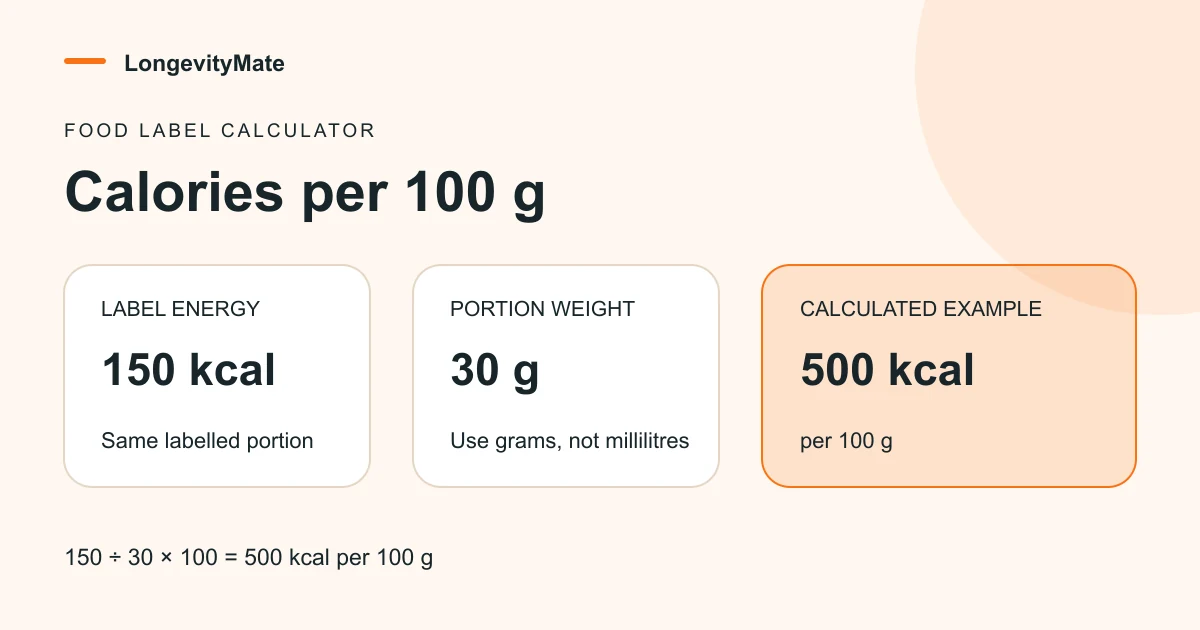
Divide the calories in a labelled portion by that portion’s weight in grams, then multiply by 100. For example, 150 kcal in 30 g equals 500 kcal per 100 g. Enter food-label calories (kcal) and grams from the same portion. [1][2]
Use two numbers from the same portion
Find the portion’s calories and its gram weight. Enter both numbers exactly as the label reports them. If the label already provides calories per 100 g, you can read that column directly. [1][2]
A packet can contain more than one serving. Do not pair the calories for the whole packet with the weight of one serving. Both inputs must refer to the same amount. [2]
Compare on the same basis
Example A lists 150 kcal per 30 g: 150 ÷ 30 × 100 = 500 kcal per 100 g. Example B lists 200 kcal per 50 g: 200 ÷ 50 × 100 = 400 kcal per 100 g. These are invented arithmetic examples, not branded foods or serving recommendations.
A common 100 g basis can help compare the energy labels of similar foods. It does not tell you which food is best for you; ingredients, nutrients, usual portions and your needs are separate questions. [1][2]
Keep units and preparation consistent
Enter kcal, not kJ. If a liquid label reports per 100 mL, this gram-based calculator needs a corresponding measured gram weight. It cannot assume that 1 mL weighs 1 g. [1]
Use both figures for the same preparation state: dry with dry, or prepared with prepared. Adding water changes weight without changing the original ingredient’s calories, while added ingredients can change both. This calculation cannot identify a mismatched pair.
Rounding and privacy
The calculator scales the numbers you supply. It does not look up a food database, inspect a product or validate its calorie claim. The output is rounded to one decimal place.
The calculation runs in your browser. Entered amounts and results are not added to the shared page address or analytics details. Reset clears the calculation.
Formula and assumptions
- Version
- Food-label energy per 100 g, label-energy-per-100g-v1
- Rounding
- Use exact fractions from the decimal inputs and integer factor 100; round the nonnegative result once to one decimal place, with halfway values rounded up. This improves arithmetic accuracy but cannot improve food-label measurement accuracy.
- Worked example
- 150 kcal in a 30 g labelled portion: 150 ÷ 30 × 100 = 500.0 kcal per 100 g.
Who this is for — and when not to use it
Intended use
Neutral arithmetic for anyone who has energy in kcal and weight in grams for the same labelled food portion.
Not intended for
This calculator does not set daily calories, select portions, assess food quality, calculate personal dietary needs, guide weight loss, diagnose a condition, convert liquid volume to mass or verify a manufacturer’s label.
Exclusions
- Diet prescriptions, calorie targets and treatment decisions
- Health rankings or safe and unsafe food classifications
- Converting millilitres, scoops or cups into grams without a measured mass
- Mixing prepared-food calories with dry-product weight
- Treating a rounded label as an exact laboratory measurement
Evidence sources
- 1. Nutrition information panels — Food Standards Australia New Zealand. Accessed Sep 8, 2026.
- 2. How to Understand and Use the Nutrition Facts Label — U.S. Food and Drug Administration. Accessed Sep 8, 2026.