
What this result means
One international inch is exactly 2.54 centimetres. Divide a centimetre value by 2.54 to get inches; multiply inches by 2.54 to get centimetres. The length stays the same. This converter uses decimal inches, not feet-and-inches notation. [1][2]
The unit changes, the length stays the same
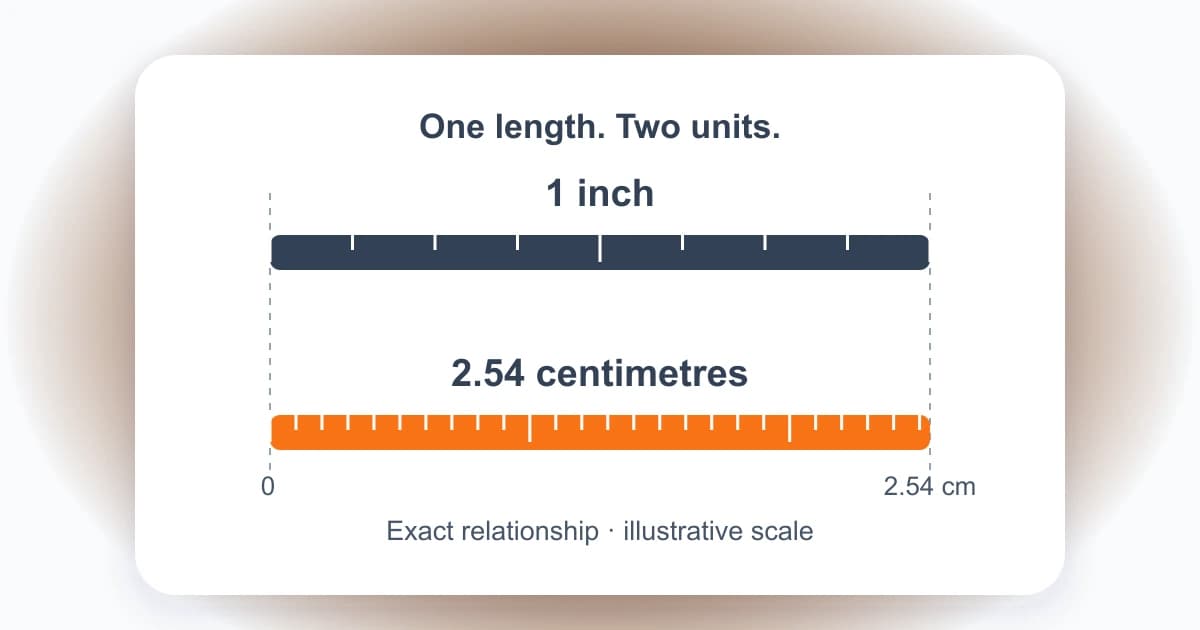
NIST lists the international inch as exactly 2.54 centimetres. The diagram shows two scales with identical endpoints: 1 inch and 2.54 centimetres describe one length. It is an explanatory drawing, not an on-screen measuring ruler. [1][2]
A recorded 10 cm becomes approximately 3.937008 inches at the six-place display precision. In the other direction, 10 inches is exactly 25.4 cm. These examples restate known lengths; neither is a body-size recommendation.
Use the original full unit label
A number such as 5.8 entered in inches means 5.8 decimal inches. It does not mean five feet eight inches. Mixed notation, apostrophes, fractions and unit text are rejected instead of being guessed.
Square inches and cubic centimetres describe different quantities. This tool converts length only. For kilometres and miles, the distance converter provides separate directions and examples.
An exact factor does not make the measurement exact
The engine uses exact integer ratios: 50/127 for centimetres to inches and 127/50 in reverse. It keeps the original decimal input through the calculation and rounds once at the end. Returning a displayed rounded result through the reverse direction can therefore differ slightly from the original value.
For an exact rounding example, 0.00000127 cm is 0.0000005 inch; the halfway result displays as 0.000001 inch. Below that display threshold, a tiny positive result is labelled as less than 0.000001 rather than becoming an asserted exact zero.
Six decimal places describe software display precision. They cannot add accuracy to a tape, label or measurement that was already rounded.
Plain decimal input and transparent software bounds
Both directions accept 0 to 1,000,000 in the starting unit. These limits keep calculation bounded; they are not physiological limits or reference intervals. Blank entries, negatives, inequalities, unit text, scientific notation, comma separators, fractions and nonfinite values are rejected.
Switching direction clears the previous entry so a centimetre number is not silently reinterpreted as inches. Check the visible starting and destination units before using a result in another record.
Calculate without storing the measurement
Inputs and results stay in browser memory. Reset or reload clears the entered value. Share uses the page address without input or output values. The optional recent-tools list stores the tool identifier rather than the length entered.
Formula and assumptions
- Version
- International inch and centimetre exact length conversion, international-inch-centimetre-exact-127-over-50-v1
- Rounding
- Use exact ratios 50/127 and 127/50. Round once to six decimal places; nonnegative halfway ties round upward. Display precision is not measurement accuracy.
- Worked example
- A stated 25.4 cm divided by 2.54 is exactly 10 inches. In reverse, 10 inches multiplied by 2.54 is exactly 25.4 cm. The two values describe one known length, not a new measurement or health interpretation.
Who this is for — and when not to use it
Intended use
Convert a known length between centimetres and international inches. Compare the same stated measurement when one record uses centimetres and another uses decimal inches.
Not intended for
Estimate a height, waist circumference, distance or body measurement. Classify a body measurement or set a health target. Parse feet-and-inches notation, mixed units, fractions or area and volume.
Exclusions
- Unclear units, negative values and quantities other than length.
- Feet-and-inches notation or fractional inches without a plain decimal starting value.
Evidence sources
- 1. Guide to the SI, Appendix B.9: length conversion factors — National Institute of Standards and Technology. Accessed Oct 14, 2026.
- 2. Handbook 44, 2026, Appendix C: units of length — National Institute of Standards and Technology. Accessed Oct 14, 2026.