
What this result means
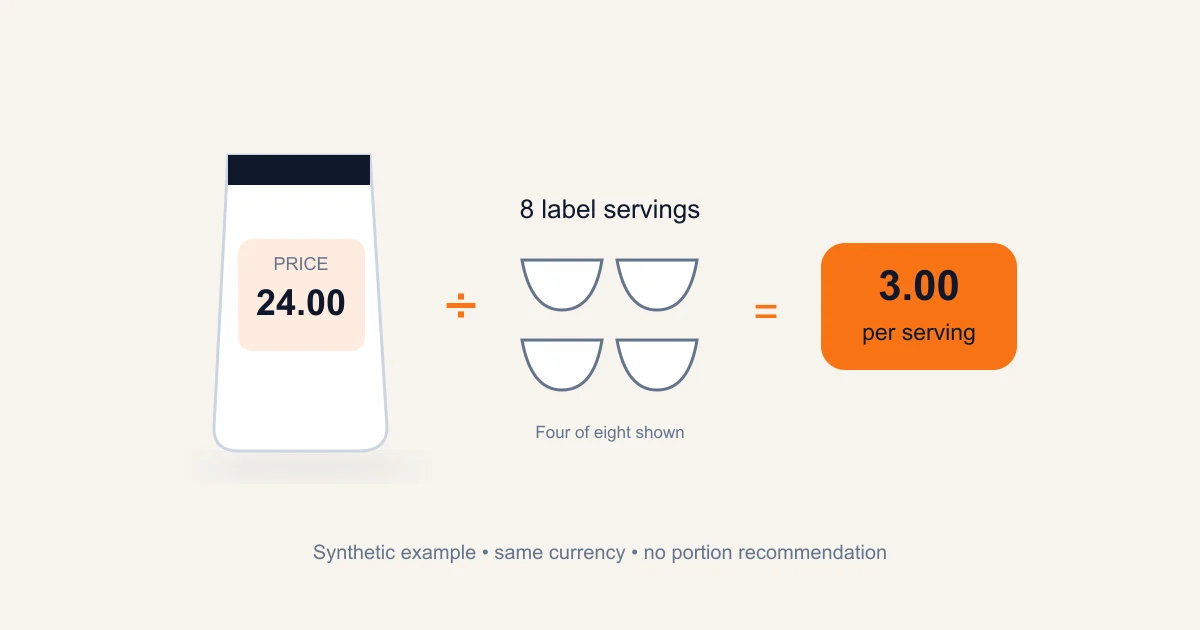
Divide package price by the number of matching servings in that package. A synthetic price of 24.00 divided by eight servings gives 3.00 per serving in the same currency. A label serving is not a recommended portion, and differently sized servings can make product comparisons misleading. [1][2]
Match the price to the package
Use the price paid for the package whose servings you are counting. If a price covers two packs, either count servings across both packs or use the price of one pack. Do not divide a multi-pack price by the servings in just one component.
The calculator does not add taxes, delivery costs, deposits or discounts. Decide which known costs belong to this package and use the same basis when making a comparison. It does not forecast future prices.
Enter a count, not a serving weight
Use the number of servings in the package, not grams per serving. A label saying eight servings and 40 g per serving supplies two different quantities. The denominator here is eight, not 40. [1]
If the matching quantity calculation gives a partial serving, retain it. Synthetic example: a price of 25.00 divided by 12.5 servings gives 2.00 per serving. Rounding the denominator to twelve or thirteen changes the answer.
Different serving sizes can reverse the comparison
Synthetic example: Product A costs 2.00 for a 20 g labelled serving; Product B costs 3.00 for a 40 g labelled serving. A looks cheaper per serving, but the matching mass costs are 10.00 and 7.50 per 100 g. The serving basis changes the comparison.
NIST unit-pricing guidance emphasizes consistent units for meaningful price comparisons. Use a mass or volume comparison when serving sizes differ. Price alone also does not measure nutrition, taste, waste or suitability. [2]
FDA and NIDDK explain that a label serving and the portion a person chooses to eat are different concepts. This result describes the chosen label basis; it does not recommend how much to eat. [1][3]
Read the rounding honestly
Synthetic halfway example: 2.01 divided by two servings is exactly 1.005 and displays as 1.01. The ratio 1.00 divided by three servings displays as 0.33. Display rounding is applied once, after division.
Doubling the matching price and serving count leaves the answer unchanged: 24.00 ÷ 8 and 48.00 ÷ 16 both give 3.00. A known zero price is valid; a missing price should be left blank rather than invented as zero.
Entry limits and privacy
Price must be from 0 to 100,000; serving count from 0.01 to 100,000. These are technical limits, not food, shopping or dose targets. Enter decimal-point numbers without symbols, unit text or comma separators.
Calculation runs in your browser. Numeric entries and results do not enter the shared page address or analytics details. Reset clears the entries; sharing copies the page address, not your calculation.
Formula and assumptions
- Version
- Cost per labelled serving, cost-per-serving-v1
- Rounding
- Use exact decimal fractions, then round once to two decimal places; nonnegative exact halfway values round up. Keep fractional serving counts rather than rounding them to whole numbers.
- Worked example
- Synthetic example: package price 24.00 ÷ eight matching labelled servings = 3.00 per serving in the same currency.
Who this is for — and when not to use it
Intended use
Neutral price arithmetic with known matching package price and labelled serving count, in one currency.
Not intended for
No recommended portion, supplement dose, personal diet, nutritional adequacy score, currency conversion, budget forecast, investment advice or legal price/label certification.
Exclusions
- Unknown prices or serving counts entered as zero
- Prices and serving counts taken from different packages
- Comparing prices in different currencies
- Entering serving weight instead of number of servings
- Zero or negative serving count
- Using the result to select a portion or supplement dose
Evidence sources
- 1. Serving Size on the Nutrition Facts Label — U.S. Food and Drug Administration. Accessed Oct 5, 2026.
- 2. Unit Pricing Guide, NIST Special Publication 1181, 2025 edition — National Institute of Standards and Technology. Accessed Oct 5, 2026.
- 3. Food Portions: Choosing Just Enough for You — National Institute of Diabetes and Digestive and Kidney Diseases. Accessed Oct 5, 2026.