
What this result means
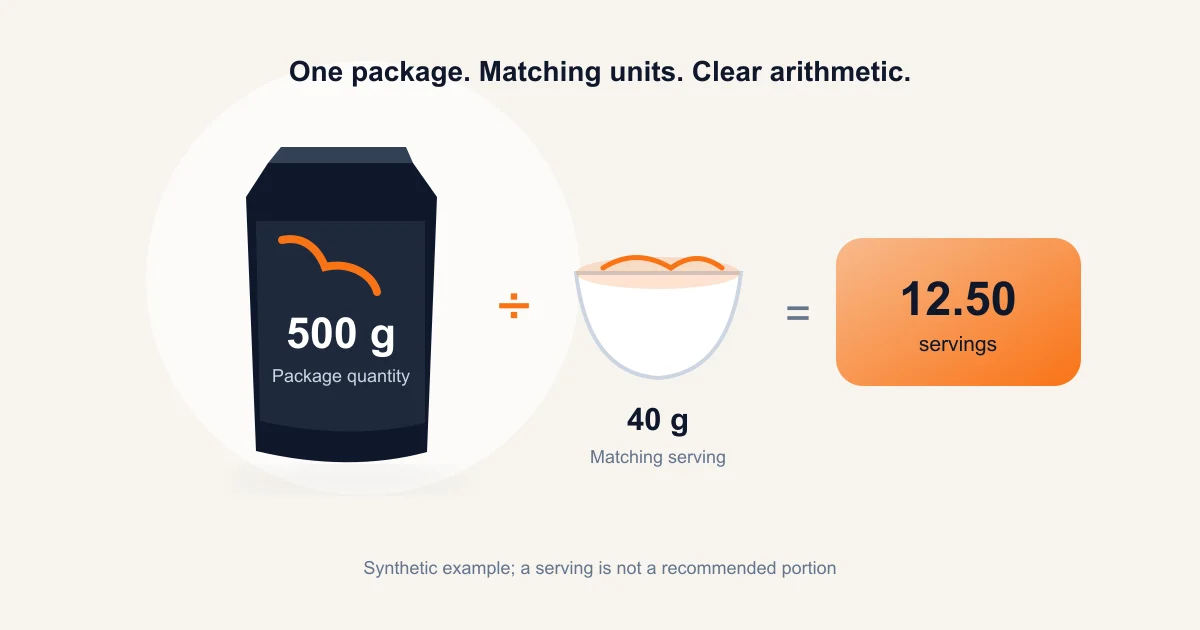
Divide package quantity by serving quantity, using the same unit and food state. A synthetic 500 g package with a 40 g serving gives 12.50 theoretical servings. A label serving describes the label’s basis; it is not a recommendation for how much you should eat. [1]
Match the unit before dividing
Use grams with grams, millilitres with millilitres, or a count with the matching count. Convert within the same unit type before entry if needed: 1 kg is 1,000 g. Never substitute volume for mass without reliable density information. [2]
The calculator has no way to identify a unit from a bare number. The field labels remind you to use the same unit, but they cannot certify that you did so. A plausible result can still come from mismatched entries.
Keep the food state consistent
A dry package quantity needs a serving quantity for that same dry food. A drained quantity needs the matching drained serving basis. Added water, discarded liquid, waste and inedible packaging change what is being compared; this tool does not estimate them.
Use the serving quantity printed beside the relevant nutrition information. FDA guidance explains that serving sizes describe customary consumption and the basis for label information; they do not prescribe how much a person should eat. [1]
A partial serving belongs in the result
Synthetic example: 500 g ÷ 40 g = 12.50 servings. This describes twelve full 40 g servings plus a 20 g remainder. The tool keeps that fraction rather than pretending the package contains thirteen full servings.
A smaller package can give a result below one. A synthetic 20 g package divided by a 40 g serving gives 0.50. This is valid arithmetic, not an entry error or advice about your portion.
The displayed precision has limits
An exact synthetic ratio of 201 ÷ 200 is 1.005 and displays as 1.01. The ratio 200 ÷ 201 displays as 1.00. Two displayed digits do not make rounded label quantities more precise.
Doubling both quantities keeps the result unchanged: 500 ÷ 40 and 1,000 ÷ 80 both give 12.50. If scaling matching entries changes your expected result, check the copied numbers.
Printed servings-per-container figures can follow different rounding rules. U.S. rules include whole-serving or half-serving rounding and wording such as “about”, with exceptions. This calculator retains a two-decimal mathematical ratio; it does not apply those labeling rules or certify a label. If the printed figure differs, keep the label’s declared basis and rounding rather than treating this arithmetic as a labeling verdict. [3]
Input safeguards and privacy
Package quantity must be from 0 to 100,000; serving quantity from 0.01 to 100,000. These are technical entry limits, not food or diet targets. A zero package is valid only when its quantity is actually known to be zero. Use a decimal point and enter numbers without unit text.
Calculation runs in your browser. Numeric entries and results do not enter the shared page address or analytics details. Reset clears the entries; sharing copies the page address, not your calculation.
Formula and assumptions
- Formula
- Servings = package quantity ÷ matching serving quantity [1]
- Version
- Theoretical servings per package, servings-per-package-v1
- Rounding
- Use exact decimal fractions, then round once to two decimal places; nonnegative exact halfway values round up. Keep fractional servings rather than truncating to whole servings.
- Worked example
- Synthetic label example: 500 g package ÷ matching 40 g serving = 12.50 theoretical servings, including a half serving.
Who this is for — and when not to use it
Intended use
Neutral arithmetic using known package and serving quantities on a matching unit and food-state basis.
Not intended for
No recommended portion, personal diet, nutrient adequacy, calorie target, supplement dose, legal label certification, density conversion or prediction of how long food will last.
Exclusions
- Missing quantities or guessing unknown food content as zero
- Mixing mass, volume or counts
- Including packaging weight
- Pairing cooked, dry, drained or undrained quantities inconsistently
- Zero or negative serving quantity
- Treating theoretical servings as a recommended amount to eat
Evidence sources
- 1. Serving Size on the Nutrition Facts Label — U.S. Food and Drug Administration. Accessed Oct 4, 2026.
- 2. SI Units: Mass — National Institute of Standards and Technology. Accessed Oct 4, 2026.
- 3. 21 CFR101.9: Nutrition labeling of food, paragraphs(b)(8)-(9) — Electronic Code of Federal Regulations; U.S. Food and Drug Administration. Accessed Oct 4, 2026.