
What this result means
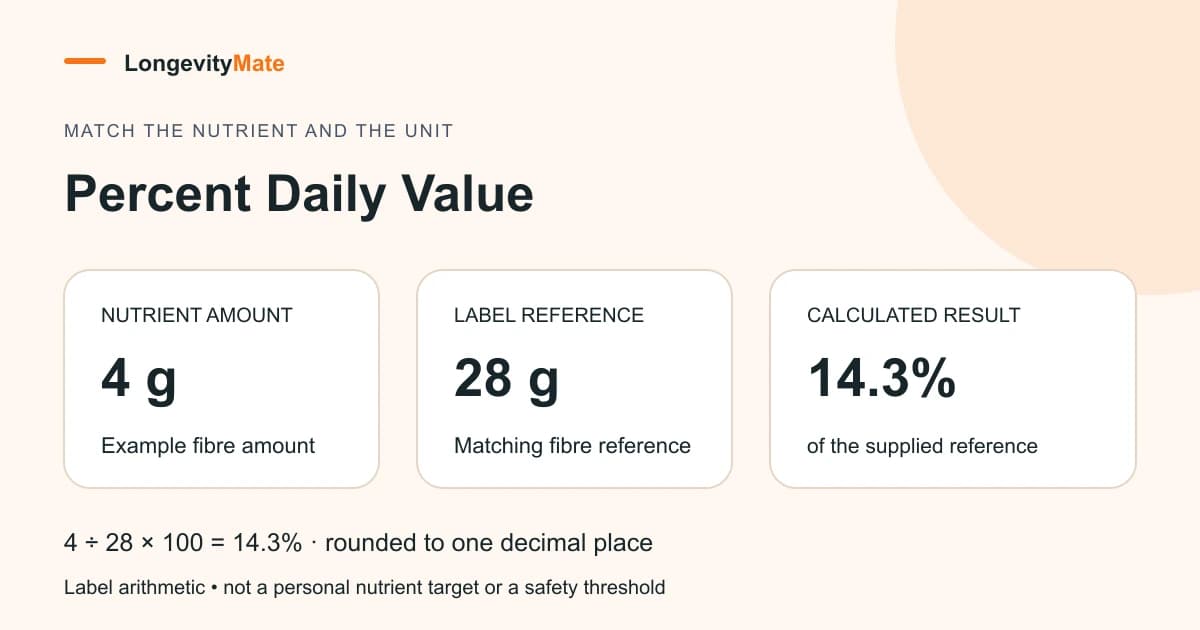
Divide the nutrient amount by its matching Daily Value, then multiply by 100. For example, 4 g of fibre against a 28 g reference gives 14.3%. Both entries must use the same nutrient and unit. This calculator does not choose a daily intake target. [1]
Choose a valid reference before calculating
Find the Daily Value for the same nutrient in the relevant official label guidance. The U.S. FDA’s general reference table lists, for example, 28 g for dietary fibre and 2,300 mg for sodium. Check that the reference applies to the label and population being considered. [1]
Some nutrients, including total sugars and trans fat, do not have a Daily Value on the U.S. Nutrition Facts label. A missing reference is not zero and is not permission to invent one. References for other populations or countries can differ. [2]
Keep both entries in the same unit
For an invented sodium amount of 230 mg and a 2,300 mg reference, enter 230 and 2300: the result is 10.0%. Converting both to grams gives 0.23 and 2.3, also 10.0%. The percentage stays the same because both quantities were scaled together.
Mixing 230 mg with 2.3 g as plain numbers gives a misleading 10,000.0%. The calculator cannot recognise that mismatch. Convert both entries to one unit first. Do not treat IU, RAE, DFE or NE as interchangeable with a plain mass unit. [1]
Changing the serving changes the amount, not the reference
The FDA’s fibre example has 4 g in one serving and 8 g in two servings. Against the same 28 g reference, this calculator gives 14.3% and 28.6%. Unlike a per-100-g food ratio, the Daily Value stays fixed when you double the serving. [1][2]
Use the nutrient amount for the serving you want to check. If a package contains several servings, distinguish the per-serving and per-container columns. A label serving is not a recommendation for how much to eat. [2]
A result above 100% is possible
An amount equal to the reference gives 100.0%. An amount twice the reference gives 200.0%. That is valid arithmetic. The percentage alone does not tell you whether an intake is appropriate or harmful, because a label reference is not a personalised assessment.
Percentages for different nutrients should not be added into one total: 20% of a fibre reference plus 30% of a sodium reference does not produce a meaningful 50% nutrition score. [2]
Why your result may differ from a printed label
This tool performs the simple ratio once and displays one decimal place. A printed label may use different rounding and nutrient-specific rules. Some vitamin units express biological equivalents, and protein labelling can involve quality considerations. This is not a tool for certifying a Nutrition Facts or Supplement Facts panel. [1][2][3]
A tiny positive ratio may round to 0.0%. For an exact halfway value at the displayed precision, 2.1 ÷ 200 × 100 = 1.05%, displayed as 1.1%. The rounding describes the arithmetic, not the accuracy of the original label amounts.
Your entries stay in the calculator
Calculations run in your browser. The shared page address contains no entered nutrient amount, reference or result, and analytics details do not include those values. Reset clears the calculation.
Formula and assumptions
- Version
- Percentage of a nutrient reference, daily-value-percentage-v1
- Rounding
- Parse the decimal inputs as exact fractions. Multiply their ratio by 100, then round once to one decimal place; exact halfway cases round up.
Who this is for — and when not to use it
Intended use
Neutral arithmetic for an already identified nutrition-label reference and a nutrient amount in matching units.
Not intended for
No personal nutrient targets, diagnosis, supplement dosing, toxicity assessment, diet prescription or regulatory label certification. It cannot perform protein-quality correction or convert vitamin equivalents.
Exclusions
- Using a reference for the wrong age or life stage
- Different nutrients, units or serving bases in the same calculation
- Clinical diet planning or supplement dose selection
- Protein-quality adjustments or conversion of IU, RAE, DFE or NE
- Nutrients with no established Daily Value and zero or invented references
Evidence sources
- 1. Daily Value on the Nutrition and Supplement Facts Labels — U.S. Food and Drug Administration. Accessed Sep 10, 2026.
- 2. How to Understand and Use the Nutrition Facts Label — U.S. Food and Drug Administration. Accessed Sep 10, 2026.
- 3. Industry Resources on the Changes to the Nutrition Facts Label: Label Claims — U.S. Food and Drug Administration. Accessed Sep 10, 2026.