
What this result means
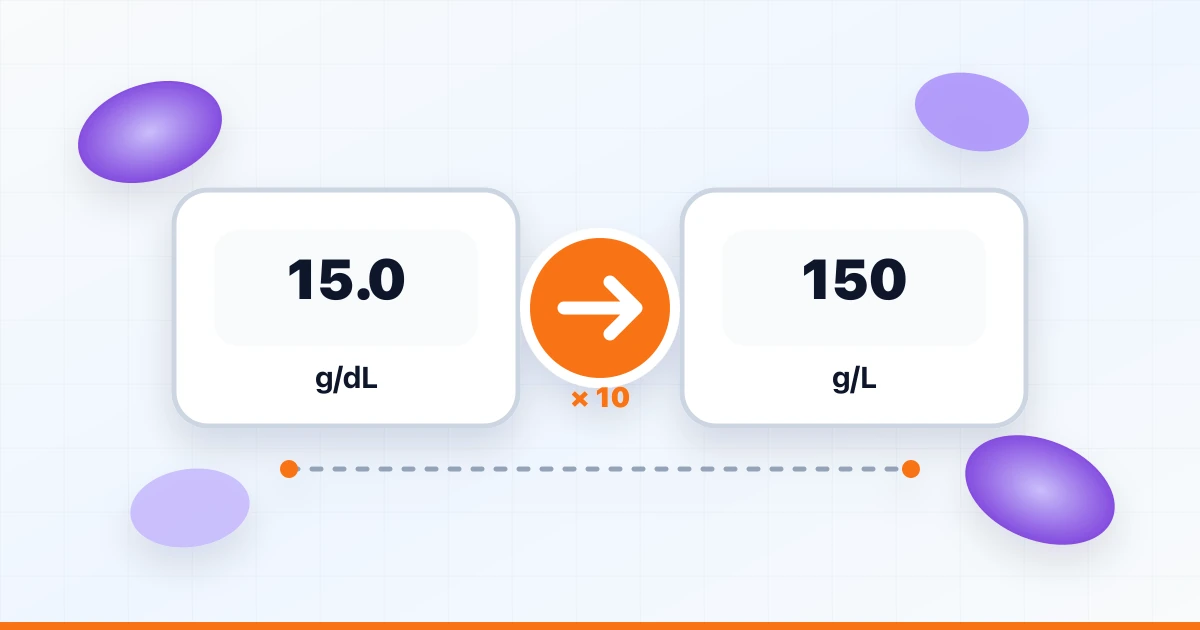
One gram per decilitre equals 10 grams per litre. Choose the direction and enter the hemoglobin number from your report; the converter multiplies or divides by exactly 10. [1][2]
How to convert hemoglobin units
The concentration does not change
Keep the report's own reference interval
This converter deliberately does not provide a normal range. If you compare a result with a reference interval, convert both into the same unit and use the interval from the same report and laboratory context.
For an explanation of hemoglobin, report ranges and related CBC measurements, use the separate LongevityMate hemoglobin guide. That guide and its interactive range tool own interpretation; this page owns unit conversion only.
This is not an HbA1c converter
Hemoglobin concentration in g/dL or g/L is different from HbA1c, which is commonly reported as a percentage or mmol/mol. Do not enter an HbA1c result here.
The tool also does not estimate hematocrit, MCH, MCHC, oxygen carrying capacity or oxygen saturation.
Privacy and limitations
The conversion runs locally in your browser. The entered value and result are not placed in the page URL or sent as analytics details.
The calculator cannot check whether a laboratory value was entered correctly, whether the specimen or assay was suitable, or what action a result may require.
Formula and assumptions
- Version
- Hemoglobin g/dL and g/L conversion, hemoglobin-gdl-gl-conversion-v1
- Rounding
- Use exact decimal arithmetic with 10 stored as 10/1 and its reciprocal as 1/10, then round the displayed result once to two decimal places. Exact halfway ties round upward in magnitude; a positive value below display resolution uses a less-than result.
Who this is for — and when not to use it
Intended use
Neutral unit conversion for a person who already has a hemoglobin or haemoglobin mass concentration reported in g/dL or g/L.
Not intended for
This tool does not interpret hemoglobin, apply a reference range or cutoff, diagnose anemia or polycythemia, estimate hematocrit, convert HbA1c, assess oxygen saturation or guide testing, treatment, supplements, pregnancy or paediatric care.
Exclusions
- Hemoglobin reference ranges, low or high classification, clinical cutoffs and diagnosis
- HbA1c, glycated hemoglobin, mmol/mol and estimated average glucose
- Hematocrit, MCH, MCHC, red-cell count, oxygen saturation and other measurements
- Pregnancy, childhood, altitude, transfusion, bleeding, symptoms and urgent-care decisions
- Treatment, iron or other supplement advice and follow-up testing decisions
- Assay quality, specimen suitability and changing precision absent from the source report
Evidence sources
- 1. SI prefixes — International Bureau of Weights and Measures. Accessed Aug 30, 2026.
- 2. SI units and prefixes — National Institute of Standards and Technology. Accessed Aug 30, 2026.