
Six points that prevent most HCT mistakes
- Use the interval printed by the reporting laboratory. Published adult examples differ and are not universal targets.See reference 1,See reference 2,See reference 3,See reference 4
- 42% and 0.42 L/L describe the same volume fraction; convert by dividing or multiplying by 100.See reference 1,See reference 2
- HCT is not the same as haemoglobin, RBC count, oxygen saturation, red-cell mass or blood viscosity.See reference 3,See reference 5
- Dehydration can raise HCT by reducing plasma volume, while pregnancy, recent fluids or overhydration can lower it by dilution.See reference 1,See reference 2,See reference 4,See reference 11
- A high HCT does not diagnose polycythaemia vera, and a low HCT does not prove iron deficiency.See reference 5,See reference 7,See reference 8,See reference 10
- Do not self-start iron, aspirin, testosterone changes, blood donation or phlebotomy from one HCT result.See reference 5,See reference 7,See reference 8
What HCT measures—and what it does not
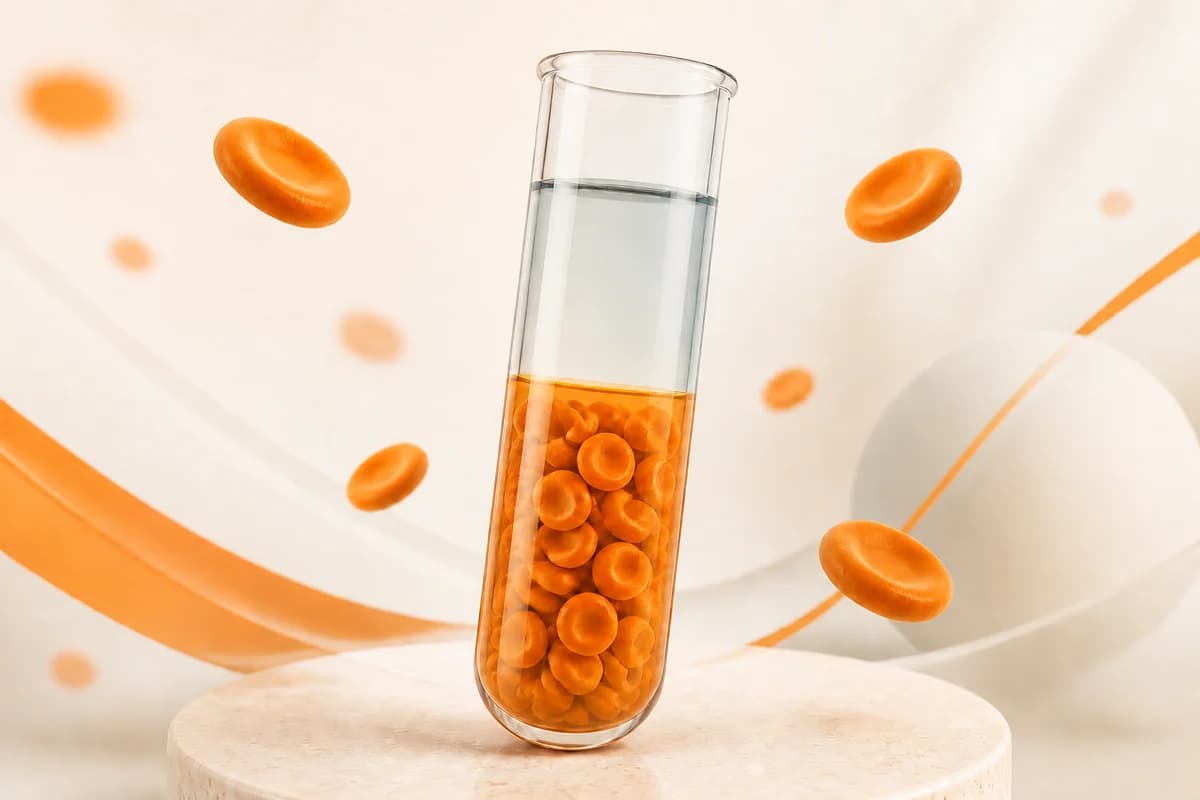
Haematocrit estimates the proportion of whole blood occupied by red cells. It is usually part of a complete blood count or full blood count and may be calculated by an analyser from RBC count and average cell volume or measured as packed cell volume, depending on the laboratory method.See reference 1,See reference 2,See reference 3
It does not directly measure the number of red cells, haemoglobin concentration, oxygen saturation, total red-cell mass, blood viscosity or tissue oxygen delivery. Method, calibration, specimen handling and the local reference population matter.See reference 3,See reference 5,See reference 10
Because HCT reflects red-cell number, cell size and plasma volume together, it can disagree with RBC count or haemoglobin. MCV, RDW, reticulocytes and a blood-film comment can explain patterns that one percentage cannot.See reference 3,See reference 4,See reference 10
Adult range examples show why your own report comes first
- Source and population
- Your reporting laboratory
- Educational HCT example
- The interval printed beside your result
- How to use it safely
- Best first comparison because the laboratory knows its method and reference population. It is still not a diagnosis, target or emergency threshold.See reference 1,See reference 2,See reference 3,See reference 4
- Source and population
- MedlinePlus adult example
- Educational HCT example
- Male: 37–48%; female: 34–43%
- How to use it safely
- A common educational example only. MedlinePlus says ranges vary among laboratories.See reference 2
- Source and population
- NHLBI adult example
- Educational HCT example
- Men: 41–50%; women: 36–44%
- How to use it safely
- NHLBI notes that age, altitude, race and ethnicity can affect results.See reference 3
- Source and population
- Cleveland Clinic adult example
- Educational HCT example
- Male: 41–50%; female: 36–44%
- How to use it safely
- The source separately notes age, pregnancy and sex-related differences. It is not a worldwide standard.See reference 4
Units, preparation, specimen and timing
Percent is a volume fraction multiplied by 100: 42% equals 0.42 L/L, and 0.37 L/L equals 37%. A number without its unit is unsafe to interpret. HCT is not converted using haemoglobin units such as g/dL or RBC units such as million/µL.See reference 1,See reference 2
HCT itself generally needs no fasting or special preparation. Follow the order's instructions if another test collected at the same time requires fasting. Do not stop prescribed medicines, hormones or supplements merely to change the result.See reference 1,See reference 2
The specimen is usually venous whole blood. Preserve the original result, unit, interval, date and laboratory comments. Hydration, heat, exercise, vomiting or diarrhoea, posture, recent IV fluids, donation, transfusion or bleeding can affect comparison with an earlier result.See reference 1,See reference 2,See reference 12
Low haematocrit: four mechanism groups
- Mechanism
- Blood loss
- Examples
- Heavy menstrual bleeding, gastrointestinal or urinary bleeding, surgery, injury
- Context that helps
- Symptoms, haemoglobin trend, reticulocytes, iron studies and source-directed evaluation. Very early acute bleeding may not immediately show the expected fall.See reference 1,See reference 2,See reference 10
- Mechanism
- Reduced red-cell production
- Examples
- Iron, B12, folate or copper deficiency; kidney or inflammatory disease; marrow suppression; selected medicines or cancer treatment
- Context that helps
- MCV, RDW, reticulocytes, ferritin/iron studies, nutrient tests, kidney function and clinical history.See reference 1,See reference 2,See reference 10
- Mechanism
- Increased red-cell destruction
- Examples
- Immune, inherited, mechanical or infection-related haemolysis
- Context that helps
- Reticulocytes, bilirubin, LDH, haptoglobin, smear and clinician-directed testing.See reference 1,See reference 2,See reference 10
- Mechanism
- Dilution or physiology
- Examples
- Pregnancy plasma expansion, overhydration or recent large-volume fluids
- Context that helps
- Pregnancy stage, fluid history, symptoms and the wider CBC; use an appropriate local interval.See reference 1,See reference 4,See reference 11
High haematocrit: concentration versus increased production
- Mechanism
- Relative haemoconcentration
- Examples
- Dehydration, vomiting, diarrhoea, heavy sweating, shock or other plasma loss
- What it does not prove
- Does not prove increased total red-cell mass. Restore fluids safely according to the clinical situation rather than forcing water.See reference 1,See reference 2,See reference 5,See reference 8
- Mechanism
- Response to lower oxygen
- Examples
- Altitude, smoking or carbon monoxide, sleep apnoea, chronic lung disease or selected heart disease
- What it does not prove
- Does not identify which cause is present. Oxygenation, exposure and cardiopulmonary context matter.See reference 1,See reference 4,See reference 5,See reference 8
- Mechanism
- Medicine, hormone or renal drive
- Examples
- Testosterone, anabolic steroids, prescribed erythropoietin and selected kidney disease or tumours
- What it does not prove
- Do not stop a prescription or donate blood without the treating team. Cause-directed review is required.See reference 4,See reference 5,See reference 8
- Mechanism
- Primary marrow process
- Examples
- Polycythaemia vera or another clonal disorder
- What it does not prove
- One HCT does not diagnose it. Persistent patterns may lead to repeat CBC, erythropoietin, JAK2 and specialist testing.See reference 5,See reference 7,See reference 8
What if HCT, haemoglobin and RBC count seem to disagree?
HCT reflects both how many red cells are present and how large they are, while haemoglobin measures protein concentration. Small cells can produce a relatively preserved RBC count with lower HCT; larger cells can shift HCT in the other direction. Plasma-volume changes can move HCT and haemoglobin together without the same change in total red-cell mass.See reference 3,See reference 10
The rough idea that HCT is about three times haemoglobin in g/dL is not a conversion or universal validity check. It can fail with unusual cell size or haemoglobin content, haemoglobin disorders, analytical interference and acute clinical change.See reference 3,See reference 10
Review the exact unrounded values, MCV, MCH/MCHC, RDW, reticulocytes, smear comments and trend. Do not choose iron, B12, phlebotomy or another treatment from a ratio alone.See reference 3,See reference 10
Pregnancy, altitude, smoking and hormone context
- Context
- Pregnancy
- Why HCT may differ
- Plasma volume usually expands more than red-cell mass, so HCT commonly falls and varies with gestational age.
- Safer interpretation
- Use pregnancy- and laboratory-appropriate context. A generic non-pregnant adult interval cannot diagnose anaemia in pregnancy.See reference 1,See reference 4,See reference 11
- Context
- Altitude
- Why HCT may differ
- Long-term lower oxygen exposure can increase red-cell production and HCT.
- Safer interpretation
- Report residence and recent travel. No universal HCT altitude-correction formula was verified; WHO altitude adjustments are haemoglobin-based.See reference 1,See reference 3,See reference 9
- Context
- Smoking or carbon monoxide
- Why HCT may differ
- Reduced oxygen delivery can stimulate erythropoiesis and raise HCT.
- Safer interpretation
- Record exposure; do not silently subtract a web correction or assume polycythaemia vera.See reference 4,See reference 5,See reference 8
- Context
- Testosterone or erythropoietin therapy
- Why HCT may differ
- Treatment can increase red-cell production and HCT.
- Safer interpretation
- Use the prescriber's monitoring plan. Do not alter a dose, donate blood or start aspirin from an online threshold.See reference 4,See reference 5,See reference 7
Symptoms can matter more than the HCT number
Use urgent local medical care now for bleeding that will not stop; vomiting blood; black or bloody stool with weakness; fainting, confusion or difficult waking; new one-sided weakness, trouble speaking or vision change; chest pain; severe or worsening breathlessness; coughing blood; or a painful, swollen, warm leg with sudden breathlessness. Do not wait for a calculator or routine repeat. These symptoms can signal major bleeding, heart attack, stroke, deep-vein thrombosis or pulmonary embolism regardless of one HCT result.See reference 1,See reference 5
What may change HCT—and what not to self-prescribe
- Situation
- Possible dehydration or recent fluid loss
- Responsible next step
- Address the cause and rehydrate safely when appropriate; urgent illness may need medical care.
- Unsafe shortcut
- Forcing large amounts of water to manufacture a lower number.See reference 1,See reference 2
- Situation
- Possible iron or nutrient deficiency
- Responsible next step
- Confirm the pattern and cause with clinician-directed tests before treatment.
- Unsafe shortcut
- Starting iron, B12 or folate because HCT is low.See reference 1,See reference 10
- Situation
- Smoking, sleep apnoea, lung, heart or altitude context
- Responsible next step
- Assess the exposure or oxygen-related cause and treat that cause.
- Unsafe shortcut
- Using aspirin, oxygen, donation or phlebotomy without diagnosis.See reference 5,See reference 8
- Situation
- Testosterone, erythropoietin or another implicated medicine
- Responsible next step
- Review the value, symptoms and monitoring plan with the prescriber.
- Unsafe shortcut
- Stopping, changing or counteracting a prescription alone.See reference 4,See reference 5,See reference 7
- Situation
- Confirmed polycythaemia vera
- Responsible next step
- Follow a specialist plan; disease-specific targets do not apply to everyone with a high HCT.
- Unsafe shortcut
- Copying a venesection target from a guideline into self-treatment.See reference 5,See reference 6
When to repeat HCT and how to read a trend
There is no universal repeat interval. A stable, unexpected outpatient result may be confirmed after reviewing collection and fluid context, while a persistent, rapidly changing, markedly abnormal or symptomatic result needs timely clinician assessment.See reference 1,See reference 4,See reference 5
For a cleaner comparison, preserve the same unit and laboratory where practical, and note posture, hydration, heat, endurance exercise, vomiting or diarrhoea, IV fluids, bleeding, donation, transfusion, pregnancy, altitude, smoking and medicine changes.See reference 1,See reference 2,See reference 12
Within-person and analytical variation mean a small movement is not automatically disease progression or treatment success. Read the HCT trend with haemoglobin, RBC count, indices, symptoms and the reason the test was ordered.See reference 10,See reference 12
Common haematocrit misconceptions
- Claim
- High HCT means polycythaemia vera
- More accurate answer
- No. Dehydration, altitude, smoking, sleep apnoea, lung or heart disease, medicines and renal causes are alternatives.See reference 5,See reference 8
- Claim
- Low HCT proves iron deficiency
- More accurate answer
- No. Loss, reduced production, destruction, kidney or inflammatory disease, pregnancy and dilution are alternatives.See reference 1,See reference 2,See reference 10
- Claim
- HCT is the same as haemoglobin or RBC count
- More accurate answer
- No. They measure a volume fraction, protein concentration and cell number respectively.See reference 3
- Claim
- One online range applies to everyone
- More accurate answer
- No. Laboratory method, age, sex or hormone context, pregnancy, altitude and population matter.See reference 1,See reference 2,See reference 3,See reference 4
- Claim
- Donate blood or overhydrate to correct HCT
- More accurate answer
- That can be unsafe, obscure the cause and delay appropriate care.See reference 5,See reference 7
- Claim
- HCT always equals three times haemoglobin
- More accurate answer
- That is only a rough pattern under typical cell conditions, not a universal conversion, diagnosis or treatment rule.See reference 3,See reference 10
A safe sequence after an HCT result
- Confirm the exact unrounded value, unit and interval on the same report.See reference 1,See reference 2
- Check haemoglobin, RBC count, MCV, RDW, reticulocytes, WBC, platelets and smear comments rather than HCT alone.See reference 3,See reference 10
- Record symptoms, bleeding, pregnancy, hydration, exercise, altitude, smoking, recent transfusion or donation and medicine or hormone use.See reference 1,See reference 4,See reference 5
- Use cause-directed testing and a repeat interval chosen for the pattern; do not copy a universal web panel or timeline.See reference 5,See reference 8,See reference 10
- Use urgent care for major bleeding, chest pain, severe breathlessness, fainting, neurological symptoms or possible clot symptoms.See reference 5
What this guide cannot settle
No worldwide HCT interval, optimal longevity target, pregnancy table, altitude correction, hormone-specific rule, transfusion threshold or repeat schedule applies to every person and method. The reporting laboratory and clinical setting remain essential.See reference 1,See reference 2,See reference 3,See reference 9,See reference 11
HCT can support an anaemia or erythrocytosis pattern, but it cannot identify cause or severity by itself. Symptoms, speed of change, haemoglobin, indices, oxygenation, bleeding and cause-directed tests may change the meaning.See reference 5,See reference 8,See reference 10
Put HCT in the context of the whole result
Upload a laboratory report to LongevityMate to organise HCT beside haemoglobin, RBC count, MCV, RDW, reticulocytes, ferritin, kidney markers and prior results. You receive structured educational context for discussion—not a diagnosis, emergency decision or treatment prescription.
Understand your lab resultsQuestions people ask about haematocrit
What is a normal haematocrit?
Use the interval on the same laboratory report. MedlinePlus gives adult examples of 37–48% for males and 34–43% for females, while NHLBI and Cleveland Clinic examples differ. These are educational ranges, not universal targets.See reference 2,See reference 3,See reference 4
What does HCT or PCV mean on a blood test?
HCT means haematocrit or hematocrit; PCV means packed cell volume. Both describe the fraction of whole-blood volume occupied by red cells.See reference 1,See reference 2
Is 42% the same as 0.42 L/L?
Yes. Percent is the decimal volume fraction multiplied by 100, so 42% equals 0.42 L/L. Keep the result and laboratory limits in the same unit before comparing them.See reference 1,See reference 2
What causes low haematocrit?
Possibilities include bleeding, reduced marrow production, iron or vitamin deficiency, kidney or inflammatory disease, increased destruction, pregnancy and dilution. The wider CBC and cause-directed tests determine which explanation fits.See reference 1,See reference 2,See reference 10
Does low HCT always mean iron deficiency?
No. Iron deficiency is one possibility, not a diagnosis from HCT. Haemoglobin, MCV, RDW, ferritin, reticulocytes, bleeding history and clinical context may point elsewhere.See reference 3,See reference 10
What causes high haematocrit?
Dehydration can concentrate the blood. Increased production can occur with altitude, smoking, sleep apnoea, lung or heart disease, kidney-related erythropoietin, testosterone or erythropoietin use, and marrow disorders.See reference 1,See reference 4,See reference 5,See reference 8
Does high HCT mean polycythaemia vera?
No. Polycythaemia vera is one cause of persistent erythrocytosis, but relative and secondary causes are important alternatives. Diagnosis requires clinical evaluation and appropriate tests such as erythropoietin and JAK2.See reference 5,See reference 7,See reference 8
Can dehydration raise HCT?
Yes. Reduced plasma volume can raise the measured proportion without the same increase in total red-cell mass. Do not use extreme water intake as treatment; assess the fluid-loss context safely.See reference 1,See reference 2,See reference 5
Why can HCT fall during pregnancy?
Plasma volume usually expands more than red-cell mass, so dilution commonly lowers HCT. Gestational age and local obstetric intervals matter; a generic adult range is not enough.See reference 1,See reference 4,See reference 11
Do I need to fast for an HCT test?
Usually not. HCT itself generally needs no special preparation, but another test ordered at the same time may have separate instructions.See reference 1,See reference 2
When should abnormal HCT be repeated?
There is no universal timing. A stable unexpected result may be confirmed after reviewing collection and fluid context, but major symptoms, rapid change, active bleeding or possible clot symptoms need prompt assessment rather than waiting for a routine repeat.See reference 1,See reference 4,See reference 5
Get the weekly longevity brief
The week's best longevity research in plain English. Free, every Tuesday.
References
- 1. Hematocrit Test
MedlinePlusOfficial guidance
- 2. Hematocrit
MedlinePlus Medical EncyclopediaOfficial guidance
- 3. Anemia: Diagnosis
National Heart, Lung, and Blood InstituteOfficial guidance
- 4. Hematocrit Test
Cleveland ClinicOfficial guidance
- 5. Erythrocytosis
NHSOfficial guidance
- 6. Management of specific situations in polycythaemia vera and secondary erythrocytosis
British Society for HaematologyGuideline
- 7. Diagnostic workflow for hereditary erythrocytosis and thrombocytosis
American Society of Hematology Education ProgramEvidence review
- 8. Investigation and management of erythrocytosis
CMAJEvidence review
- 9. Guideline on haemoglobin cutoffs to define anaemia in individuals and populations
World Health OrganizationGuideline
- 10. Evaluation of Anemia
Merck Manual Professional EditionEvidence review
- 11. Mining the Gap: Deriving Pregnancy Reference Intervals for Hematology Parameters Using Clinical Datasets
Clinical ChemistryObservational study
- 12. Haematocrit: within-subject and seasonal variation
Sports MedicineEvidence review
Editorial transparency
- Published by
- LongevityMate Editorial
- Editorial review by
- Lukas Dvorsky, Founder — editorial review
- Published
- Updated
Medical disclaimer
Educational information only, not an anaemia, bleeding, pregnancy, erythrocytosis, polycythaemia vera, marrow, oxygen-delivery, blood-viscosity or cancer diagnosis; transfusion, donation, phlebotomy, aspirin, medicine, hormone or emergency decision; or a personal target. Use the original laboratory report and qualified clinical care for individual decisions.