
What this result means
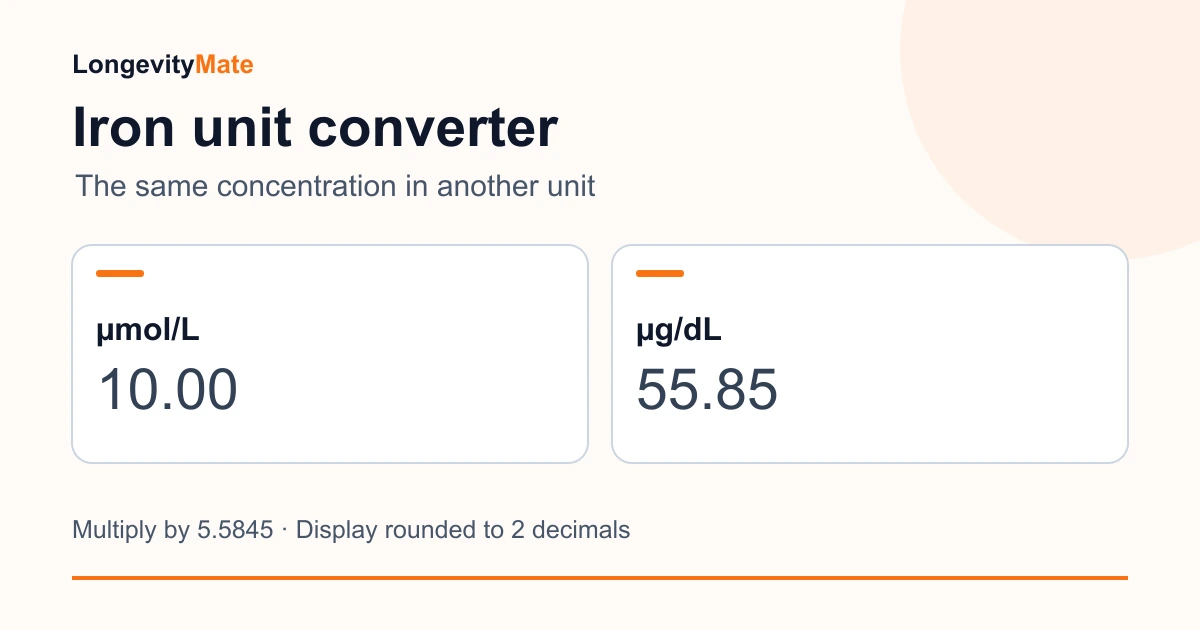
For iron, multiply µmol/L by 5.5845 to get µg/dL. Divide µg/dL by 5.5845 to get µmol/L. This uses the reference molar mass 55.845 g/mol and rounds the displayed answer once, to two decimals. [1][2]
Start with the unit printed on the report
Choose µmol/L to µg/dL or the reverse, then enter the number alone. Changing direction clears the entry so the same digits are not silently treated as a different unit. Keep the laboratory report beside the answer.
Where 5.5845 comes from
NIST lists iron’s standard atomic weight as 55.845(2). Using the corresponding reference molar mass of 55.845 g/mol, one micromole of iron has a mass of 55.845 micrograms. Dividing by ten converts a per-litre concentration into a per-decilitre concentration, giving 5.5845. [1][2]
The parentheses in the NIST value indicate uncertainty. The software uses exact arithmetic for the declared factor, but that does not make the physical reference value or the laboratory measurement exact. [1]
Keep the original precision
At two decimals, 10.00 µmol/L becomes 55.85 µg/dL because the unrounded result is 55.845. The halfway value rounds upward. The reverse calculation divides by the same factor before rounding; it does not first shorten the reciprocal.
Zero, small values and reported limits
A true zero displays as 0.00. A positive result too small for two decimals displays as less than 0.01. This avoids presenting a small positive quantity as an exact zero.
If the laboratory report says less than or greater than a limit, do not remove that sign and treat the limit as an exact measurement. This calculator accepts exact numeric entries only; it does not infer a value behind a reporting limit.
Iron is not ferritin or a tablet dose
Serum iron and ferritin are different measurements. Iron tests are interpreted with other results and personal context. A factor for iron concentration cannot turn a ferritin number into an iron number. [3]
Micrograms per decilitre is an amount per volume. Milligrams in a tablet is an amount. Converting between these requires information this calculator does not have, so it cannot calculate a dose. [2]
Accepted and rejected entries
Use a decimal point. Blank, negative and above-limit entries are rejected, as are commas, fractions, scientific notation, unit text and non-finite values. The limit is technical and has no clinical meaning.
Share the calculator without the result
No account is needed. Inputs and results stay in browser memory. Share uses the clean page address; reset or reload clears the entry. The optional recently-used list stores a tool identifier, not your iron value.
Keep the clinical interpretation with the original report
This conversion supplies no laboratory range, risk color or treatment advice. Review the original result and any concerns with the clinician who ordered the test. [3]
Formula and assumptions
- Version
- Iron amount and mass concentration conversion, iron-umol-ugdl-55-845-v1
- Rounding
- Multiply by 11169/2000 or its exact reciprocal 2000/11169; round once to two decimals, with halfway ties upward. Tiny positive results use a less-than sign. The reference mass and original measurement still have physical uncertainty.
Who this is for — and when not to use it
Intended use
Neutral unit conversion of an existing iron concentration between µmol/L and µg/dL. Keep the original measurement type and use the result only as an arithmetic restatement.
Not intended for
No high/low classification, reference-range selection, iron deficiency or overload diagnosis, supplement dosing, treatment decision, ferritin conversion or iron-salt calculation.
Exclusions
- Ferritin, transferrin protein and hemoglobin concentrations
- Iron in tablets, food or iron salts; elemental-dose calculations
- Changing a specimen or laboratory method
- Diagnosis, treatment, urgent triage and screening decisions
- Reporting limits expressed with less-than or greater-than signs as exact values
Evidence sources
- 1. Atomic Weights and Isotopic Compositions for Iron — National Institute of Standards and Technology. Accessed Sep 20, 2026.
- 2. Guide to the SI: Units and Prefixes — National Institute of Standards and Technology. Accessed Sep 20, 2026.
- 3. Iron Tests — MedlinePlus. Accessed Sep 20, 2026.