
What this result means
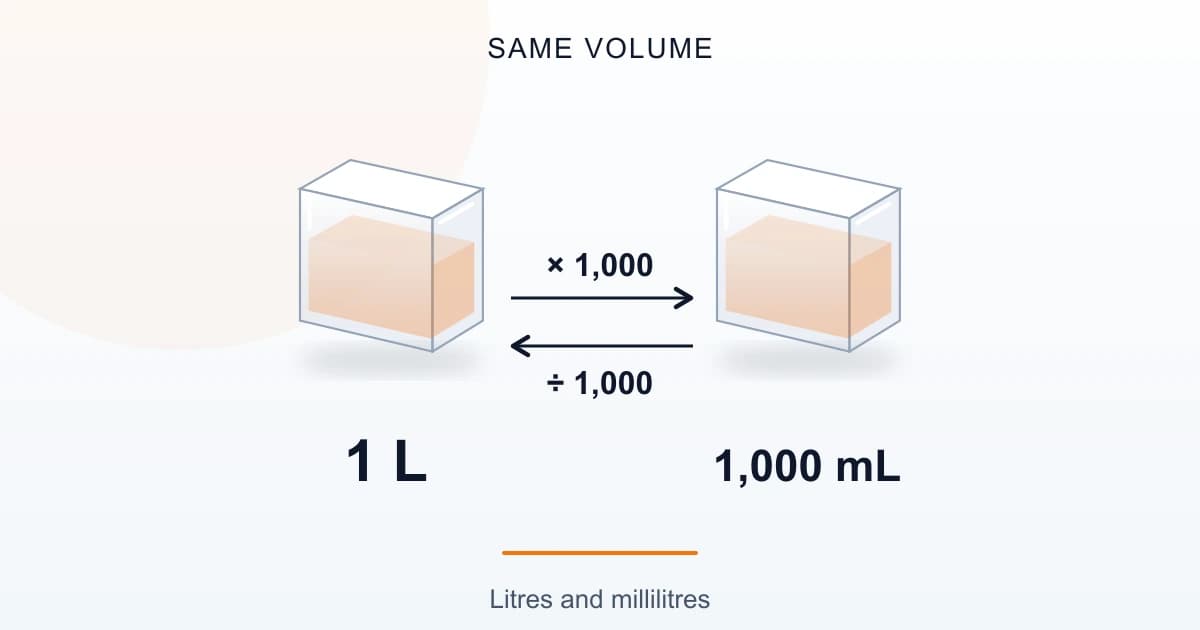
One litre (L) is exactly 1,000 millilitres (mL). Multiply litres by 1,000 to get millilitres; divide millilitres by 1,000 to get litres. Both numbers describe the same volume. This tool changes its unit, not its amount or suitability. [1]
The same volume, named in two units
NIST defines a litre as one cubic decimetre and a millilitre as one cubic centimetre. There are exactly 1,000 millilitres in one litre. The two identical volume blocks in the artwork express that same relationship rather than two differently sized quantities. [1]
The litre is accepted for use with SI units, while the coherent SI volume unit is the cubic metre. NIST lists 1 L = 1 dm³ = 10^-3 m³. This converter stays within the simple L/mL relationship. [2]
Examples that keep the volume unchanged
A bottle labelled 0.75 L holds a stated volume of 750 mL. In reverse, a stated 330 mL equals 0.33 L. These examples restate labels; they do not recommend drinking that volume or establish how precisely it was measured.
For a cross-check, 1 L becomes 1,000 mL, and 1,000 mL returns to 1 L before rounding. The container does not gain or lose liquid because the unit changes.
Volume is different from mass or concentration
A volume is the space a quantity occupies. A number in grams is a mass, and mg/mL is a concentration with both mass and volume. This tool accepts a volume alone and cannot infer those other quantities from it. [1]
It also does not convert fluid ounces or cups, whose definitions need separate context. Use the original full unit label rather than treating every bottle number as a litre or millilitre.
Rounding does not improve the original measurement
Results round once to six decimal places. For example, 0.0005 mL is exactly 0.0000005 L, which rounds upward at the halfway point to 0.000001 L. A smaller positive result below that display threshold is shown as less than 0.000001 L.
A starting label may already be rounded. Unit conversion cannot recover information that was never recorded. Extra display decimals describe the arithmetic, not a more precise measuring container.
Use a plain number and keep values in the browser
Both directions accept starting values from 0 to 1,000,000. These are software bounds, not intake or clinical limits. Enter a decimal-point number alone. Blank entries, negatives, unit text, inequalities, fractions, scientific notation, comma separators and nonfinite values are rejected. Changing direction clears the previous entry.
Calculation stays in browser memory without an account. Reset or reload clears entered values. Share uses the page address without inputs or results. The optional recently-used list stores the tool identifier, not the volume entered.
Formula and assumptions
- Version
- Litre and millilitre exact volume conversion, si-litre-millilitre-exact-1000-v1
- Rounding
- Keep the exact integer ratio 1000/1 or 1/1000; round once to six decimal places with nonnegative halfway ties upward. Display precision is not measurement accuracy.
- Worked example
- An illustrative container label: 0.75 L × 1,000 = 750 mL. In reverse, 330 mL ÷ 1,000 = 0.33 L. Both conversions keep the original stated volume; neither supplies a drinking or medicine instruction.
Who this is for — and when not to use it
Intended use
Convert a known volume between litres and millilitres. Compare the same bottle or container volume stated in two metric units.
Not intended for
Choose a hydration target, serving size or medicine dose. Convert mass, ingredient potency or a concentration such as mg/mL. Convert cups, fluid ounces or other region-dependent volume measures.
Exclusions
- Unclear quantities, concentrations or mass values without a volume.
- Negative volumes, unit text and values beyond the stated software bounds.
Evidence sources
- 1. SI Units: Volume — National Institute of Standards and Technology. Accessed Oct 13, 2026.
- 2. SP 330, section 4: units accepted for use with the SI — National Institute of Standards and Technology. Accessed Oct 13, 2026.