
What this result means
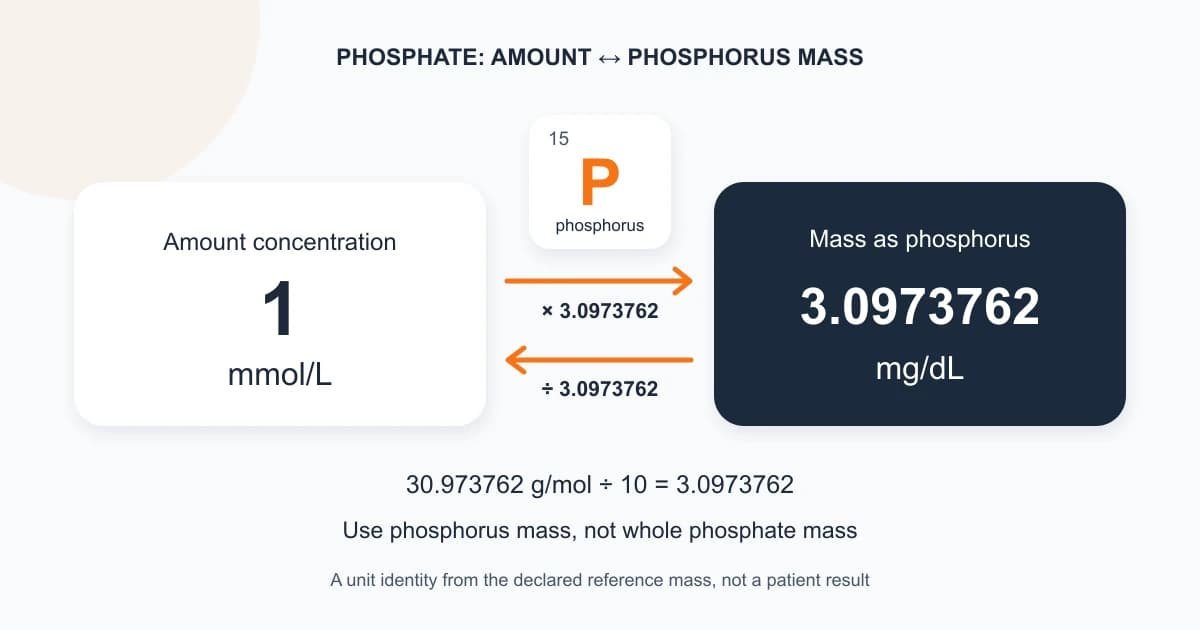
Multiply mmol/L by 3.0973762 to get mg/dL as phosphorus. Divide mg/dL by the same factor to get mmol/L. This assumes the laboratory mass basis is phosphorus, not the mass of the whole phosphate compound. The displayed answer rounds once to two decimal places. [1][2][3][4][5]
Choose the original report unit
Phosphorus mass and phosphate compound mass differ
Routine inorganic phosphate testing may be described as phosphorus. The factor here uses one phosphorus atom per phosphate group and the phosphorus reference mass. It does not use the combined mass of phosphorus and oxygen in the whole phosphate group. [1][4][5]
If a source reports phosphate compound mass, a phosphate salt or an unknown basis, do not apply this conversion. A shared word in the label does not establish the same quantity. The calculator cannot check the issuing laboratory’s convention for you.
Why the factor is 3.0973762
NIST lists a phosphorus atomic weight of 30.973762. Using the corresponding reference molar mass in g/mol, one millimole of phosphorus has a mass of 30.973762 mg. One litre contains ten decilitres, so 30.973762 mg/L becomes 3.0973762 mg/dL. [1][2][3]
Laboratory tables may round the conversion to 3.10 or use 0.323 in the reverse direction. This tool uses its declared fixed factor and exact reciprocal before display rounding. Extra factor digits do not increase the precision of a laboratory measurement. [5]
A synthetic unit example
An invented value of 1.00 mmol/L converts to 3.0973762 mg/dL as phosphorus and displays 3.10 mg/dL. This is arithmetic illustration, not a real patient result or a suggested normal value.
Converting the original 3.0973762 mg/dL back gives 1.00 mmol/L. Converting a rounded display instead can lose digits. Preserve the original report number for records and later calculations.
Rounding and tiny positive answers
The calculation uses exact decimal fractions for the declared factor, then rounds once to two decimal places. Halfway ties round upward. A true zero displays 0.00; a positive answer too small for this precision uses a less-than sign.
The reference atomic weight is a rounded physical reference. Exact arithmetic is a property of the calculation, not a claim that the reference value or blood measurement is exact. [1]
Enter a number, not a unit or a limit
Blank entries, negative values, commas, fractions, scientific notation, unit text and values above the technical input limit are rejected. Use a decimal point, for example 1.00. The tool is not designed for mg/L or another unlisted unit.
Do not enter the boundary from a less-than or greater-than report as if it were an exact measurement. Keep the qualifier and ask the laboratory how to represent it in the other unit.
Changing units does not change interpretation
A serum result remains a serum result after conversion. The tool supplies no range, color grading, diagnosis or treatment recommendation. A urine amount, food phosphorus total or phosphate medicine dose is a different quantity. [4]
Discuss the original report and its laboratory interval with the clinician who ordered it. A converted value is a way to display the same information, not a new assessment of your health. [4]
Your entered number stays private
The calculation runs in the browser without an account. Numeric inputs and results are not added to analytics details or the shared address. Share uses the clean page link; Reset or reload clears the entry.
Formula and assumptions
- Formula
- mg/dL (as phosphorus) = mmol/L × 3.0973762. mmol/L = mg/dL (as phosphorus) ÷ 3.0973762. [1][2][3][5]
- Version
- Phosphate amount concentration and phosphorus mass concentration, phosphate-as-phosphorus-mmol-mgdl-30-973762-v1
- Rounding
- Use the fixed rational 15486881/5000000 or its exact reciprocal 5000000/15486881; round once to two decimal places, with nonnegative halfway ties upward. Tiny positive answers use a less-than sign. Exact arithmetic does not make the reference mass or measurement physically exact.
- Worked example
- Synthetic example, not a patient result: 1.00 mmol/L × 3.0973762 = 3.0973762 mg/dL as phosphorus; displayed to two decimals as 3.10 mg/dL.
Who this is for — and when not to use it
Intended use
Neutral unit conversion of an existing serum or plasma inorganic phosphate concentration with mg/dL explicitly on a phosphorus mass basis.
Not intended for
No clinical interpretation, normal range, diagnosis, treatment, supplement or medicine dose, phosphate salt mass conversion, elemental dietary phosphorus amount, urine total, or conversion from another unit such as mg/L.
Exclusions
- Unknown analyte or unknown phosphorus-versus-phosphate mass basis
- Mass reported as the whole phosphate compound or a phosphate salt
- Other units such as mg/L, g/L, μmol/L or mEq/L
- Inequalities, ranges, missing results or guessing an absent value as zero
- Urine totals, food content, supplement amounts or medicine doses
- Using the conversion as a clinical result classification
Evidence sources
- 1. Atomic Data for Phosphorus — National Institute of Standards and Technology. Accessed Oct 3, 2026.
- 2. Metric (SI) Prefixes — National Institute of Standards and Technology. Accessed Oct 3, 2026.
- 3. SI Guide: Units Outside the SI — National Institute of Standards and Technology. Accessed Oct 3, 2026.
- 4. Phosphorus (Inorganic), Serum — Mayo Clinic Laboratories. Accessed Oct 3, 2026.
- 5. SI Unit Conversion Table: Phosphorus, serum — Labcorp. Accessed Oct 3, 2026.