
What this result means
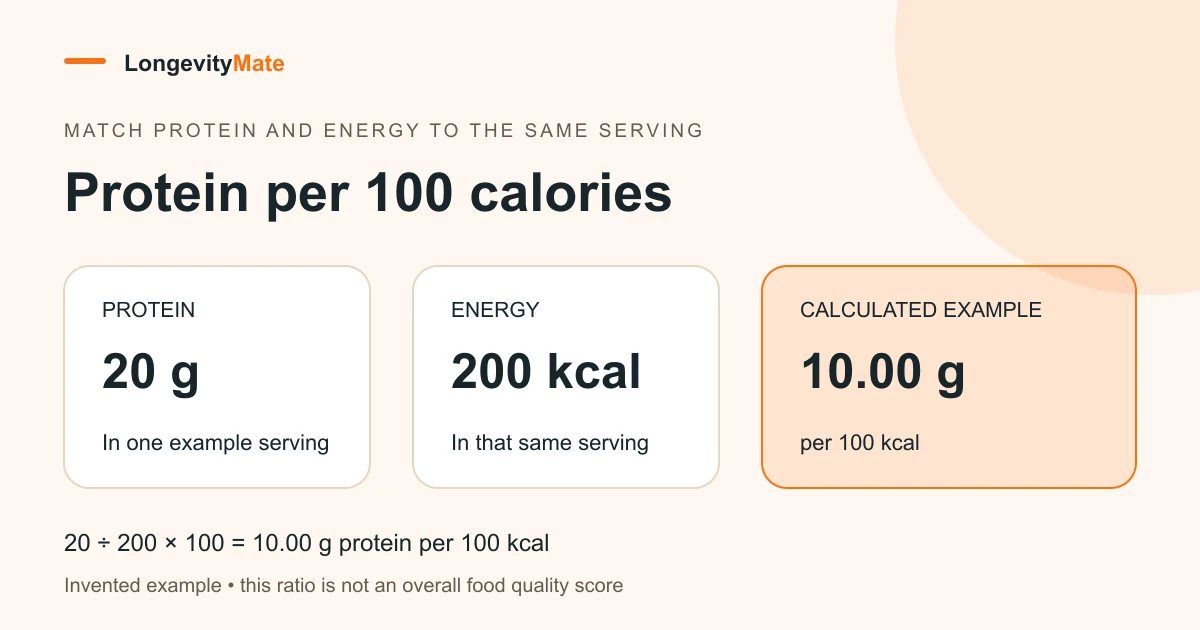
Divide protein in grams by energy in kilocalories, then multiply by 100. A serving with 20 g protein and 200 kcal gives 10.00 g protein per 100 kcal. Use protein and calories from the same serving or label column. This ratio does not measure overall food quality. [1][2]
Start with matching values
Find protein in grams and energy in kcal for the same serving on the label. If there are separate columns for one serving and the whole container, stay in one column. A serving size describes the label basis; it is not a recommendation for how much to eat. [1]
Per-100-g values also work if both entries are per 100 g. For a product that changes during preparation, match values for the same state: do not combine dry-powder protein with calories for a prepared drink.
On food labels, Calories mean kilocalories, abbreviated kcal. Kilojoules, abbreviated kJ, are a different unit of energy. Use the linked converter if your label supplies only kJ. [3]
Compare the same amount of energy
An invented Food A has 20 g protein and 200 kcal: 20 ÷ 200 × 100 = 10.00 g per 100 kcal. An invented Food B has 10 g protein and 80 kcal: 10 ÷ 80 × 100 = 12.50 g per 100 kcal. B has the higher ratio, while A has more protein in the serving entered.
The two statements answer different questions. Compare this ratio when you want protein relative to energy; look at grams per serving when you want the amount in that serving. Neither number makes the whole food better or worse.
Doubling the serving leaves the ratio unchanged
The FDA’s example label lists 15 g protein and 280 Calories for one serving, and 30 g protein and 560 Calories for two servings. Both give 5.36 g protein per 100 kcal after rounding. The total protein and total energy double together. [2]
A mismatched pair gives a misleading result. Using 30 g protein from the two-serving column with 280 kcal from the one-serving column would give 10.71 g per 100 kcal. The arithmetic is correct for those entries, but they do not describe the same food amount.
What the result cannot tell you
The ratio contains only the two values you entered. It does not include fibre, sodium, other nutrients, protein composition, price, taste or your needs. There is no universal target or pass mark in this tool.
A zero-energy entry cannot be used as the denominator. If energy is shown as zero on a rounded label, use a more precise valid label basis if one is available; do not invent a tiny calorie value to force a result. Very low energy can make the ratio highly sensitive to rounding.
Rounding and privacy
The output rounds once to two decimal places. In a numerical example, 2.01 g protein and 200 kcal produce exactly 1.005 g per 100 kcal, displayed as 1.01. Rounding can hide differences between nearby results, and displayed decimal places do not improve the precision of a food label.
Calculations run in your browser. Entered protein, calories and results are not included in the shared page address or analytics details. Reset clears the calculation.
Formula and assumptions
- Version
- Protein per 100 kilocalories, protein-per-100-kcal-v1
- Rounding
- Use exact fractions from the decimal inputs and integer factor 100. Round the nonnegative result once to two decimal places, with exact halfway values rounded up.
- Worked example
- An invented serving with 20 g protein and 200 kcal: 20 ÷ 200 × 100 = 10.00 g protein per 100 kcal.
Who this is for — and when not to use it
Intended use
Neutral label arithmetic for expressing protein relative to food energy on a common basis of 100 kcal.
Not intended for
This tool does not prescribe protein or calorie intake, rank foods as healthy or unhealthy, estimate protein absorption or amino-acid quality, calculate a clinical diet, or determine whether a label is accurate.
Exclusions
- Personal protein or calorie targets and clinical diet planning
- Food quality scores or healthy and unhealthy labels
- Assessment of amino-acid composition, digestion or protein absorption
- Mixing per-serving values with per-container or per-100-g values
- Treating kJ as kcal or dividing by zero calories
Evidence sources
- 1. Serving Size on the Nutrition Facts Label — U.S. Food and Drug Administration. Accessed Sep 9, 2026.
- 2. How to Understand and Use the Nutrition Facts Label — U.S. Food and Drug Administration. Accessed Sep 9, 2026.
- 3. Interactive Nutrition Facts Label: Glossary — U.S. Food and Drug Administration. Accessed Sep 9, 2026.