
What this result means
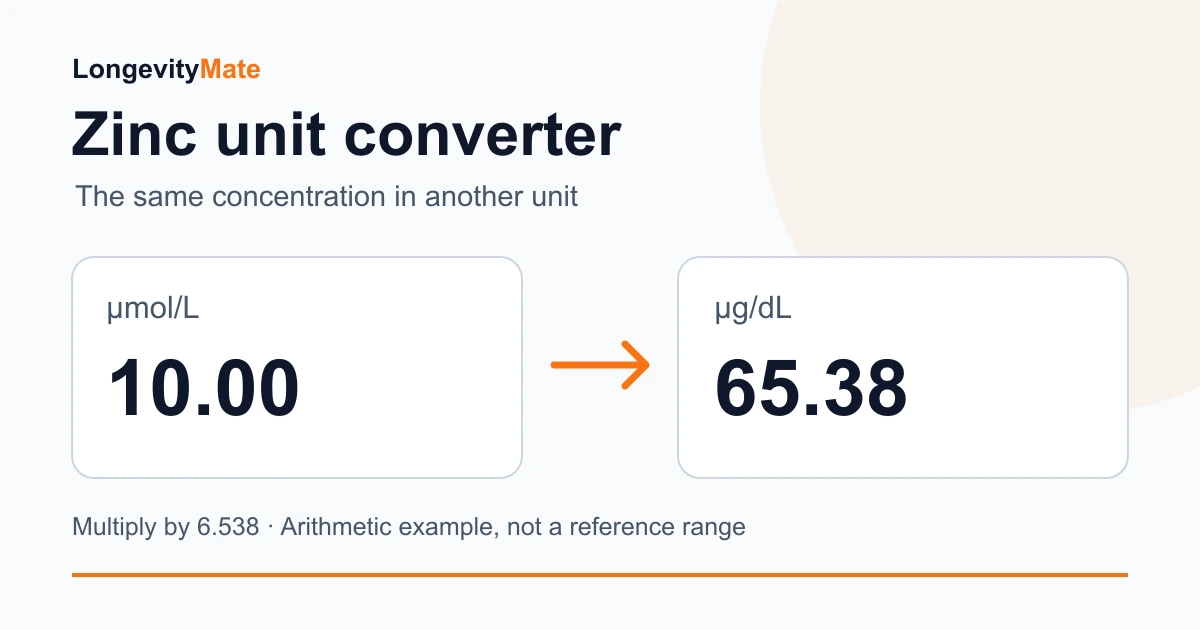
For zinc, multiply µmol/L by 6.538 to get µg/dL. Divide µg/dL by 6.538 to get µmol/L. This factor uses the declared zinc atomic-weight value 65.38 and the SI unit prefixes. The display rounds once to two decimals. [1][2]
Start with the unit on the zinc report
Choose the direction matching the printed unit, then enter the number alone. Changing direction clears the entry so its digits are not silently assigned a different unit. Keep the original report and laboratory comments with the converted number.
Where the 6.538 factor comes from
CIAAW lists zinc with a standard atomic-weight value of 65.38 and an uncertainty of 0.02. Using 65.38 grams per mole, one micromole of zinc has a mass of 65.38 micrograms. One litre contains ten decilitres, giving 6.538 micrograms per decilitre for each micromole per litre. [1][2]
This calculator declares that convention rather than treating physical zinc or a laboratory assay as exact. The reverse direction divides by 6.538 without first shortening its reciprocal.
µg/dL, mcg/dL and other units
The µ prefix means micro, and d means deci. Laboratories may write micrograms as µg or mcg. Both spellings use the same numeric entry here. Milligrams per litre and micrograms per litre have different scale factors and are not direct input units for this calculator. [2]
Round once and preserve the original report
For example, 2.5 µmol/L gives 16.345 µg/dL before rounding, displayed as 16.35. The reverse conversion is calculated from the entered value and the declared factor before rounding.
Do not treat two displayed decimals as extra measurement accuracy. A rounded conversion followed by a reverse conversion can lose information; keep the original unrounded report value.
Zero and very small positive values
An exact zero displays as 0.00. A positive answer too small for the two-decimal display appears as less than 0.01, so it is not presented as an exact zero.
A laboratory report such as less than 5 gives a reporting limit, not an exact measurement of 5. Inequality signs are rejected. The tool does not infer the concentration behind that limit.
A unit change does not change the test
Converting units cannot turn serum into whole blood, remove collection effects or align different laboratory methods. Keep the test name, specimen and laboratory interval attached to the result.
This page calculates a concentration, which is an amount per volume. A tablet contains an amount. There is no calculation here that turns a zinc blood concentration into a supplement dose. [2]
Entries the calculator accepts
Enter a nonnegative number with a decimal point. Blank, negative, over-limit and malformed entries are rejected, including commas, fractions, scientific notation and unit text. The upper bound is a technical limit, not a safe or normal blood concentration.
Share the page without your number
No account is needed. Values remain in browser memory. Reset or reload clears the entry, and Share uses the clean page address. The optional recently-used list stores the tool identifier without the concentration.
Use the laboratory report for interpretation
The output has no risk color, reference range or diagnosis. Whether a result matters depends on why the test was requested and other findings. Discuss that interpretation with the clinician responsible for the test.
Formula and assumptions
- Version
- Zinc mass and amount concentration conversion, zinc-umoll-ugdl-65-38-v1
- Rounding
- Calculate with 3269/500 or its exact reciprocal 500/3269, then round once to two decimals with halfway ties upward. A tiny positive result displays as less than 0.01. Physical uncertainty remains.
Who this is for — and when not to use it
Intended use
Neutral arithmetic conversion of an existing zinc concentration between µmol/L and µg/dL using the declared atomic-weight convention.
Not intended for
No diagnosis, high/low classification, reference-range selection, supplement dose, treatment recommendation, screening or urgent-care assessment.
Exclusions
- Other elements or compounds with different molar masses
- Zinc supplement amounts or food intake
- Changing the specimen, laboratory method or reference interval
- Converting a reporting limit into an exact measurement
- Diagnosis, treatment selection, dosing and urgent triage
Evidence sources
- 1. Atomic Weight of Zinc — IUPAC Commission on Isotopic Abundances and Atomic Weights. Accessed Sep 22, 2026.
- 2. Guide to the SI: Units and Prefixes — National Institute of Standards and Technology. Accessed Sep 22, 2026.