Creatine evidence guide
Creatine Monohydrate: Benefits, Dosage, Safety and Evidence
Creatine monohydrate can modestly improve strength and measured lean mass when paired with progressive resistance training, and it improves some repeated high-intensity exercise measures. The familiar 3–5 g/day regimen is well studied in healthy adults; broader brain, mood, glucose, bone and longevity claims are not established.1,2,3,4,5,8,13,18
Research and writing
LongevityMate Research
Editorial oversight
Lukas Dvorsky, FounderClinical review
Not yet assigned or claimed
Educational information, not medical advice
The answer first
Should you take Creatine?
Start with the reason, not the product. A supplement is most useful when it closes a real gap or serves a defined, measurable goal.
LongevityMate verdict
For a healthy adult pursuing strength or repeated high-intensity performance, plain third-party-tested creatine monohydrate at 3–5 g/day is the best-supported choice. Loading is optional. Expect possible water-weight gain and mild stomach symptoms, disclose use before kidney blood tests, and do not treat it as a substitute for training, sleep, nutrition or prescribed care.1,2,17,18,23,24,30
Most likely to help
Adults doing progressive resistance training or sports with repeated brief, intense efforts. Older adults may gain a small additional benefit when creatine is paired with supervised resistance training.2,3,5,6
May help, but evidence is narrower
Women and postmenopausal adults can benefit from training, but creatine-specific estimates are less precise. Selected cognitive effects during severe sleep loss come from two small same-lab studies using unusually high one-off doses.7,8,10
Not an established reason
General cognition, depression treatment, glucose control, stronger bones, steady-state endurance, heart protection, injury prevention or longer life.8,9,11,13,15,16
Pause and get individual advice
Pregnancy or breastfeeding, under 18, kidney or liver disease, bipolar disorder or past mania, relevant medicines, abnormal kidney tests, or planned surgery.12,25,27,34,43,44
How to read our evidence ratings
Evidence strength shows how confident we are in a conclusion. The finding label separately shows whether the result was helpful, small, mixed, negative or still unknown.
High confidence in the conclusion from established care, guidelines or consistent high-quality human evidence.
Reasonable confidence from several human trials or a useful synthesis, with some important limits.
Low confidence because studies are early, small, short, inconsistent or indirect.
Too little reliable human outcome evidence to reach a useful conclusion.
Strong evidence can show that something does not work. “Insufficient” means the research cannot yet give a reliable answer.
The basics
What is Creatine?
Biological importance does not automatically prove that taking more produces a health benefit.
Creatine is a nitrogen-containing compound made by the body from amino acids and obtained from meat and fish. Most is stored in skeletal muscle as free creatine or phosphocreatine.1,2
Creatine monohydrate is the reference supplement form. “Creatine” and “creatinine” are not the same: creatinine is a breakdown product used in kidney testing, and supplementation can change its interpretation.17,18,25
The live LongevityMate catalogue contains separate Creatine Monohydrate and Creatine HCl entries. This canonical guide covers the whole creatine family because the search intent overlaps, while grading monohydrate and HCl separately.
How it may work, in plain English
A plausible mechanism can explain a research question. It cannot prove that the supplement improves symptoms or long-term health.
Faster ATP recycling
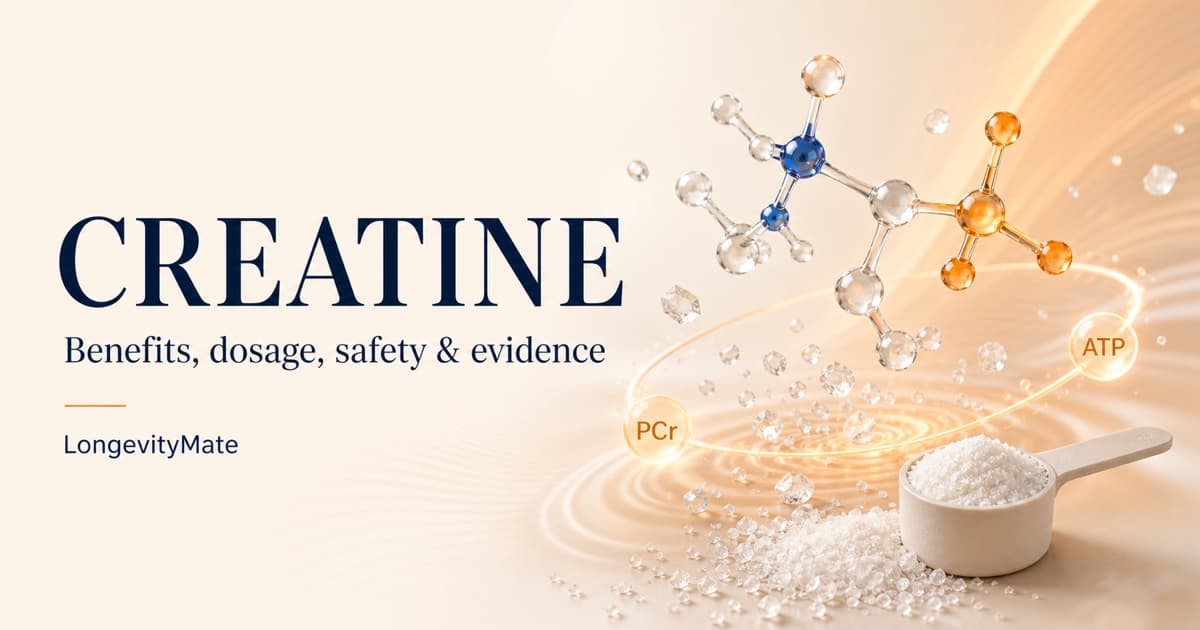
Phosphocreatine donates phosphate to help regenerate ATP during brief, high-energy work. This explains why repeated intense efforts are a better fit than long, steady endurance.1,2,5
Higher muscle creatine stores
Supplementation increases muscle creatine availability. Loading raises stores faster; a smaller daily dose reaches a similar saturation more gradually.1,2,41
Cell water and training capacity
Creatine draws water into muscle cells and may allow slightly more high-quality training work. Early lean-mass measurements therefore include water and cannot be read as pure new muscle tissue.4,19,41
Brain energy is plausible—not a proven benefit
Brain creatine and phosphocreatine are biologically relevant, but changing an energy biomarker does not prove better memory, mood or disease outcomes.8,9,10,11
Benefits by evidence level
Scientific evidence summary
Evidence strength and finding direction are shown separately. Open a benefit for the measured effect, study population and important limitations.
Strong evidence
2 outcomesStrength with resistance training
Creatine monohydrate adds a modest strength gain on top of progressive resistance training, with the clearest evidence in younger men.
StrongFinding: benefit supportedOutcome: Symptoms or function3
Strength with resistance training
Creatine monohydrate adds a modest strength gain on top of progressive resistance training, with the clearest evidence in younger men.
- Measured effect
- A 2024 meta-analysis of 23 trials found an additional 4.43 kg for upper-body and 11.35 kg for lower-body strength versus the same training without creatine.
- What was studied
- Mostly healthy adults under 50, doses from 2–10 g/day or weight-based equivalents, paired with 4–12 weeks of resistance training.
- Limits
- Women were underrepresented, exercise tests varied, and no included trial lasted longer than 12 weeks. These are group averages, not guaranteed gains.
Bone density and fracture prevention
Current evidence supports no important bone-mineral-density benefit in postmenopausal women.
StrongFinding: no meaningful benefitOutcome: Health outcome7
Bone density and fracture prevention
Current evidence supports no important bone-mineral-density benefit in postmenopausal women.
- Measured effect
- 2 large 2-year trials and a 2026 meta-analysis found essentially no meaningful DXA bone-density improvement.
- What was studied
- 7 randomized trials involving 608 postmenopausal women, including trials with exercise and without prescribed training.
- Limits
- Some bone-geometry signals are uncertain. Falls and fractures were not adequately powered, so prevention is unproven.
Moderate evidence
5 outcomesRepeated high-intensity performance
Creatine can improve mean power or total work across repeated short, intense efforts; it does not improve every sprint measure.
ModerateFinding: benefit supportedOutcome: Symptoms or function1,2,5
Repeated high-intensity performance
Creatine can improve mean power or total work across repeated short, intense efforts; it does not improve every sprint measure.
- Measured effect
- A 14-trial meta-analysis found mean power SMD 0.61 after short loading, while peak power and fatigue decline were not statistically significant; body mass increased by 0.79 kg.
- What was studied
- Double-blind trials in adults completing 5–20 repeated efforts of 10 seconds or less, usually after about 20 g/day for 3–7 days.
- Limits
- The evidence is largely short laboratory testing. Added mass may be unhelpful in weight-sensitive running or jumping sports.
Measured lean mass with resistance training
Measured lean mass usually rises modestly when creatine is combined with resistance training, but the measurement includes water.
ModerateFinding: small benefitOutcome: Biomarker4,37
Measured lean mass with resistance training
Measured lean mass usually rises modestly when creatine is combined with resistance training, but the measurement includes water.
- Measured effect
- Meta-analyses commonly report roughly 0.4–1.4 kg more measured lean or fat-free mass. Direct imaging found only a small hypertrophy effect.
- What was studied
- Adults following resistance-training programmes for several weeks to months, commonly with 3–5 g/day after optional loading.
- Limits
- DXA and BIA cannot separate all intracellular water from new contractile tissue. Creatine without progressive training is not a reliable muscle-building strategy.
Older adults alongside resistance training
Older adults may gain small additional lean-mass and strength benefits when creatine is paired with resistance training.
ModerateFinding: small benefitOutcome: Symptoms or function6,7
Older adults alongside resistance training
Older adults may gain small additional lean-mass and strength benefits when creatine is paired with resistance training.
- Measured effect
- A 33-trial synthesis reported about 1.08 kg more lean tissue and small strength effects, but functional results were heterogeneous.
- What was studied
- Mostly adults over 50 completing supervised resistance training for 8–104 weeks, often using 5 g/day or about 0.1 g/kg/day.
- Limits
- This does not establish treatment of diagnosed sarcopenia, prevention of falls, preserved independence or a special anti-ageing effect.
Women and postmenopausal adults
Women can use the same evidence-based form and general maintenance range, but female-specific outcome certainty is lower because trials enrolled fewer women.
ModerateFinding: small benefitOutcome: Symptoms or function3,7
Women and postmenopausal adults
Women can use the same evidence-based form and general maintenance range, but female-specific outcome certainty is lower because trials enrolled fewer women.
- Measured effect
- A 2026 postmenopausal meta-analysis found 0.37 kg more lean mass and 7.5 kg greater leg-press strength, although the prediction interval included no lean-mass benefit.
- What was studied
- 7 trials involving 608 postmenopausal women, with and without resistance training, over 12–104 weeks.
- Limits
- Only 3 trials contributed the leg-press estimate, longer studies were less convincing, and bone density did not improve meaningfully.
Steady-state endurance
Creatine does not reliably improve steady-state endurance performance.
ModerateFinding: no meaningful benefitOutcome: Symptoms or function1,15
Steady-state endurance
Creatine does not reliably improve steady-state endurance performance.
- Measured effect
- A meta-analysis in trained athletes found SMD −0.07, with the confidence interval crossing no effect.
- What was studied
- 13 studies in trained endurance athletes using time-trial, time-to-exhaustion and related protocols.
- Limits
- Repeated bursts or an end-spurt within a mixed sport are a different question. Extra water mass may matter in weight-bearing events.
Limited evidence
4 outcomesCognition during acute sleep deprivation
Two small studies from one laboratory suggest selected cognitive effects during major sleep loss after unusually large single doses.
LimitedFinding: small benefitOutcome: Symptoms or function10
Cognition during acute sleep deprivation
Two small studies from one laboratory suggest selected cognitive effects during major sleep loss after unusually large single doses.
- Measured effect
- In the 2026 replication with 29 adults, logic improved 6.1% and was the only named outcome to survive multiplicity correction.
- What was studied
- Single doses of 0.2–0.35 g/kg during about 21 hours of sleep deprivation, with effects measured over several hours.
- Limits
- The studies were small, same-lab and not evidence for routine 3–5 g/day, better sleep, or replacing sleep. Do not self-test these high doses.
Depression and mood
Creatine is not an established depression treatment and should not replace psychiatric care.
LimitedFinding: mixed resultsOutcome: Health outcome11,12
Depression and mood
Creatine is not an established depression treatment and should not replace psychiatric care.
- Measured effect
- An 11-trial meta-analysis found an average effect equivalent to about 2.2 HAM-D points—below a 3-point meaningful threshold—with very-low certainty and high heterogeneity.
- What was studied
- Adjunctive trials across depressive conditions, usually alongside established treatment rather than as a replacement.
- Limits
- The true effect may be trivial or absent. 2 creatine participants in a small bipolar-depression trial switched to hypomania or mania.
Blood glucose and HbA1c
Creatine is not established as a glucose-lowering treatment.
LimitedFinding: mixed resultsOutcome: Biomarker13,14
Blood glucose and HbA1c
Creatine is not established as a glucose-lowering treatment.
- Measured effect
- 1 trial involving 25 people combined 5 g/day with exercise and reported an HbA1c difference of −1.1 percentage points over 12 weeks, but pooled fasting glucose and insulin-resistance results were null.
- What was studied
- A small number of short studies, with only 2 involving people with diabetes in the pooled review.
- Limits
- The positive trial cannot separate creatine from the supervised exercise programme and is too small to guide diabetes treatment.
Exercise recovery and soreness
Some muscle-damage biomarkers change after acute exercise, but better recovery, less soreness and injury prevention are not established.
LimitedFinding: mixed resultsOutcome: Biomarker16
Exercise recovery and soreness
Some muscle-damage biomarkers change after acute exercise, but better recovery, less soreness and injury prevention are not established.
- Measured effect
- A 2022 meta-analysis reported lower acute creatine kinase, LDH or myoglobin at some time points, while soreness, inflammation and chronic-training findings were inconsistent.
- What was studied
- 23 heterogeneous studies using damaging exercise or longer training programmes.
- Limits
- Biomarker changes are not the same as faster functional recovery, fewer injuries or improved readiness.
Insufficient evidence
1 outcomeGeneral cognition and memory
Creatine is not proven to improve general cognition in healthy, rested adults.
InsufficientFinding: still unknownOutcome: Symptoms or function8,9
General cognition and memory
Creatine is not proven to improve general cognition in healthy, rested adults.
- Measured effect
- EFSA found no cause-and-effect relationship after reviewing the human evidence, and the EU formally rejected the broad cognitive health claim in 2026.
- What was studied
- Small, heterogeneous trials across healthy adults, vegetarians, older adults and clinical populations, using different tests and regimens.
- Limits
- A positive 2024 meta-analysis double-counted correlated outcomes, overstating precision. Do not infer dementia prevention from a mechanism or brain-creatine change.
Safety before optimisation
Who may benefit, who should avoid it and interactions
Kidney function, pregnancy, age, dose and medicines can change whether a supplement is sensible or dangerous.
Who may benefit
Who should avoid it or get advice first
People who are pregnant or breastfeeding should not routinely self-start for wellness or performance: adequate human safety evidence is absent.27
InsufficientChildren and adolescents should not copy adult regimens unsupervised. Short studies have not shown a consistent harm signal, but samples are small and long-term development data are inadequate.43
LimitedPeople with chronic liver disease need individual advice because dedicated supplementation-safety evidence is sparse.
InsufficientPeople with bipolar disorder, past mania or hypomania, or unstable mood should not self-start because a small trial recorded possible mood switching.12
LimitedAnyone preparing for surgery should disclose all supplements and follow the surgical and anesthesia team’s stop and restart instructions.34
Limited
Common side effects
Rare but serious effects
Stop and seek urgent care for severe allergy, markedly reduced urine, severe dehydration, jaundice, cola-coloured urine with severe muscle symptoms, rapidly worsening swelling or breathing difficulty.
LimitedStop and seek urgent mental-health help for a markedly reduced need for sleep, racing thoughts, agitation, grandiosity or unsafe behaviour—especially with bipolar history.12
Limited
Drug and supplement interactions
Timing can sometimes solve an absorption interaction. A clinician check means the underlying safety question is more important than spacing doses.
Medicines that can affect kidneys
Do not self-manage- What can happen
- Direct interaction studies are sparse. Tacrolimus, cyclosporine, aminoglycosides, frequent high-dose NSAIDs and some antivirals can create kidney risk or monitoring complexity.
- Practical action
- Tell the prescriber and pharmacist before use; do not self-manage creatine when kidney function or a narrow-therapeutic-index medicine is being monitored.
PrEP and other creatinine-monitored treatment
Clinician check- What can happen
- Creatine can raise serum creatinine and make creatinine-based eGFR look lower, complicating interpretation without proving filtration damage.
- Practical action
- Disclose creatine before testing and follow the treating clinician’s plan. Do not dismiss a new creatinine rise automatically.
Caffeine
Timing matters- What can happen
- Evidence is mixed on whether chronic simultaneous use changes some performance effects. This is not an established dangerous interaction, but high caffeine can add GI symptoms.
- Practical action
- If tolerance or performance is worse, separate intake or reduce caffeine rather than assuming creatine has failed.
Diuretics, dehydration risk and extreme heat
Clinician check- What can happen
- Creatine has not caused dehydration in controlled studies, but evidence does not cover every high-risk medicine, illness or heat exposure.
- Practical action
- Use ordinary individualized hydration and heat precautions; get clinical advice when a medicine or illness changes fluid or kidney balance.
Sodium bicarbonate and large GI-active doses
Timing matters- What can happen
- No dangerous interaction is established, but taking several GI-active supplements together can worsen bloating or diarrhea.
- Practical action
- Separate them or reduce the single-dose burden if symptoms occur.
Surgery and anesthesia
Clinician check- What can happen
- Human evidence does not establish a creatine-specific bleeding or anesthetic interaction, but perioperative data are limited.
- Practical action
- Give the surgical team a complete supplement list and follow its stop and restart instructions; do not rely on a universal internet washout rule.
Use the amount actually studied
Evidence-based dosage and how to take it
Trial doses describe research, not an automatic personal recommendation. Read the active amount on the label and use the lowest dose that fits a defined purpose.
Simple maintenance without loading
- Typical studied dose
- 3–5 g/day of creatine monohydrate
- Duration studied
- Daily; muscle saturation develops over about 3–4 weeks
- How to use this information
- The simplest default for a healthy adult with a supported training goal. Take it every day, including rest days.
Optional loading phase
- Typical studied dose
- About 0.3 g/kg/day, commonly 20 g/day split into 4 doses of 5 g
- Duration studied
- 5–7 days, then 3–5 g/day
- How to use this information
- Use only if faster saturation matters. Split doses to reduce stomach symptoms; skipping loading reaches a similar endpoint later.
Resistance training and repeated high-intensity sport
- Typical studied dose
- Usually 3–5 g/day after optional loading
- Duration studied
- At least 4–12 weeks alongside progressive training
- How to use this information
- Measure the relevant lift, repeat-sprint output or training volume—not only scale weight.
Older adults with resistance training
- Typical studied dose
- Commonly 5 g/day or about 0.1 g/kg/day
- Duration studied
- 8–104 weeks in trials
- How to use this information
- A conservative 3–5 g/day without loading is practical when otherwise appropriate. Frailty, polypharmacy and kidney context need individual review.
Cognition, mood or medical conditions
- Typical studied dose
- No established self-care dose
- Duration studied
- Protocols vary widely
- How to use this information
- Do not copy high-dose research protocols or use creatine to replace sleep, mental-health care, diabetes treatment or neurological care.
How to take it
Consistency matters more than pre- versus post-workout timing. Current trials do not establish a meaningful timing advantage.23
ModerateDietary fat is not required and has no proven absorption or outcome advantage.
InsufficientIf loading causes diarrhea, nausea or bloating, skip loading or split smaller doses. A small trial found more diarrhea with one 10 g dose than two 5 g doses.24
ModerateMix powder into liquid and drink it reasonably soon. Dry powder is stable, while prolonged storage in acidic or hot liquid increases conversion to creatinine.32
Moderate
Choosing a quality product
Prefer lot-specific independent testing. Competitive athletes can look for HASTA or Informed Sport in Australia, or NSF Certified for Sport in the US.30
Strong
Absorption is not the same as results
Forms, formulation and bioavailability
A form can absorb better without being proven better for symptoms or long-term health. We grade those questions separately.
Creatine monohydrate
Best-supported default for efficacy, safety and value
Outcome evidenceStrongFinding: benefit supported1,2,21
Creatine monohydrate
Best-supported default for efficacy, safety and value
Absorption and formulation
Well absorbed; muscle uptake increases over days to weeks depending on the regimen.
Extensively studied, high oral bioavailability, stable as dry powder and widely available as a single ingredient.
Proven health outcomes
Direct evidence supports strength and some repeated high-intensity outcomes when used with appropriate training.
Can settle in cold liquid, cause mild GI symptoms in some people and increase early water weight.
Micronized creatine monohydrate
People who prefer easier mixing
Outcome evidenceLimitedFinding: no meaningful benefit21,32
Micronized creatine monohydrate
People who prefer easier mixing
Absorption and formulation
No convincing evidence of clinically important absorption superiority over ordinary monohydrate.
Smaller particles may disperse more easily. It remains the same creatine monohydrate molecule.
Proven health outcomes
No demonstrated outcome advantage when the same monohydrate dose is used.
Often costs more, and improved mixing is not proof of greater muscle uptake or better results.
Creatine HCl
A smaller-volume alternative when monohydrate is not tolerated
Outcome evidenceInsufficientFinding: still unknown21,32
Creatine HCl
A smaller-volume alternative when monohydrate is not tolerated
Absorption and formulation
Greater solubility does not establish superior whole-body absorption, muscle saturation or tolerance.
More soluble in water by formulation and may require less powder volume.
Proven health outcomes
No convincing evidence that HCl produces better strength, muscle, cognitive or safety outcomes than monohydrate.
Human outcome trials and long-term safety data are much smaller than for monohydrate. Lower labelled doses are not proven equivalent.
Buffered creatine
Marketing claims about stability or stomach comfort
Outcome evidenceModerateFinding: no meaningful benefit22
Buffered creatine
Marketing claims about stability or stomach comfort
Absorption and formulation
Buffering changes the formulation but has not shown a meaningful uptake advantage.
Marketed as more stable and easier to tolerate.
Proven health outcomes
No demonstrated advantage over monohydrate.
A controlled trial found no superiority for muscle creatine, body composition, performance or side effects.
Plain-English verdict
Do not pay more expecting stronger outcomes.22
Creatine ethyl ester and other salts
Alternative-form comparisons
Outcome evidenceInsufficientFinding: still unknown21,32
Creatine ethyl ester and other salts
Alternative-form comparisons
Absorption and formulation
Solubility, blood levels and muscle uptake are different questions and should not be merged.
Different taste, solubility, capsule size or product format may suit preferences.
Proven health outcomes
No alternative form has established superior health, performance or long-term safety outcomes.
Evidence bases are smaller; ethyl ester has performed worse than monohydrate in some comparisons.
Capsules, gummies and ready-to-drink products
Convenience when the full verified dose is practical
Outcome evidenceInsufficientFinding: still unknown31,32,36,37
Capsules, gummies and ready-to-drink products
Convenience when the full verified dose is practical
Absorption and formulation
The delivery format does not prove superior absorption. Verify the actual grams of creatine and product stability.
Pre-portioned formats may be easier to carry or remember.
Proven health outcomes
Equivalent outcomes are plausible only when identity, dose and stability truly match studied monohydrate—not because the format is newer.
Capsules may require many units; gummies may under-dose or add sugar; long-stored liquids raise stability questions.
Food first
Creatine in food
Creatine occurs mainly in meat and fish. Food contributes to normal intake, but the amount used in trials would require impractically large servings; plant foods contain little to none.
Approximate amount per serving
Strong| Food | Serving | Creatine |
|---|---|---|
| Herring | About 113 g (4 oz) | 0.9 g |
| Pork | About 113 g (4 oz) | 0.6 g |
| Beef | About 113 g (4 oz) | 0.5 g |
| Salmon | About 113 g (4 oz) | 0.5 g |
| Tuna | About 113 g (4 oz) | 0.4 g |
| Cod | About 113 g (4 oz) | 0.3 g |
| Cow’s milk | About 240 mL (1 cup) | 0.1 g |
Set a review date
How long does Creatine take to work?
Timing depends on the outcome. Pick one measure, keep other changes stable where practical, then review rather than escalating indefinitely.
Measure the reason and the result
Biomarkers to consider before and after
Testing should answer a decision. Kidney function may be a safety check; the best outcome measurement depends on your goal and medical context.
Explore by health goal
Compare the supplement with higher-impact actions for the outcome you actually care about.
Built to change with the evidence
What would change our mind
A trustworthy conclusion should state what new evidence could make it stronger—or show that it is wrong.
Large, independently funded, preregistered trials in women and diverse populations showing a reproducible benefit beyond progressive resistance training.
High-quality cognition trials that avoid correlated-outcome errors, use meaningful daily function outcomes and replicate across independent groups.
Long-term trials showing fewer falls, fractures, disability, diabetes complications, cardiovascular events or dementia—not only biomarker movement.
Trials longer than 1 year using measured GFR, cystatin C, urine albumin and prespecified adverse-event reporting in both healthy and higher-risk adults.
Direct head-to-head trials showing that HCl, buffered, gummy or another form improves meaningful outcomes or tolerance at an equivalent verified dose.
Prospective pregnancy, breastfeeding, adolescent, kidney-disease, liver-disease and polypharmacy safety evidence strong enough to replace current caution.
Plain answers to real searches
Frequently asked questions
Each answer includes the confidence level behind it. Open only the questions that matter to you.
What does creatine actually do?
Strong
What does creatine actually do?
How much creatine should I take?
Strong
How much creatine should I take?
Do I need a loading phase?
Strong
Do I need a loading phase?
Should I take creatine before or after a workout?
Moderate
Should I take creatine before or after a workout?
Take it when you will remember it. Current evidence does not establish a meaningful pre- versus post-workout advantage. Consistency over days and weeks matters more.23
Should I take creatine on rest days?
Strong
Should I take creatine on rest days?
Does creatine cause weight gain or make you fat?
Moderate
Does creatine cause weight gain or make you fat?
Does creatine damage healthy kidneys?
Moderate
Does creatine damage healthy kidneys?
Should I stop creatine before a creatinine blood test?
Moderate
Should I stop creatine before a creatinine blood test?
Does creatine cause hair loss?
Limited
Does creatine cause hair loss?
Does creatine dehydrate you or cause cramps?
Moderate
Does creatine dehydrate you or cause cramps?
Is creatine good for the brain?
Insufficient
Is creatine good for the brain?
Is creatine different for women?
Moderate
Is creatine different for women?
Can teenagers take creatine?
Limited
Can teenagers take creatine?
Adult evidence should not be copied automatically. Small short studies have not found a consistent major harm signal, but long-term developmental evidence is inadequate. Routine unsupervised use is not justified; involve a guardian and qualified sports or medical professional.43
Is creatine safe during pregnancy or breastfeeding?
Insufficient
Is creatine safe during pregnancy or breastfeeding?
It is not adequately studied. Natural presence in the body or breast milk does not prove that supplemental doses are safe. Do not routinely self-start for wellness or performance without obstetric or pediatric specialist advice.27
Is creatine HCl better than monohydrate?
Insufficient
Is creatine HCl better than monohydrate?
Are creatine gummies as good as powder?
Insufficient
Are creatine gummies as good as powder?
Do I need to cycle creatine?
Moderate
Do I need to cycle creatine?
Trace every conclusion
References and evidence sources
Primary research and official guidance form the evidence base. Social sources appear only where a public claim is audited.
- Official guidance
Dietary Supplements for Exercise and Athletic Performance
NIH Office of Dietary Supplements. Current health-professional fact sheet covering creatine efficacy, dosing, forms, safety and food content.
- Official guidance
Creatine
Australian Institute of Sport. Group A applied sport guidance covering indications, dosing, use, product choice and practical cautions.
- Meta-analysis
Effects of Creatine Supplementation on Muscle Strength Gains During Resistance Training
Nutrients. 2024 meta-analysis of 23 randomized trials in adults under 50; strongest direct strength synthesis, with limited female evidence and disclosed industry relationships.
- Meta-analysis
Creatine Supplementation and Body Composition Changes in Resistance-Trained Adults
Journal of Strength and Conditioning Research. 2024 systematic review and meta-analysis reporting lean-mass and fat-mass estimates while highlighting water-sensitive measurement limits.
- Meta-analysis
The Effect of Creatine Supplementation on Repeated Sprint Exercise Performance
International Journal of Sport Nutrition and Exercise Metabolism. 2022 meta-analysis of 14 double-blind trials finding improved mean power but not significant peak-power or fatigue effects.
- Meta-analysis
Creatine Supplementation and Physical Function in Older Adults
Journal of Parenteral and Enteral Nutrition. 2024 systematic review and meta-analysis of 33 trials; small muscle and strength effects with heterogeneous functional results.
- Meta-analysis
Creatine Supplementation in Postmenopausal Women: Muscle, Bone and Function
Journal of the International Society of Sports Nutrition. 2026 review of seven randomized trials and 608 women; small muscle signals with high-certainty evidence of no important BMD benefit. Publication and author industry links disclosed.
- Official guidance
Creatine Supplementation and Cognitive Function
European Food Safety Authority. 2024 scientific opinion finding that a cause-and-effect relationship for improved cognition was not established.
- Official guidance
Commission Regulation (EU) 2026/1118
European Union. 2026 legal decision rejecting authorization of the proposed general cognitive-function health claim for creatine.
- Randomised trial
Acute Creatine Supplementation and Cognitive Performance During Sleep Deprivation
Nutrients. 2026 randomized crossover replication in 29 adults; one logic result survived correction after a single 0.2 g/kg dose.
- Meta-analysis
Creatine Supplementation for Depression: A Meta-analysis
British Journal of Nutrition. 2025 synthesis of 11 trials and 1,093 participants; small average effect below a usual meaningful threshold, high heterogeneity and very-low certainty.
- Randomised trial
Creatine Monohydrate as Adjunctive Treatment for Bipolar Depression
Journal of Affective Disorders. Small randomized trial with a null primary outcome and two creatine participants switching to hypomania or mania.
- Meta-analysis
Creatine Supplementation and Glycemic Control
Clinical Nutrition ESPEN. 2022 systematic review and meta-analysis finding no significant pooled fasting-glucose or insulin-resistance effect.
- Randomised trial
Creatine in Type 2 Diabetes: A Randomized, Double-Blind Trial
Medicine & Science in Sports & Exercise. 12-week, 25-person trial combining 5 g/day with supervised exercise; positive HbA1c signal but too small to establish treatment.
- Meta-analysis
Effects of Creatine Supplementation on Endurance Performance in Trained Athletes
Sports Medicine. 2023 systematic review and meta-analysis finding no meaningful overall steady-state endurance benefit.
- Meta-analysis
Creatine Supplementation and Exercise-Induced Muscle Damage and Recovery
Sports Medicine. 2022 systematic review and meta-analysis showing inconsistent biomarker, soreness and chronic-training findings.
- Meta-analysis
Creatine Supplementation and Kidney Function
BMC Nephrology. 2026 meta-analysis of 19 randomized and crossover trials finding serum creatinine +0.13 mg/dL without significant urea or eGFR differences; long-term evidence remains sparse.
- Meta-analysis
Effect of Creatine Supplementation on Kidney Function: A Systematic Review and Meta-analysis
Renal Failure. 2025 synthesis finding a modest creatinine rise without a significant GFR change.
- Evidence review
Safety of Creatine Supplementation: Analysis of 685 Clinical Trials
Journal of the International Society of Sports Nutrition. 2026 structured review finding no consistent study-level adverse-event excess, while noting incomplete reporting and inability to exclude rare harms.
- Randomised trial
Creatine Supplementation Does Not Influence DHT or Hair Growth in Resistance-Trained Males
Journal of the International Society of Sports Nutrition. 2025 randomized 12-week trial with 38 completers finding no DHT or measured hair difference; small and short.
- Systematic review
Creatine Formulations and Their Effects on Exercise, Muscle and Health
Nutrients. 2022 systematic review finding no convincing outcome superiority for alternative forms over monohydrate.
- Randomised trial
Buffered Creatine Does Not Promote Greater Changes Than Creatine Monohydrate
Journal of the International Society of Sports Nutrition. Controlled comparison finding no buffered-form advantage for muscle creatine, body composition, performance or side effects.
- Systematic review
Creatine Timing and Resistance Training Adaptations
Nutrients. 2022 review concluding that evidence is insufficient for a meaningful pre- versus post-exercise timing advantage.
- Randomised trial
Gastrointestinal Distress After Creatine Supplementation
Research in Sports Medicine. Small trial reporting more diarrhea with a single 10 g serving than two 5 g servings.
- Official guidance
Cystatin C and Creatinine-Based eGFR
National Kidney Foundation. Clinical guidance explaining when cystatin C can add information, including contexts where creatinine generation is altered.
- Official guidance
Creatinine Test
Mayo Clinic. Current clinical patient guidance noting that creatine supplements can affect test interpretation and should be disclosed.
- Official guidance
Creatine: Drugs and Lactation Database
U.S. National Library of Medicine. LactMed review reporting no studies of maternal creatine supplementation during breastfeeding.
- Systematic review
Creatine Supplementation in Children and Adolescents: A Review
European Journal of Sport Science. 2023 review of pediatric use, efficacy and safety emphasizing the small evidence base and need for stronger long-term research.
- Official guidance
The 2026 Prohibited List
World Anti-Doping Agency. Official list effective 1 January 2026; creatine is not a prohibited substance.
- Official guidance
Creatine in Sport
Sport Integrity Australia. Official athlete guidance confirming creatine is permitted while emphasizing strict liability, contamination risk and batch testing.
- Official guidance
Questions and Answers on Dietary Supplements
U.S. Food and Drug Administration. Official explanation that US supplements are not preapproved for safety, effectiveness or label accuracy.
- Evidence review
Common Questions and Misconceptions About Creatine Supplementation
Journal of the International Society of Sports Nutrition. Broad critical review covering monohydrate, alternative forms, solubility, stability and outcome boundaries; industry relationships require cautious use.
- Systematic review
Creatine and Caffeine Co-Ingestion: A Systematic Review
International Journal of Sport Nutrition and Exercise Metabolism. 2022 review finding mixed performance results and no established dangerous interaction.
- Official guidance
Managing Complementary Products Around Surgery
NHS Specialist Pharmacy Service. Conservative general perioperative guidance; not evidence of a creatine-specific anesthetic or bleeding interaction.
- Social claim source
What to Know About Creatine’s Possible Brain Benefits
TIME. Current public-media example used only to audit popular cognition claims, not as scientific evidence.
- Social claim source
Creatine for Women
Woman & Home. Current public-media example used only to audit women, menopause and product-format claims.
- Social claim source
Best Creatine Supplements
Marie Claire. Current commercial-investigation example used only to audit form and product superiority claims.
- Social claim source
Creatine Is Having a Longevity Moment
Axios. Current media example used only to audit broad healthy-ageing and universal-use claims.
- Systematic review
Creatine and Resistance Training: Evidence, Sponsorship and Conflicts
Journal of the International Society of Sports Nutrition. 2025 review finding 37 of 61 included trials partly or fully industry sponsored and 60.7% without a conflict statement.
- Systematic review
Creatine Supplementation and Hydration or Heat Tolerance
Journal of Athletic Training. Systematic review finding no adverse hydration or thermoregulation signal in the small studied healthy active populations.
- Evidence review
Common Questions and Misconceptions About Creatine Supplementation
Journal of the International Society of Sports Nutrition. 2021 evidence review covering dosing, loading, cycling, kidneys, hair and cramps; useful context but not a substitute for newer primary syntheses.
- Official guidance
GRAS Notice No. 931: Creatine Monohydrate
U.S. Food and Drug Administration. FDA response to specified food-use conditions; not approval of every creatine supplement, product, dose or claim.
- Systematic review
Safety of Creatine Supplementation in Children and Adolescents
Nutrients. 2026 systematic review finding sparse short-term evidence and insufficient long-term data; same evidence base as the pediatric-use review.
- Official guidance
Taking PrEP With Other Medicines and Supplements
UK National Health Service. Official guidance noting that creatine can affect kidney blood-test interpretation during PrEP monitoring.
Trust through transparency
How this page was prepared
Evidence method
Literature searched through 29 July 2026. Priority was given to current guidelines, meta-analyses, systematic reviews and randomized human trials. Health outcomes, biomarkers, absorption and mechanisms were kept separate.
Commercial independence
LongevityMate does not rank a form because its manufacturer pays more. Industry funding and conflicts are stated when they materially affect interpretation.
Editorial status
Published 29 July 2026. Editorial oversight: Lukas Dvorsky, Founder of LongevityMate. Clinical review has not yet been assigned and is not claimed.
Corrections
Evidence changes. If a source, conclusion or disclosure needs correction, LongevityMate will record the substantive update.
This page is general education. It cannot diagnose a deficiency, select treatment or account for your full medical history, pregnancy, kidney function or medicines.
Popular claims, checked
What supplement influencers are saying
These claims are included because people encounter them. Follower count, a podcast opinion and a personal routine are not scientific proof.
What is claimed
Evidence check
Exaggerated. The brain-energy mechanism is plausible, but EFSA found no established cause-and-effect for general cognition. The strongest new signal is limited to selected tasks during severe sleep loss after unusually high one-off doses.
What is claimed
Evidence check
Partly supported for a small muscle or strength addition with resistance training, but not as a universal need. Bone-density benefit is not supported, and broad cognition or longevity effects are unproven.
What is claimed
Evidence check
Unsupported as a group. Micronizing may improve mixing, and HCl is more soluble, but neither proves better outcomes. Buffered creatine failed to outperform monohydrate. Gummies must prove identity, dose and stability.
What is claimed
Evidence check
The first half is fair: research includes older adults and clinical questions. The universal longevity conclusion is not. No trial shows that creatine extends human life or prevents major age-related disease.
What is claimed
Evidence check
Mostly unsupported or overstated. Kidney reviews show a small creatinine rise without demonstrated filtration harm in studied healthy adults; controlled hydration data are reassuring; 1 small 12-week hair trial found no DHT or hair change. Rare and high-risk harms remain uncertain, and no cycling requirement is established.
What is claimed
Evidence check
Contradicted. Loading only accelerates saturation; consistent maintenance works. Timing evidence does not establish a meaningful pre- or post-workout advantage, and routine cycling is unnecessary.