
What this result means
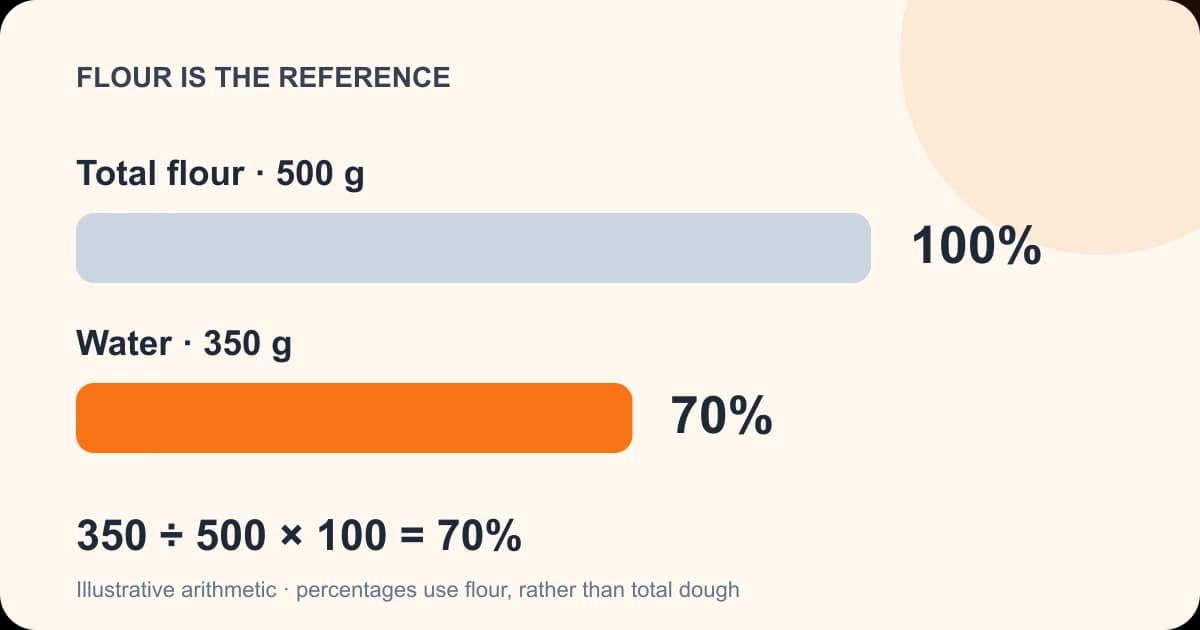
Baker’s percentage = ingredient weight ÷ total flour weight × 100. Flour is the 100% reference. For example, 350 g water with 500 g total flour is 70%, regardless of the total dough weight. [1]
Flour stays at 100%
Baker’s percentages use flour as the common denominator. They are not parts of a total that must sum to 100%. For 500 g flour, 350 g water and 10 g salt, the respective baker’s percentages are 100%, 70% and 2%. Their sum is 172%, which is expected. [1]
Add the flour weights before dividing
Illustrative example: 400 g white flour plus 100 g whole-wheat flour makes 500 g total flour. With 400 g water, the calculation is 400 ÷ 500 × 100 = 80%. Dividing by only the white flour would incorrectly describe that complete formula as 100%. [1]
Keep the same recipe scope
For a complete dough formula, include the flour and water supplied by a preferment in the corresponding totals. Do not combine total dough water with only the flour added at the final mixing stage. If you do not know the preferment’s composition, this tool cannot infer it. [3]
Water percentage describes hydration, with limits
When the ingredient is water, the flour-based percentage is commonly called hydration. Recipes can exceed 100% hydration. The number does not determine handling on its own: flour type and other ingredients affect how a dough behaves. This calculator supplies arithmetic, rather than a target hydration. [2]
Read the rounding and scale consistently
Doubling both known masses leaves the ratio unchanged: 350 ÷ 500 and 700 ÷ 1,000 both give 70.00%. For an exact halfway example, 1.01 g ÷ 200 g × 100 = 0.505%, displayed as 0.51%. These are illustrative calculations, rather than recipes.
Zero ingredient weight gives 0.00%. A blank means unknown, rather than zero. A positive value smaller than the display resolution may also round to 0.00%; keep the original weights if that distinction matters.
Enter weights and share the clean page
Enter plain decimal-point numbers in grams. Ingredient weight accepts 0 to 100,000; flour accepts 0.01 to 100,000. These software limits are not recipe targets. Unit text, fractions, scientific notation and comma separators are rejected.
Calculation runs in your browser without an account. Reset or reload clears the entry. Share uses the page address without the weights or result; the optional recently-used list stores a tool identifier rather than your recipe values.
Formula and assumptions
- Formula
- Ingredient percentage = ingredient weight (g) ÷ total flour weight (g) × 100 [1]
- Version
- Baker's ingredient percentage, ingredient-over-total-flour-percent-v1
- Rounding
- Use exact decimal fractions, then round once to two decimals; nonnegative halfway values round upward. Percentages greater than 100 are permitted.
- Worked example
- Illustrative example: 350 g water with 500 g total flour gives 350 ÷ 500 × 100 = 70.00%. If the ingredient is 10 g salt with the same flour, its baker’s percentage is 2.00%. Each ingredient uses the same flour denominator. [1]
Who this is for — and when not to use it
Intended use
Express one known ingredient mass relative to the total flour mass in the same recipe scope. Check flour-based percentages in a written baking formula.
Not intended for
Recommend a recipe, target hydration, salt intake, serving size or nutrient intake. Determine dough texture, fermentation time, baking temperature or food safety. Convert cups or spoons to grams, or infer unknown preferment composition.
Exclusions
- Missing flour weight or zero flour denominator.
- Volume inputs, mixed measurement units or unknown ingredient composition.
Evidence sources
- 1. Baker’s percentage — King Arthur Baking: professional reference. Accessed Oct 9, 2026.
- 2. What is bread hydration? — King Arthur Baking. Accessed Oct 9, 2026.
- 3. What is baker’s math, and how can I use it in everyday bread baking? — Martin Philip, King Arthur Baking. Accessed Oct 9, 2026.