
What this result means
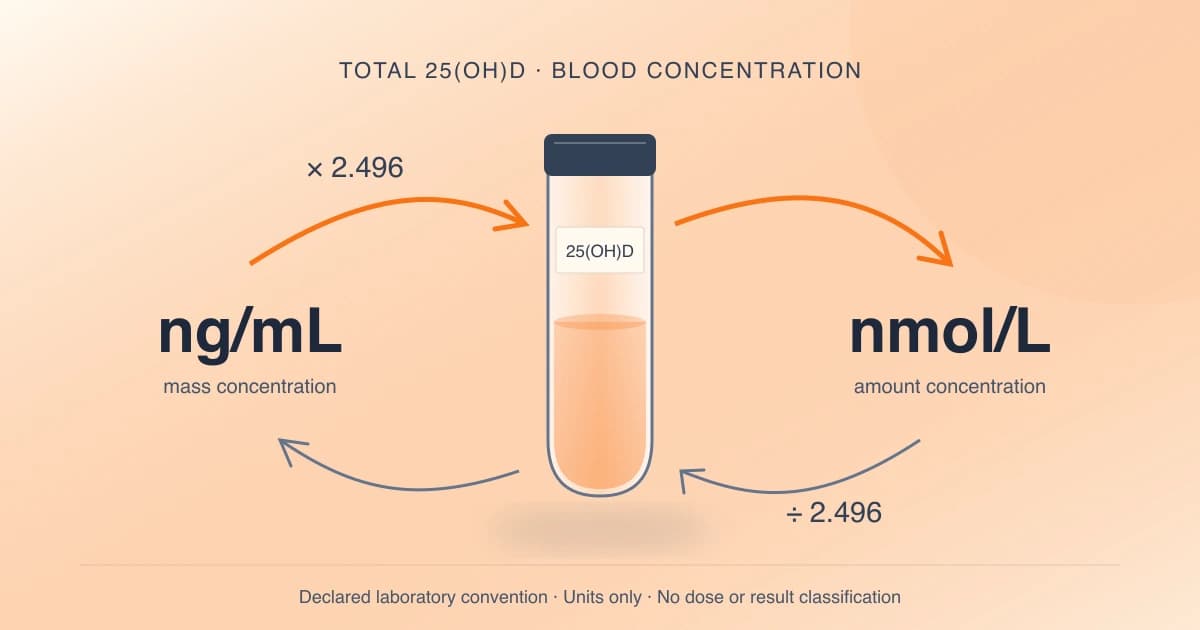
For a reported total 25-hydroxyvitamin D blood result, multiply ng/mL by 2.496 to get nmol/L. Divide nmol/L by 2.496 to reverse it. This page uses Mayo Clinic Laboratories’ published total-result convention and rounds once to two decimals. [1]
Why this tool uses 2.496
Mayo publishes 2.496 for total 25-hydroxyvitamin D. CDC’s NHANES note gives 2.4959 for total 25(OH)D and a different factor for individual D2. These are declared laboratory conventions; this tool does not apply its total-result factor to individual D2. [1][2]
A rounded 2.5 convention can give a slightly different number: 20 ng/mL becomes 50.00 nmol/L with 2.5, and 49.92 here. The difference comes from arithmetic convention, not a new measurement or a change in your vitamin D status.
Check the complete test name
Use an existing total 25-hydroxyvitamin D result, also written total 25(OH)D. Individual D2, individual D3 and 1,25-dihydroxyvitamin D are separate reported quantities. Identical-looking units do not make those tests interchangeable. [1][2]
This page does not add separate D2 and D3 mass concentrations. Keep the laboratory’s reported total result and method. Converting units cannot correct differences between assays. [2]
Preserve the original precision
The calculator rounds once to two decimals using the exact reciprocal in the reverse direction. A real zero displays 0.00. A positive result below the display resolution shows less than 0.01, preserving the distinction from zero.
Two displayed decimals do not mean the laboratory measured that precisely. A report marked less than or greater than contains a reporting limit, not an exact value; inequality entries are rejected.
Blood concentrations and supplement amounts differ
A blood concentration describes an amount per volume. A supplement amount in IU or micrograms is a different quantity. No arithmetic on this page can turn a blood result into a supplement dose.
Enter the number alone
Choose the report’s unit and use a decimal point. Blank, negative and above-limit entries are rejected, as are unit text, inequalities, commas, fractions, scientific notation and non-finite values. The maximum input is a software limit, without clinical meaning.
Share the page without sharing your result
No account is required. Values stay in browser memory. Reset or reload clears the entry, and Share uses the clean page address. The optional recently-used list retains a tool identifier rather than your blood value.
Formula and assumptions
- Version
- Total 25-hydroxyvitamin D blood concentration conversion, total-25ohd-ngml-nmoll-2-496-v1
- Rounding
- Use 312/125 or its exact reciprocal 125/312; round once to two decimals with halfway ties upward. Tiny positive results display a less-than sign.
- Worked example
- Arithmetic example only: 20.00 ng/mL × 2.496 = 49.92 nmol/L. Dividing 49.92 by 2.496 returns 20.00 ng/mL. These values demonstrate the conversion, not a normal interval or a treatment target. [1]
Who this is for — and when not to use it
Intended use
Convert the units of an already reported total 25(OH)D blood concentration. Show arithmetic under the explicitly declared 2.496 convention.
Not intended for
Classify deficiency, adequacy, toxicity or a personal target. Calculate supplement amounts, IU, micrograms or a dose. Convert individual 25(OH)D2, 1,25-dihydroxyvitamin D or other analytes. Combine separate D2 and D3 mass values or harmonize assay methods.
Exclusions
- Reports using another analyte, specimen or unit.
- Inequalities, text, missing values and results outside the technical input limits.
Evidence sources
- 1. International System of Units conversion: 25-Hydroxy D Total — Mayo Clinic Laboratories. Accessed Oct 7, 2026.
- 2. Analytical note for 25-hydroxyvitamin D: conversion conventions — CDC, National Center for Health Statistics. Accessed Oct 7, 2026.