
The six most useful things to know
- 25-hydroxy vitamin D reflects the body’s main circulating reservoir and is the preferred initial test for vitamin D status.See reference 1,See reference 2,See reference 3
- 1,25-dihydroxy vitamin D is the active hormone. Being active does not make it the better screening test.See reference 1,See reference 2,See reference 3
- The kidneys perform most conversion to calcitriol, while PTH, calcium, phosphate and other regulators influence production and breakdown.See reference 1,See reference 3
- A normal or high calcitriol result does not prove vitamin D stores are adequate.See reference 1,See reference 2
- High or low results are patterns, not diagnoses. The paired laboratory results and clinical reason for testing are essential.See reference 1,See reference 2,See reference 3
- Do not change vitamin D or calcium supplements from a calcitriol result alone.See reference 1,See reference 2
25-hydroxy versus 1,25-dihydroxy vitamin D
- Feature
- Main biological role in testing
- 25-hydroxy vitamin D [25(OH)D]
- Reservoir and transport form used to assess stores/status
- 1,25-dihydroxy vitamin D [1,25(OH)2D]
- Active hormone used for selected regulation questionsSee reference 1,See reference 2,See reference 3
- Feature
- Routine deficiency assessment
- 25-hydroxy vitamin D [25(OH)D]
- Preferred initial test when testing is clinically indicated
- 1,25-dihydroxy vitamin D [1,25(OH)2D]
- Not an accurate measure of storesSee reference 1,See reference 2
- Feature
- Where it fits in the pathway
- 25-hydroxy vitamin D [25(OH)D]
- Formed after liver hydroxylation and circulates as the main reservoir
- 1,25-dihydroxy vitamin D [1,25(OH)2D]
- Produced mainly by kidney 1-alpha-hydroxylase from 25(OH)DSee reference 1,See reference 2,See reference 3
- Feature
- Typical interpretation context
- 25-hydroxy vitamin D [25(OH)D]
- Intake, absorption, synthesis, supplements and overall stores
- 1,25-dihydroxy vitamin D [1,25(OH)2D]
- Kidney function, PTH, calcium, phosphate and extra-renal productionSee reference 1,See reference 2,See reference 3
Why the active hormone can misrepresent vitamin D stores
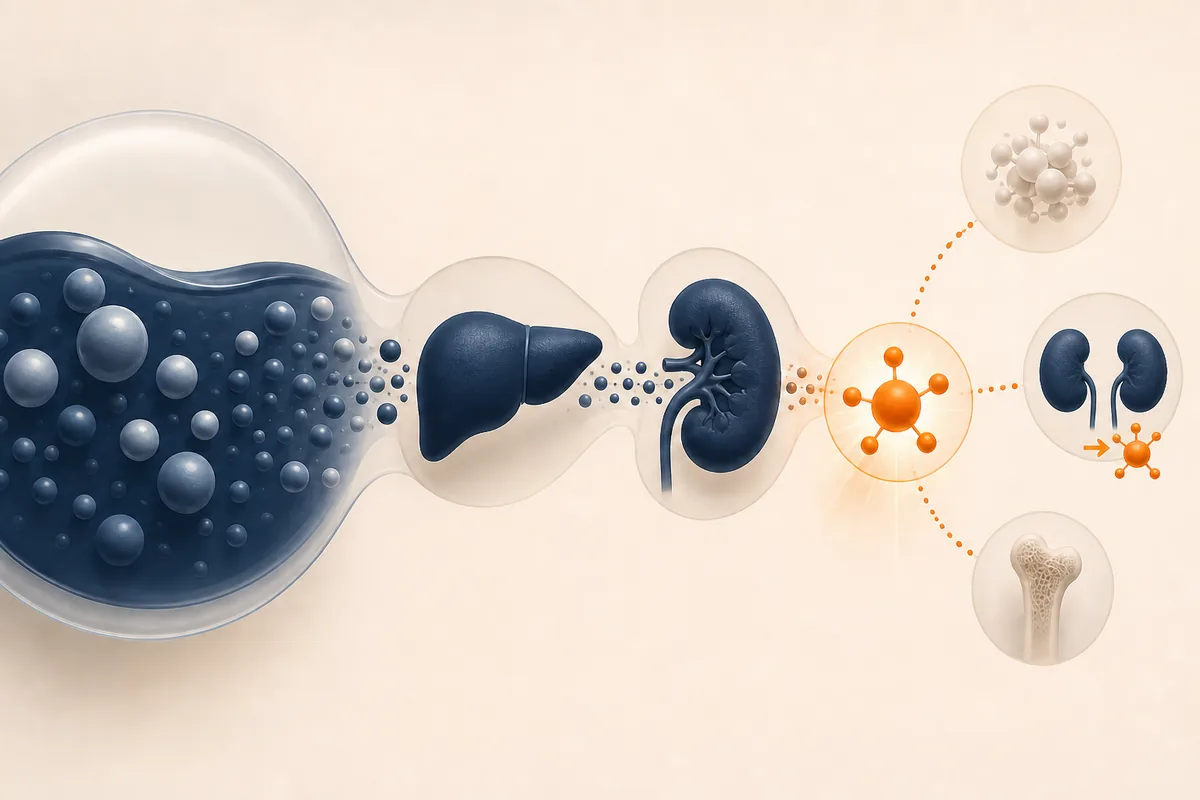
Vitamin D from skin synthesis, food or supplements is processed first into 25(OH)D, the more abundant circulating reservoir. A smaller fraction is converted into 1,25(OH)2D, mainly in the kidneys. Calcitriol then acts as a hormone in mineral regulation. Its concentration is controlled, rather than simply tracking how much vitamin D is stored.See reference 1,See reference 2,See reference 3
This control system can increase conversion when calcium balance or PTH signals demand it. As a result, calcitriol may remain within range—or become elevated—while 25(OH)D is low. The reverse can occur when kidney activation is impaired. That is why the two tests answer different questions.See reference 1,See reference 2,See reference 3
When calcitriol testing can add useful information
- Clinical question
- Confirmed high calcium with suppressed PTH
- Why calcitriol may help
- Can support investigation of PTH-independent calcitriol production
- What else is needed
- Repeat/confirmed calcium, albumin or ionized calcium, PTH, kidney function and the wider cause-specific workupSee reference 1,See reference 2
- Clinical question
- Selected chronic kidney disease or mineral-bone questions
- Why calcitriol may help
- Kidney activation may be reduced and treatment context can alter the result
- What else is needed
- eGFR or creatinine, calcium, phosphate, PTH, alkaline phosphatase and 25(OH)DSee reference 1,See reference 2,See reference 3
- Clinical question
- Rickets, osteomalacia or inherited phosphate/vitamin D dysregulation
- Why calcitriol may help
- The active hormone pattern can help distinguish mechanisms
- What else is needed
- Age-specific clinical assessment, phosphate handling, PTH, kidney function, genetics or specialist testing as appropriateSee reference 1,See reference 3
- Clinical question
- Suspected granulomatous disease or certain malignancy-related calcium disorders
- Why calcitriol may help
- Some tissues can produce calcitriol outside normal kidney control
- What else is needed
- The result supports a cause-specific investigation; it does not identify the disease by itselfSee reference 1,See reference 2
A context-first way to read the result
- Pattern
- Low calcitriol
- Examples that may fit
- Reduced kidney activation, hypoparathyroid physiology or selected inherited/metabolic disorders
- Important limitation
- Does not identify the cause; kidney function, PTH, calcium, phosphate and 25(OH)D are neededSee reference 1,See reference 2
- Pattern
- High calcitriol
- Examples that may fit
- PTH-driven production, granulomatous production or selected malignancy and inherited contexts
- Important limitation
- Does not diagnose sarcoidosis, cancer or hyperparathyroidismSee reference 1,See reference 2
- Pattern
- Calcitriol in range with low 25(OH)D
- Examples that may fit
- Regulation can preserve the active hormone despite reduced stores
- Important limitation
- An in-range calcitriol value does not cancel a low 25(OH)D resultSee reference 1,See reference 2,See reference 3
- Pattern
- Unexpected or discordant pattern
- Examples that may fit
- Timing, supplements or medicines, assay differences and the underlying calcium-phosphate state
- Important limitation
- Repeat testing is useful only when it will answer a defined clinical questionSee reference 1,See reference 2,See reference 3
Use the range and method on your own report
Calcitriol may be reported in pg/mL or pmol/L, and reference intervals can vary by age, sex, assay and laboratory. Do not compare the number with a 25(OH)D range: these are different molecules, measured at very different concentrations, for different clinical purposes.See reference 1,See reference 2,See reference 3
Mayo’s current test catalog, for example, lists different adult intervals for males and females and uses liquid chromatography-tandem mass spectrometry. This illustrates why an online range should not replace the interval printed by the laboratory that measured the sample. If a converted value is needed, use the laboratory’s validated conversion or ask the reporting service.See reference 2,See reference 3
Do not use calcitriol alone to change vitamin D or calcium intake
Calcitriol is not a vitamin D store meter, and an in-range result does not make extra vitamin D automatically safe. Excess vitamin D or prescribed active vitamin D can disturb calcium balance. Review the exact test, 25(OH)D, calcium, kidney function, PTH, current supplements and prescriptions with a clinician or pharmacist before changing a dose.See reference 1,See reference 2
Questions that make the result more useful
- Was calcitriol intentionally ordered, or was the intended test 25-hydroxy vitamin D?See reference 1,See reference 2
- What were calcium, phosphate, PTH, creatinine or eGFR, and 25(OH)D at the same time?See reference 1,See reference 2,See reference 3
- Which laboratory method, units and age-appropriate interval apply?See reference 2,See reference 3
- Could prescribed calcitriol, vitamin D, calcium or another medicine affect the interpretation?See reference 1,See reference 2
- Will this result change a defined clinical decision, or is another test more direct?See reference 1,See reference 3
Common questions about calcitriol testing
Is 1,25-dihydroxy vitamin D the same as vitamin D?
It is the active hormone made from 25-hydroxy vitamin D. In everyday language both may be called vitamin D, but the blood tests measure different metabolites and answer different questions.See reference 1,See reference 2,See reference 3
Which test checks for vitamin D deficiency?
When testing is clinically indicated, 25-hydroxy vitamin D is the preferred initial measure of stores/status. Calcitriol is not the routine deficiency test.See reference 1,See reference 2
Can calcitriol be high when 25-hydroxy vitamin D is low?
Yes. Hormonal regulation can increase conversion to the active form even when the reservoir is low. The paired calcium, phosphate, PTH and kidney results help explain the pattern.See reference 1,See reference 2,See reference 3
Does high calcitriol mean sarcoidosis?
No. Granulomatous disease is one possible context, but hyperparathyroid states, certain malignancies and other causes can also fit. The result cannot identify a disease on its own.See reference 1,See reference 2
Why does my range differ from a range online?
Age, sex, assay, units and laboratory validation can differ. Use the interval on the original report and confirm that you are comparing calcitriol with calcitriol—not with 25-hydroxy vitamin D.See reference 2,See reference 3
Get the weekly longevity brief
The week's best longevity research in plain English. Free, every Tuesday.
See your blood results in context
If you already have blood test results, the paid LongevityMate app can help you view related markers together. It provides educational context, not a diagnosis or a replacement for your clinician.
Explore blood test analysisReferences
- 1. Hypercalcemia and Hypocalcemia – Vitamin D Testing
ARUP ConsultOfficial guidance
- 2. 1,25-Dihydroxyvitamin D, Serum (DHVD)
Mayo Clinic LaboratoriesOfficial guidance
- 3. Assessing vitamin D metabolism – four decades of experience
Clinical Chemistry and Laboratory MedicineEvidence review
Editorial transparency
- Published by
- LongevityMate Editorial Team
- Published
- Updated
Medical disclaimer
This page provides general education, not diagnosis or personal supplement advice. A 1,25-dihydroxy vitamin D result must be interpreted with the reporting laboratory’s interval, related mineral and kidney results, medicines and the reason for testing. Do not change vitamin D, calcium or prescribed calcitriol without the responsible clinician.