
Six points that prevent most interpretation mistakes
- 11-Deoxycortisol is a cortisol precursor, not another name for cortisol and not the same molecule as 11-deoxycorticosterone.See reference 1,See reference 2
- The collection context—baseline, after ACTH, or after metyrapone—changes what the number is expected to do.See reference 1,See reference 3
- An elevated result can occur when the CYP11B1 step is impaired or when ACTH is driving adrenal steroid production, but it does not identify the cause by itself.See reference 1,See reference 2
- A baseline result that is not elevated does not always exclude 11-beta-hydroxylase deficiency; specialist-directed stimulation testing may be needed.See reference 1
- Reference intervals and challenge-test thresholds are method and protocol specific. Start with the interval printed beside the result.See reference 1,See reference 3
- Metyrapone testing can cause clinically important cortisol deficiency and belongs in supervised care—not self-testing.See reference 1,See reference 3
What 11-deoxycortisol measures
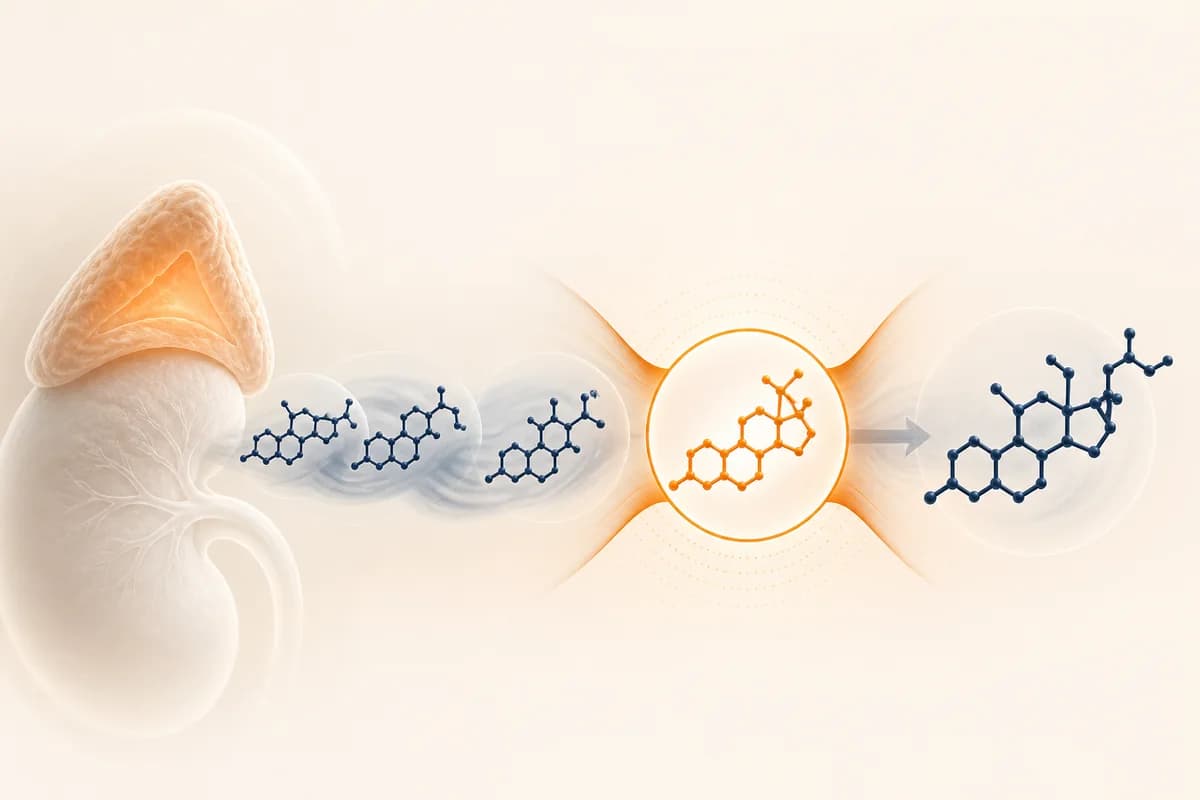
The adrenal cortex builds cortisol through a chain of enzyme-controlled steps. In the final step, the enzyme 11-beta-hydroxylase, encoded by CYP11B1, converts 11-deoxycortisol into cortisol. That makes 11-deoxycortisol a useful upstream marker: it may accumulate when the conversion step is impaired, and it may rise when ACTH signals the adrenal gland to make more steroid.See reference 1,See reference 2
This pathway explains why the result is never read in isolation. Low cortisol can increase pituitary ACTH, which then increases precursor production. Other adrenal steroids help show where the pathway may be altered, while blood pressure, electrolytes and androgen-related findings can supply clinical context in suspected congenital adrenal hyperplasia.See reference 2
First identify which test you actually had
- Collection context
- Baseline serum sample
- What clinicians are assessing
- Whether the precursor is elevated before a stimulation or blocking medicine
- Safe reading rule
- Use the laboratory’s baseline interval; do not compare it with a stimulated thresholdSee reference 1,See reference 2
- Collection context
- After ACTH (cosyntropin)
- What clinicians are assessing
- How adrenal steroid production responds to ACTH; this can reveal a rise not seen at baseline
- Safe reading rule
- Timing and the complete steroid pattern matter more than one isolated valueSee reference 1
- Collection context
- After metyrapone
- What clinicians are assessing
- Whether lowering cortisol triggers ACTH and a rise in 11-deoxycortisol across the HPA axis
- Safe reading rule
- Use only the supervising protocol’s timing and decision limitsSee reference 1,See reference 3
What high, in-range or low results can—and cannot—suggest
- Result pattern
- High at baseline
- Possible context
- Can be seen with 11-beta-hydroxylase deficiency or ACTH-driven steroid production
- What it does not prove
- Does not diagnose CAH, locate an ACTH source or diagnose Cushing syndromeSee reference 1,See reference 2
- Result pattern
- Not elevated at baseline
- Possible context
- May be reassuring in the right setting, but some affected people show the abnormality only after ACTH
- What it does not prove
- Does not always exclude 11-beta-hydroxylase deficiencySee reference 1
- Result pattern
- Lower-than-expected rise after metyrapone
- Possible context
- Can indicate an inadequate HPA-axis response when protocol validity is confirmed
- What it does not prove
- Does not reliably distinguish primary from central adrenal failure by itselfSee reference 1,See reference 3
- Result pattern
- Low isolated baseline value
- Possible context
- Often has limited meaning outside a defined protocol
- What it does not prove
- Does not independently diagnose adrenal insufficiencySee reference 1,See reference 3
Why there is no single universal 11-deoxycortisol range
Intervals depend on age, assay, laboratory and collection context. As one method-specific example, Mayo Clinic Laboratories currently lists 10–79 ng/dL for adults older than 18 years on its baseline serum assay. That number is not a target for every laboratory and must not be applied to an ACTH- or metyrapone-stimulated sample.See reference 1
Mayo’s overnight metyrapone interpretation also uses a result below 1,700 ng/dL at eight hours as evidence of a likely inadequate response. That threshold belongs to the stated assay and protocol. Another service may use different timing, units, assay calibration or a combined cortisol/ACTH rule. The safest comparison is the protocol printed on the request or report.See reference 1,See reference 3
Metyrapone testing requires clinical supervision
Metyrapone deliberately blocks cortisol production and can precipitate clinically important adrenal insufficiency; adrenal crises have been reported. Do not take metyrapone or try to reproduce a stimulation protocol from this guide. If severe weakness, repeated vomiting, confusion, fainting or collapse occurs during an adrenal evaluation, follow the supervising team’s emergency plan or seek urgent medical care.See reference 1,See reference 3
Questions to take to the ordering clinician
- Was this a baseline sample, an ACTH-stimulated sample or a metyrapone sample?See reference 1
- Which assay, units and collection-specific interval should be used?See reference 1
- Which cortisol, ACTH and related steroid results were collected at the same time?See reference 1,See reference 2
- Could a medicine, pregnancy or the timing of collection have changed the response?See reference 1
- Is repeat or stimulation testing actually needed, and who will supervise it?See reference 1,See reference 3
Common questions about 11-deoxycortisol
Is Compound S the same as 11-deoxycortisol?
Yes. Compound S is an established alternate name for 11-deoxycortisol, the immediate precursor of cortisol.See reference 1
Does high 11-deoxycortisol mean I have congenital adrenal hyperplasia?
No. A high value can support that investigation, especially for 11-beta-hydroxylase deficiency, but ACTH-driven conditions, the collection protocol and other steroids must be considered. Diagnosis requires the full clinical and biochemical assessment.See reference 1,See reference 2
Can a normal baseline result rule out 11-beta-hydroxylase deficiency?
Not always. Mayo’s interpretive guidance notes that some affected people show an increase only after ACTH stimulation. Whether that test is appropriate is a specialist decision.See reference 1
Why is my laboratory range different from an online range?
Laboratories can use different methods, populations, units and collection protocols. Use the interval attached to the original result and make sure it matches baseline or stimulated testing.See reference 1,See reference 3
Does a low 11-deoxycortisol result mean adrenal insufficiency?
An isolated low baseline value does not establish adrenal insufficiency. In a supervised metyrapone protocol, an inadequate rise can contribute to the assessment, but cortisol, ACTH, timing and protocol validity are also required.See reference 1,See reference 3
Get the weekly longevity brief
The week's best longevity research in plain English. Free, every Tuesday.
See your blood results in context
If you already have blood test results, the paid LongevityMate app can help you view related markers together. It provides educational context, not a diagnosis or a replacement for your clinician.
Explore blood test analysisReferences
- 1. 11-Deoxycortisol, Serum (DCORT)
Mayo Clinic LaboratoriesOfficial guidance
- 2. Congenital Adrenal Hyperplasia
Endotext, NCBI BookshelfEvidence review
- 3. Endocrine Testing Protocols: Hypothalamic Pituitary Adrenal Axis
Endotext, NCBI BookshelfEvidence review
Editorial transparency
- Published by
- LongevityMate Editorial Team
- Published
- Updated
Medical disclaimer
This page provides general education and does not diagnose a condition, replace the ordering clinician’s interpretation or provide a metyrapone or ACTH-testing protocol. Reference intervals and challenge thresholds are laboratory- and protocol-specific. Seek urgent care for severe or rapidly worsening symptoms.