
What the measurement represents
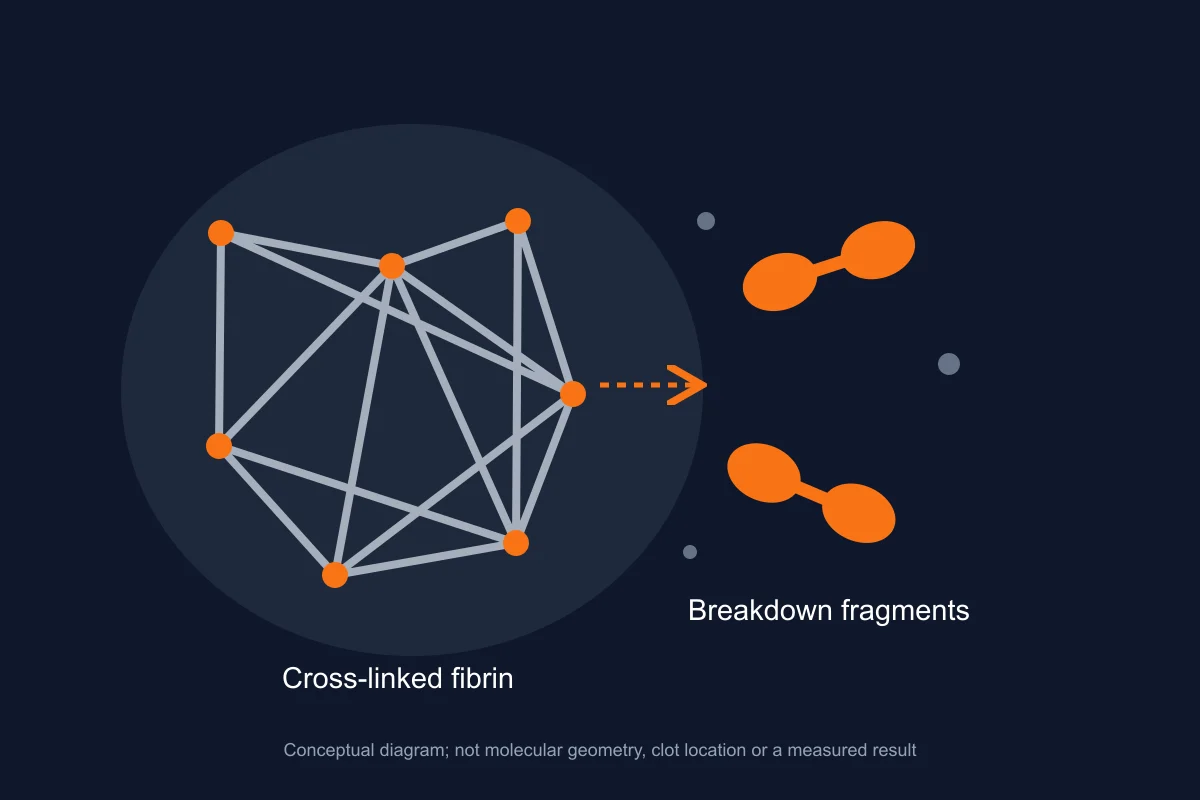
The assay looks for fragments arising from breakdown of cross-linked fibrin, part of the clot structure. D-dimer is a particular marker; a broader fibrin-degradation-products test should not automatically be treated as the same assay.See reference 5
It is also different from PT/INR, which concerns how long a sample takes to clot. A breakdown marker and a clotting-time test cannot replace one another. No clot location or personal risk percentage can be read from this page’s conceptual illustration.See reference 1,See reference 6
A result has more than one possible meaning
- Finding or context
- Raised D-dimer
- Useful point
- May accompany a clotting problem.
- Limit
- Cannot establish the diagnosis or location alone.See reference 1
- Finding or context
- Pregnancy, older age or recent surgery
- Useful point
- Can contribute to a raised result.
- Limit
- The number is not specific to a new clot.See reference 1
- Finding or context
- A low result
- Useful point
- May help within a suitable clinical assessment.
- Limit
- Must not be used alone to exclude an event.See reference 2
- Finding or context
- Different assay or units
- Useful point
- Can change the reported number and cutoff.
- Limit
- Raw numbers may not be directly comparable.See reference 2
Why a low number is not a self-clearance result
Quest’s clinical explanation explicitly cautions against excluding a thromboembolic event solely from D-dimer. The usefulness of a negative result depends on the population and assessment in which the test is used. A low value is not permission to dismiss symptoms or delay an already recommended evaluation.See reference 2
NICE places D-dimer within clinician-led diagnostic pathways. It also discusses age-adjusted thresholds in selected adults, but that does not create one universal number for every laboratory and situation. This guide supplies no cutoff, age-adjustment formula or rule-out instruction.See reference 3
FEU, DDU and the concentration unit all belong with the result
Laboratories can report fibrinogen-equivalent units (FEU) or D-dimer units (DDU). These express different reporting bases. The report may also use a concentration unit such as µg/mL, ng/mL or µg/L. A bare number loses important information.See reference 2
FEU/DDU differences are not solved by treating the label as decoration. Keep the complete unit, assay and laboratory decision limit together. This page does not provide a universal FEU-to-DDU conversion or transfer a cutoff from one method to another.See reference 2
What to retain from the report
Save the original test name, number, full unit, FEU or DDU wording if present, laboratory limit and collection date. Laboratory methods and reference information can differ. A flag identifies how the report compares with its own reference information; it does not explain the cause.See reference 4
If a previous result used another assay or reporting basis, ask whether comparison is appropriate before calling the change a trend. Missing units should be clarified with the laboratory or ordering service rather than guessed.See reference 4
Questions that clarify the result
- What clinical question was the test ordered to answer?
- What assay and reporting basis does this laboratory use?
- Is the printed limit appropriate to this assessment?
- What next step has the ordering clinician recommended?
Common questions
Does high D-dimer always mean a blood clot?
No. A raised result is not specific and needs clinical context; further assessment may be needed.See reference 1
Can I compare two numbers with different FEU/DDU labels?
Do not compare the raw numbers as if the reporting bases were the same. Keep the assay, complete unit and laboratory limit with each result.See reference 2
Is D-dimer a wellness target to lower?
This guide sets no wellness target. The test supports specific clinical questions rather than a personal optimization score.See reference 1,See reference 3
Get the weekly longevity brief
The week's best longevity research in plain English. Free, every Tuesday.
See your blood results in context
If you already have blood test results, the paid LongevityMate app can help you view related markers together. It provides educational context, not a diagnosis or a replacement for your clinician.
Explore blood test analysisReferences
- 1. D-Dimer Test
MedlinePlus, U.S. National Library of MedicineOfficial guidance
- 2. D-Dimer: clinical education FAQ
Quest DiagnosticsOfficial guidance
- 3. Venous thromboembolic diseases: diagnosis, management and thrombophilia testing, recommendations
National Institute for Health and Care ExcellenceGuideline
- 4. How to Understand Your Lab Results
MedlinePlus, U.S. National Library of MedicineOfficial guidance
- 5. D-Dimer, Plasma: clinical information and assay method
Mayo Clinic LaboratoriesOfficial guidance
- 6. Prothrombin Time Test and INR (PT/INR)
MedlinePlus, U.S. National Library of MedicineOfficial guidance
Editorial transparency
- Published by
- LongevityMate Editorial
- Published
- Updated
Medical disclaimer
General education only. This guide does not diagnose a condition, interpret your personal result, choose a treatment or recommend a supplement dose. Discuss testing, symptoms, medicines and supplements with a qualified health professional.