
Why a clinician might order DHT
Specialist testing may investigate selected disorders of androgen metabolism or sexual development, or monitor a defined treatment question. Labcorp describes contexts in which DHT is considered with testosterone. Those uses do not make this a general screening test for everyone concerned about hair or ageing.See reference 1,See reference 2
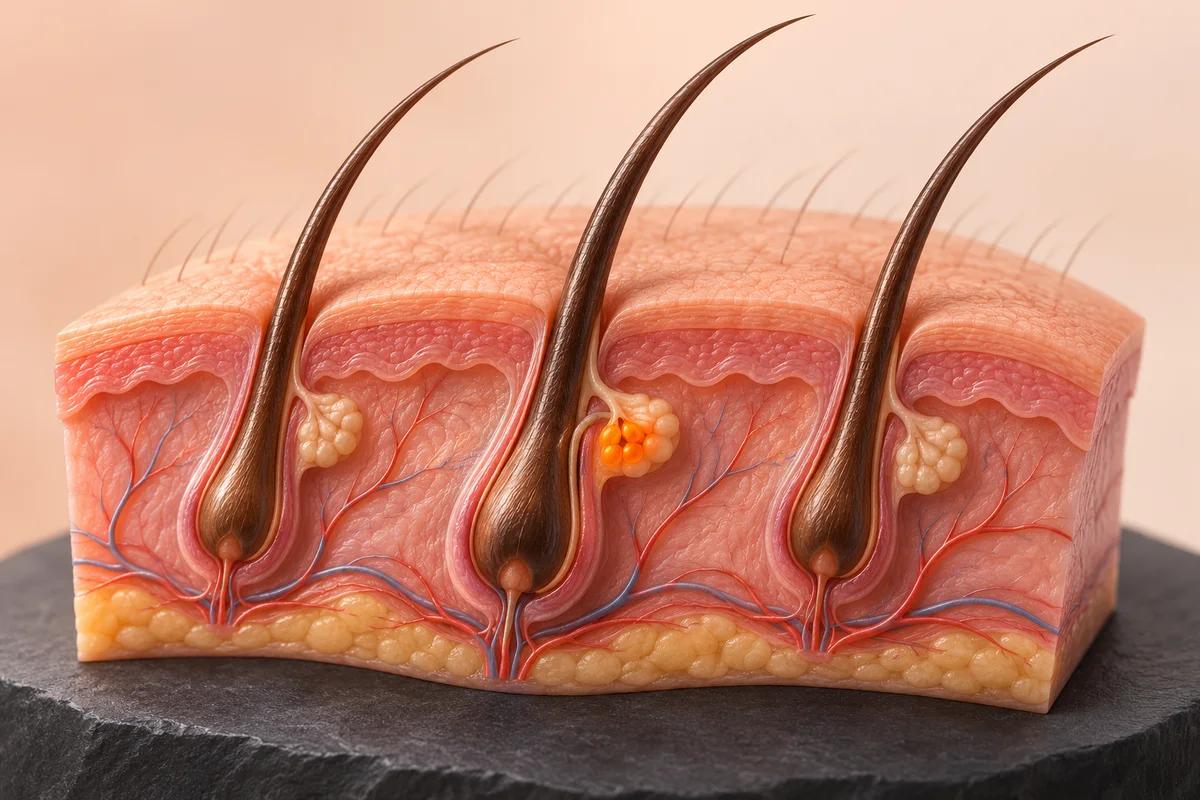
Keep DHT separate from total testosterone and free testosterone. They are different reported measurements. The scalp illustration represents one tissue context; the orange accent is a visual emphasis, not a map of measured DHT or a sign of disease.See reference 1
Four details that belong with the number
- Report detail
- Exact analyte and method
- Why it matters
- DHT is distinct from testosterone, and assays have their own performance.
- Useful question
- Which assay produced this result?See reference 1,See reference 2
- Report detail
- Age, sex and relevant developmental context
- Why it matters
- The performing laboratory may supply different comparison intervals.
- Useful question
- Is this the interval intended for this report?See reference 1
- Report detail
- Medicines and treatment timing
- Why it matters
- 5-alpha-reductase inhibitors can lower circulating DHT.
- Useful question
- Was an effect of prescribed treatment expected?See reference 1,See reference 2
- Report detail
- Unit and collection date
- Why it matters
- A different numerical scale or time point can create an apparent change.
- Useful question
- Are the older and newer results comparable?See reference 2,See reference 4
Read the laboratory interval, not a universal target
An interval describes results in a laboratory’s reference population under its method. A report flag needs the test purpose and the rest of the assessment. Do not copy a testosterone interval beside DHT, or use a child’s developmental interval for an adult.See reference 1,See reference 4
DHT may be reported in pg/mL or ng/dL. For the same analyte, 100 pg/mL equals 10 ng/dL. This changes the numerical scale only: it cannot convert total into free DHT, predict tissue exposure or select a treatment.See reference 1,See reference 2
Why the result cannot grade hair loss or prostate disease
Mayo cautions that serum DHT does not directly reflect peripheral androgen action, and that people with benign prostate enlargement or prostate cancer may not have an elevated circulating result. A number within its interval cannot provide reassurance about those conditions.See reference 1
The American Academy of Dermatology describes hair-loss assessment as a history and examination, with additional tests when a possible cause calls for them. A serum DHT result does not replace examination of the scalp or identify all causes of shedding.See reference 3
A medicine effect is not an instruction to change it
Finasteride and other 5-alpha-reductase inhibitors reduce conversion of testosterone to DHT. A lower value during treatment may reflect that action. Whether to start, stop or change a medicine depends on the clinical aim, benefits and adverse effects; the laboratory flag alone does not make that decision.See reference 1,See reference 2
Keep a medicine and supplement list, the complete report and any previous assay details. Follow the laboratory’s collection instructions. Ask what the test was expected to clarify and how its result changes, or does not change, the clinician’s assessment.See reference 2,See reference 4
Common questions
Does high serum DHT prove androgen-related hair loss?
No. Circulating concentration and local tissue action are different, and hair loss has multiple possible causes. Assessment of the pattern and scalp remains important.See reference 1,See reference 3
Does low DHT prove an enzyme disorder?
No. Medicines and the wider hormonal context matter. Specialist investigation may compare other hormones; this guide does not provide a diagnostic ratio or cutoff.See reference 1,See reference 2
Can I use DHT as a prostate cancer test?
No. Mayo specifically cautions that prostate cancer may occur without an elevated DHT concentration. A DHT result cannot establish or exclude that diagnosis.See reference 1
Get the weekly longevity brief
The week's best longevity research in plain English. Free, every Tuesday.
See your blood results in context
If you already have blood test results, the paid LongevityMate app can help you view related markers together. It provides educational context, not a diagnosis or a replacement for your clinician.
Explore blood test analysisReferences
- 1. Dihydrotestosterone, Serum
Mayo Clinic LaboratoriesOfficial guidance
- 2. Dihydrotestosterone (DHT), Endocrine Sciences, test 500142
LabcorpOfficial guidance
- 3. Hair loss: Diagnosis and treatment
American Academy of DermatologyOfficial guidance
- 4. How to Understand Your Lab Results
MedlinePlus, U.S. National Library of MedicineOfficial guidance
Editorial transparency
- Published by
- LongevityMate Editorial
- Reviewed by
- Editorial evidence review (AI-assisted)
- Published
- Updated
Medical disclaimer
General education only. This guide does not diagnose a condition, interpret your personal result, choose treatment or recommend a medicine or supplement dose. A qualified health professional can interpret the full report in context.