
The short answer
RDW describes variation, not average cell size
Red cell distribution width measures the spread of red blood cell sizes in a blood sample. RDW-CV is reported as a percentage; MCV describes average cell volume. A wider spread does not identify its cause, and a normal RDW does not rule out anaemia.See reference 1,See reference 2,See reference 4
What the RDW percentage means
CV means coefficient of variation, a statistical description of spread relative to the average. It is not the percentage of red cells that are abnormal. The manufacturer’s analyser manual distinguishes this percentage measure from RDW-SD, a separate measure of distribution spread expressed in femtolitres (fL).See reference 4
Before interpreting the number, check the full label and unit: RDW-CV (%) and RDW-SD (fL) are not interchangeable. Keep each with its matching laboratory interval. This guide primarily explains the percentage result commonly called RDW or RDW-CV.See reference 1,See reference 4
Three related numbers answer different questions
- Measure
- RDW-CV (%)
- Question
- How variable are cell volumes relative to their average?
- Limit
- Does not count abnormal cells or identify a cause.See reference 4
- Measure
- RDW-SD (fL)
- Question
- How broad is the red-cell size distribution in volume units?
- Limit
- Not a unit conversion of the percentage result.See reference 4
- Measure
- MCV (fL)
- Question
- What is the average red-cell volume?
- Limit
- An average can hide a mixture of sizes.See reference 2,See reference 4
- Measure
- Haemoglobin
- Question
- How much oxygen-carrying protein is in the sample?
- Limit
- Needs interpretation with the rest of the blood count.See reference 3
Why an average can miss a mixed population
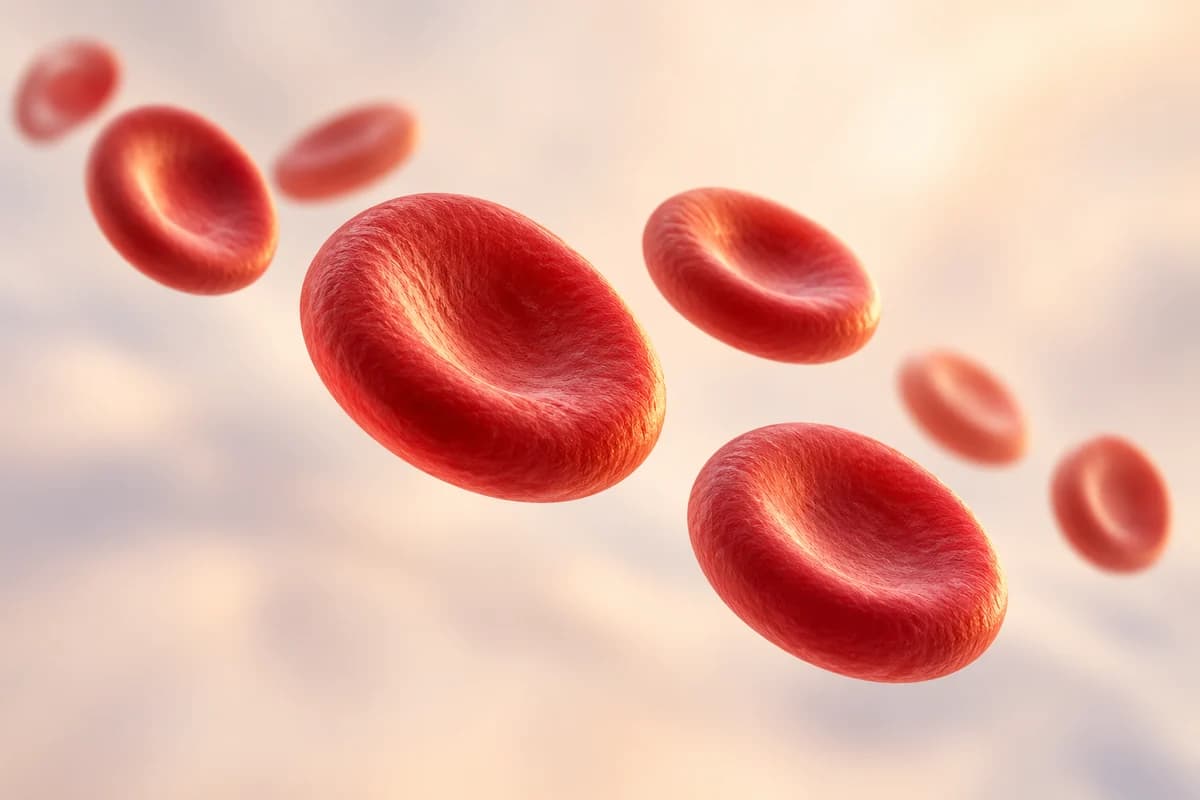
Imagine one group of objects clustered around a similar size and another containing both small and large objects. Their averages could be similar while their spread differs. That is an illustration of average versus variation, not a simulated blood report. The red cells in the artwork likewise illustrate size variation, without a diagnostic cut-off.
In a blood count, this distinction is why RDW and MCV are read together. A normal average volume cannot describe every cell, and neither measure alone diagnoses iron deficiency, vitamin deficiency or another cause of anaemia.See reference 1,See reference 2
How to understand a high, normal or low flag
A high RDW flag indicates greater size variation than the reporting laboratory’s interval. A normal result indicates variation within that interval, but the cells can still be uniformly smaller or larger than expected. A low flag indicates less variation and is not usually concerning on its own. These statements describe spread, not a diagnosis.See reference 1
The complete blood count adds red-cell count, haemoglobin, haematocrit and other measurements. A clinician combines the pattern with symptoms and history and may order additional testing. RDW does not select an iron supplement or establish that a nutrient is deficient.See reference 2,See reference 3
Keep the useful context
- Check whether the report says RDW-CV or RDW-SD and retain its units and reference interval.See reference 4
- Read the full blood count rather than reacting to one flagged item.See reference 3
- Bring the report and prior dates to a clinician when an abnormality is unexplained. The next step depends on the whole pattern, not a universal RDW target.See reference 1,See reference 3
Common questions
Is high RDW always iron deficiency?
No. RDW describes variation. It cannot identify iron deficiency by itself; the blood-count pattern and other assessment matter.See reference 1,See reference 2
Can I have anaemia with normal RDW?
Yes. Normal size variation does not rule out anaemia, including when cells are similarly small or large.See reference 1
Can I convert RDW-SD into RDW-CV?
They are different reported measures, not two units for the same number. Do not compare them as though a simple unit conversion makes them equivalent.See reference 4
Should I try to lower RDW for longevity?
The cited testing sources do not establish an RDW target that extends life. A report flag is a reason to understand the clinical context, not a stand-alone optimisation instruction.See reference 1,See reference 3
References
- 1. RDW (Red Cell Distribution Width)
MedlinePlus, U.S. National Library of MedicineOfficial guidance
- 2. MCV (Mean Corpuscular Volume)
MedlinePlus, U.S. National Library of MedicineOfficial guidance
- 3. Complete Blood Count (CBC)
MedlinePlus, U.S. National Library of MedicineOfficial guidance
- 4. DxH 900 Instructions for Use, Table 2.4: parameter derivation
Beckman CoulterOfficial guidance
Editorial transparency
- Published by
- LongevityMate Editorial
- Published
- Updated
Medical disclaimer
General education only. This guide does not diagnose a condition, interpret your personal result, choose a treatment or recommend a supplement dose. Discuss testing, symptoms, medicines and supplements with a qualified health professional.