
Check which part of blood was tested
- Specimen
- Serum
- What is in the sample
- The liquid separated after blood has clotted.
- Interpretation boundary
- Use the serum method and its matching interval.See reference 2
- Specimen
- Plasma
- What is in the sample
- The liquid fraction obtained when clotting is prevented.
- Interpretation boundary
- A plasma result needs the performing laboratory’s own instructions and interval.See reference 1
- Specimen
- Whole blood
- What is in the sample
- Fluid and blood cells together.
- Interpretation boundary
- It is a different specimen, not serum with a different label.See reference 1,See reference 3
Recent intake and longer-term status are different questions
NIH describes serum and plasma selenium as reflecting more recent intake, whereas whole blood, including red cells, provides information over a longer period. These are broad distinctions, not exact clocks. They do not show the selenium content of a particular meal or establish a daily dose from one concentration.See reference 1
The test chosen should fit the clinical question. Mayo’s serum catalogue describes monitoring selenium replacement, while its whole-blood catalogue describes assessment of tissue stores and points to serum when recent intake is the question. Those are examples of test purposes, not a recommendation that everyone needs screening.See reference 2,See reference 3
Trace-element testing depends on the sample
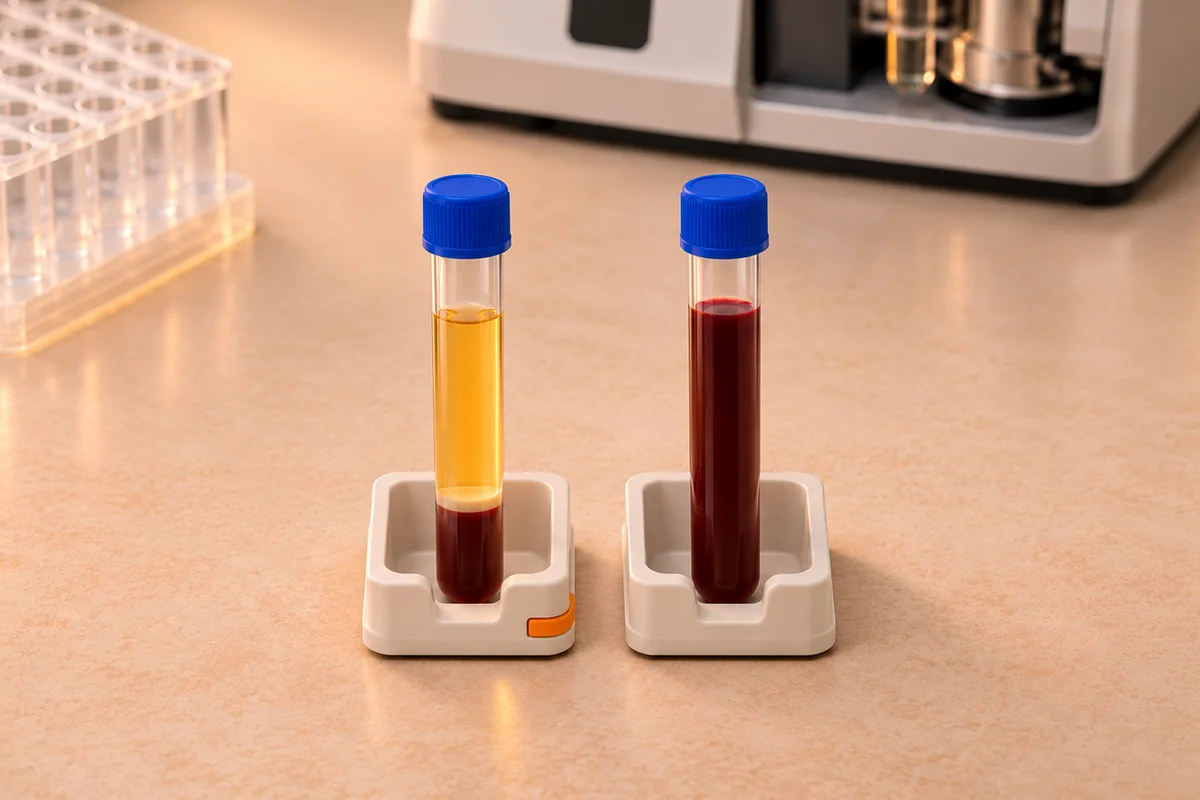
The cited Mayo methods use inductively coupled plasma mass spectrometry, a laboratory technique for measuring elements. Their collection instructions require suitable metal-free materials and specimen handling. The artwork contrasts separated serum with whole blood in closed tubes; fluid colour cannot reveal selenium concentration.See reference 2,See reference 3
Tell the ordering or collection team about medicines, supplements and recent contrast imaging. The Mayo catalogues identify interference concerns after certain contrast agents. Follow the performing laboratory’s timing and collection instructions rather than applying one universal waiting period or opening a sample yourself.See reference 2,See reference 3
What an out-of-range result can and cannot establish
Compare the value with the interval for that exact specimen, unit and laboratory. A whole-blood interval must not be used to judge serum, even if both reports use a concentration unit such as µg/L or ng/mL. Changing the unit does not turn one specimen into the other.See reference 2,See reference 3,See reference 4
A flagged concentration needs interpretation in the reason-for-testing and intake or treatment context. It does not prove that a symptom is caused by selenium, and a result inside an interval does not guarantee that an unrelated health problem has been excluded.See reference 1,See reference 4
An essential nutrient is not an argument for taking more
Selenium is part of proteins involved in functions such as thyroid hormone metabolism. That biological role does not show that raising an already adequate blood concentration improves health. NIH notes limits to selenium-status biomarkers and potential effects of inflammation on some functional markers.See reference 1
A laboratory concentration and a supplement amount are different quantities. Do not turn a low-looking result into a replacement dose or a high-looking result into a self-directed treatment plan. Bring the full report and details of any selenium-containing products to the clinician responsible for the test.See reference 1,See reference 2,See reference 3
Common questions
Can I compare serum with an older whole-blood result?
Do not treat them as the same measurement. First check the specimen, units, laboratory method and testing purpose. A valid comparison may require advice from the performing laboratory.See reference 1,See reference 2,See reference 3
Is there one ideal selenium concentration for longevity?
The cited testing and nutrient sources do not establish a universal concentration that extends life. The useful comparison is specific to the test and the clinical question, not an optimisation target.See reference 1,See reference 2,See reference 3
What should I keep with the report?
Keep the specimen name, date, unit, laboratory interval, collection notes and a list of relevant medicines or supplements. Ask what the test was intended to assess and which prior result is genuinely comparable.See reference 2,See reference 3,See reference 4
Get the weekly longevity brief
The week's best longevity research in plain English. Free, every Tuesday.
See your blood results in context
If you already have blood test results, the paid LongevityMate app can help you view related markers together. It provides educational context, not a diagnosis or a replacement for your clinician.
Explore blood test analysisReferences
- 1. Selenium: Fact Sheet for Health Professionals
NIH Office of Dietary SupplementsOfficial guidance
- 2. Selenium, Serum (SES)
Mayo Clinic LaboratoriesOfficial guidance
- 3. Selenium, Blood (SEWB)
Mayo Clinic LaboratoriesOfficial guidance
- 4. How to Understand Your Lab Results
MedlinePlus, U.S. National Library of MedicineOfficial guidance
Editorial transparency
- Published by
- LongevityMate Editorial
- Reviewed by
- Editorial evidence review (AI-assisted)
- Published
- Updated
Medical disclaimer
General education only. This guide does not diagnose a condition, interpret your personal result, choose a treatment or recommend a supplement dose. A qualified health professional can interpret the full report in context.