
Why both iron and red-cell production matter
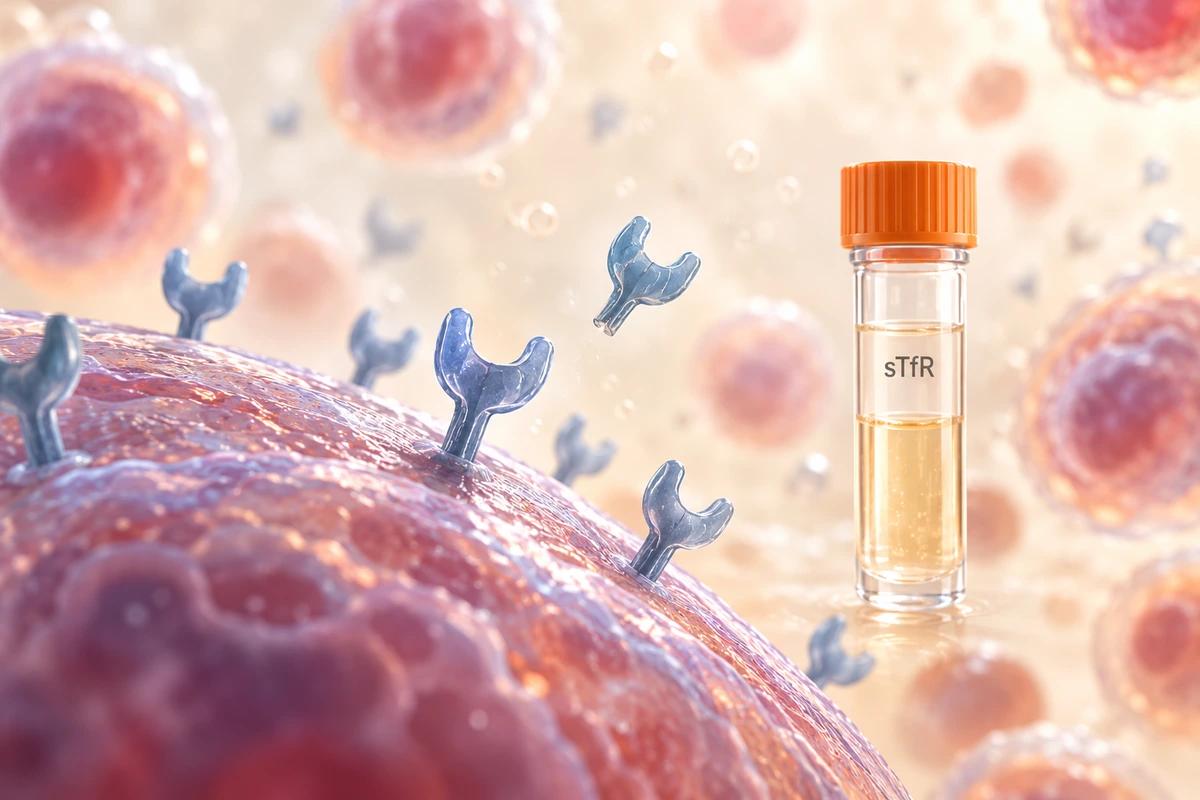
Transferrin carries iron to cells. Transferrin receptor 1 helps developing red cells take it up; a soluble portion enters the circulation. Receptors are abundant on red-cell precursors, whose work requires iron. The artwork depicts that context with abstract receptor symbols, not an exact molecular structure.See reference 5
The 2015 review describes sTfR increasing with tissue iron deficiency and stimulated production of red cells, called erythropoiesis. A rise therefore cannot be assumed to mean only that iron stores are low. Soluble receptor is also a different measurement from transferrin concentration or transferrin saturation.See reference 1
Different tests answer different questions
- Marker
- Ferritin
- Main context
- Stored iron
- Interpretation limit
- Inflammation may complicate the pictureSee reference 4
- Marker
- Transferrin saturation
- Main context
- Iron carried in relation to binding capacity
- Interpretation limit
- Read alongside the other iron studiesSee reference 4
- Marker
- sTfR
- Main context
- Iron need and red-cell production
- Interpretation limit
- Complementary; not a stand-alone iron diagnosisSee reference 1,See reference 3
Where sTfR can add information
ARUP describes sTfR as useful when other iron tests are nondiagnostic, including when inflammation complicates interpretation. It still calls for the surrounding iron-status results. Mixed iron deficiency and chronic disease can require several measurements rather than a single preferred marker.See reference 4
Mayo's 2026 notice cautions against routinely substituting sTfR when ferritin would otherwise be appropriate. It also notes that haemolysis and recent blood loss can elevate sTfR and confuse interpretation. The extra marker does not make the broader clinical history unnecessary.See reference 2
Published intervals are laboratory examples, not your range
- Catalogue example
- Mayo STFR1, 2026 notice
- Reported interval
- 0.63–2.64 mg/L
- Scope
- The notice gives this test intervalSee reference 2
- Catalogue example
- ARUP 3020070
- Reported interval
- 0.90–2.01 mg/L
- Scope
- For adults aged 18 and olderSee reference 3
Use the interval attached to the actual report
Mayo states that sTfR assays are not standardized and results from different assays should not be used interchangeably. The two catalogue intervals above illustrate why a generic internet cutoff is inadequate. Neither interval tells this page how to classify your result.See reference 2
ARUP's current test uses a chemiluminescent immunoassay, accepts serum or plasma and publishes age-specific intervals. Its interpretation explicitly combines the result with presentation and other diagnostic tests. Specimen details and the laboratory's own collection instructions belong to that specific assay.See reference 3
A useful report keeps the surrounding evidence visible
When discussing a result, keep the original concentration and unit, laboratory interval, test date and method. Bring the accompanying blood count, ferritin and other ordered iron results rather than selecting the sTfR value alone. Ask which uncertainty the additional test was intended to resolve.See reference 6,See reference 4
This guide provides no iron dose, ferritin-index formula, diagnostic cutoff or replacement for investigating a cause of anaemia. A low, normal or high flag is part of the clinical evidence, not a treatment instruction.
Keep the useful details
- Iron need and red-cell production can both affect sTfR.See reference 1
- Keep assay-specific ranges; catalogue examples are not personal targets.See reference 2
- The result complements other iron measurements.See reference 3
Common questions
Is sTfR the same as transferrin?
No. Transferrin transports iron; soluble transferrin receptor is a circulating receptor fragment.See reference 1
Can it help when ferritin is hard to interpret?
It can add information in selected assessments, including those complicated by inflammation, but should be read with other iron results.See reference 4
Does a high sTfR automatically mean iron deficiency?
No. Increased red-cell production and other clinical circumstances can affect the measurement.See reference 1
Get the weekly longevity brief
The week's best longevity research in plain English. Free, every Tuesday.
See your blood results in context
If you already have blood test results, the paid LongevityMate app can help you view related markers together. It provides educational context, not a diagnosis or a replacement for your clinician.
Explore blood test analysisReferences
- 1. Beyond soluble transferrin receptor: old challenges and new horizons
2015 review; PubMed recordEvidence review
- 2. sTfR (soluble transferrin receptor), serum: new-test notice, January 2026
Mayo Clinic LaboratoriesOfficial guidance
- 3. Soluble transferrin receptor, serum or plasma: test 3020070
ARUP LaboratoriesOfficial guidance
- 4. Iron deficiency anemia
ARUP ConsultOfficial guidance
- 5. Transferrin receptors in erythropoiesis
Richard and Verdier, 2020; International Journal of Molecular SciencesEvidence review
- 6. How to understand your lab results
MedlinePlusOfficial guidance
Editorial transparency
- Published by
- LongevityMate Editorial
- Published
- Updated
Medical disclaimer
General education only. This guide does not diagnose a condition, interpret your personal result, choose a treatment or recommend a supplement dose. Discuss testing, symptoms, medicines and supplements with a qualified health professional.