
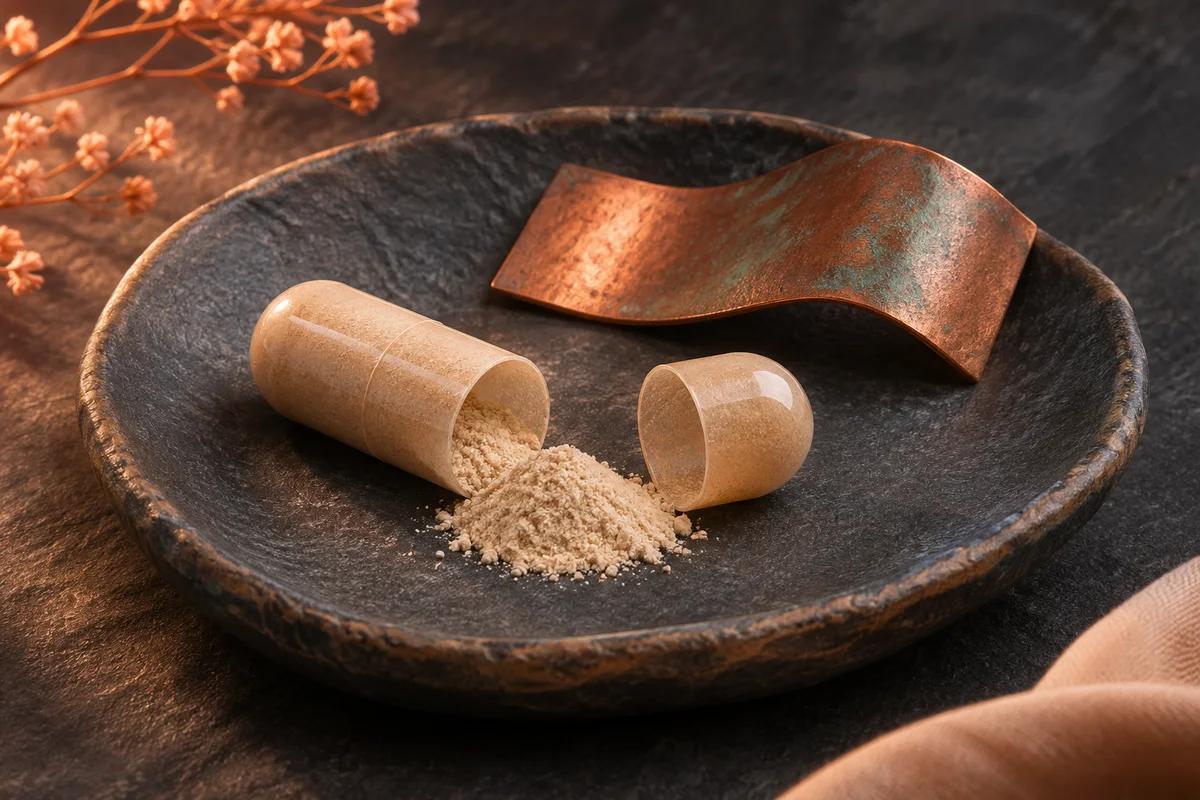
Read the copper line and serving size together
On a hypothetical label that says “Copper (as copper bisglycinate) 1 mg,” the 1 mg is the amount of copper. Check the serving size above that line. If it lists two capsules, the amount is for both capsules together. The example illustrates the label convention, rather than a suggested intake.See reference 4
Copper can also appear in multivitamins or products combining zinc and copper. Add only the amounts that apply to the same serving basis when comparing products. The name of a compound on the front of a pack is less useful than a panel that specifies the amount of copper.See reference 1,See reference 4
What human evidence can tell you
- Question
- Does the body need copper?
- What the evidence shows
- Copper supports enzymes involved in iron metabolism and energy production. Deficiency is uncommon.
- Limit
- A biological role does not establish that adding copper helps everyone.See reference 1
- Question
- Does copper glycinate improve heart health?
- What the evidence shows
- An eight-week study in middle-aged adults with moderately high cholesterol used 2 mg of copper daily as copper glycinate. Two copper enzyme activities rose, but standard cholesterol measures did not significantly improve.
- Limit
- It measured blood markers. It did not establish fewer heart attacks or strokes or test all bisglycinate products.See reference 3
- Question
- Does bisglycinate absorb better than other forms?
- What the evidence shows
- The NIH fact sheet identifies several supplemental forms and reports a lack of comparative bioavailability studies.
- Limit
- This is too little evidence to rank forms or infer absorption from the word chelated.See reference 1
Check zinc and copper across products
Large amounts of supplemental zinc taken over time can interfere with copper absorption. NIH also notes that copper status can be difficult to assess. A fixed zinc-to-copper ratio cannot account for the reason someone is taking zinc, their food intake or whether they need evaluation.See reference 1,See reference 2
Excess copper can cause nausea and other digestive symptoms. Chronic high exposure can damage the liver. People with Wilson disease have a problem clearing copper and need specialist guidance. Bring the full product label to a clinician or pharmacist if copper is already part of a medical plan.See reference 1
Common questions
Are copper glycinate and copper bisglycinate labels interchangeable?
PubChem lists copper glycinate and copper bisglycinate as names for the same compound. The study called its form copper glycinate. Chemical naming does not establish that a retail product matches the trial material or contains the same amount. Compare the elemental amount on the panel.See reference 3,See reference 4,See reference 5
Can a blood copper result tell me how much to take?
Blood copper can be affected by factors unrelated to how much copper you eat, and no single lab measure reliably describes copper status in all settings. A clinician can put the result in context.See reference 1
Get the weekly longevity brief
The week's best longevity research in plain English. Free, every Tuesday.
References
- 1. Copper: Health Professional Fact Sheet
NIH Office of Dietary SupplementsOfficial guidance
- 2. Zinc: Health Professional Fact Sheet
NIH Office of Dietary SupplementsOfficial guidance
- 3. A randomized trial of copper supplementation and blood markers
DiSilvestro and colleagues, MetabolismRandomized trial
- 4. Dietary Supplement Labeling Guide, Chapter IV
U.S. Food and Drug AdministrationOfficial guidance
- 5. Cupric glycinate (CID 3032611)
PubChem, U.S. National Library of MedicineOfficial guidance
Editorial transparency
- Published by
- LongevityMate Editorial
- Reviewed by
- Editorial evidence review (AI-assisted)
- Published
- Updated
Medical disclaimer
For general education. A qualified health professional can interpret your results and advise on testing, medicines or supplements.