
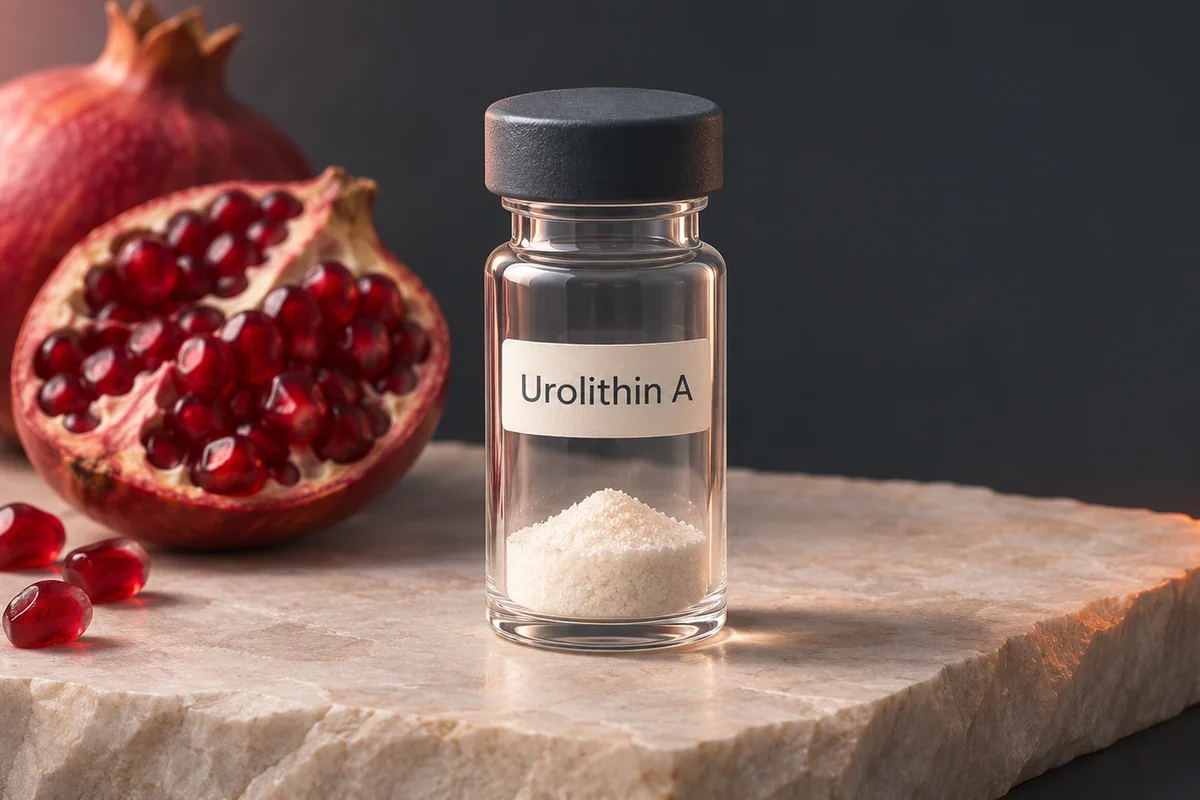
Pomegranate is precursor context, not an equivalent dose
The pathway from dietary compounds to urolithin A depends on gut microbial conversion, which varies between people. A measured direct urolithin A supplement is therefore a different exposure from eating a precursor food. The pomegranate in the illustration is context, not a claim that a fruit serving equals the powder or amount used in a trial.See reference 2,See reference 3
Read the measured outcome before the headline
- Trial
- Older adults, 2022
- Population and studied exposure
- 66 adults aged 65–90; 1,000 mg/day for 4 months.
- Result and boundary
- Six-minute walking distance and maximal ATP production did not improve significantly versus placebo. Selected muscle-endurance measures improved at 2 months.See reference 1
- Trial
- ATLAS, 2022
- Population and studied exposure
- 88 middle-aged adults; 500 or 1,000 mg/day for 4 months.
- Result and boundary
- The primary peak-power outcome was not significantly different. Some strength and endurance measures were promising secondary findings.See reference 2
- Trial
- Vascular function, October 2026
- Population and studied exposure
- 50 middle-aged adults with obesity; 1,000 mg/day for 4 weeks.
- Result and boundary
- No significant improvement in the primary peripheral artery-function measure. A brain blood-flow response changed, while task performance did not.See reference 3
Why primary and secondary outcomes are different
A trial’s primary outcome is the main question it was designed to test. A favorable secondary measurement can be useful, but should not erase a null primary result. ATLAS itself identifies the negative primary peak-power result as a limitation and calls for confirmatory work.See reference 2
Likewise, more repeated muscle contractions in a laboratory task do not automatically mean a person walks farther, avoids disability or lives longer. The older-adult trial reported no significant between-group improvement in the six-minute walk or its assessed ATP-production outcome.See reference 1
What the October 2026 study adds
The four-week study did not significantly improve flow-mediated dilation, its primary measure of peripheral artery function. Some task-evoked brain hemodynamic responses differed, but task performance did not. Calling that a proven improvement in cognition or cardiovascular health would go beyond the measured result.See reference 3
The trial was small, short and performed at one site. It included middle-aged adults with obesity, so it cannot settle effects in all healthy adults, elite athletes or people with a particular disease. This updated result is a useful counterweight to claims built only on favorable biomarkers.See reference 3
Mitophagy explains a research hypothesis
Mitophagy is a cellular process involved in removing mitochondria. Urolithin A research examines this pathway and related molecular signals. A change in a pathway marker is not itself proof of better everyday function; the functional outcomes have to be measured and reproduced.See reference 2
Short-term tolerability is not a lifetime guarantee
The older-adult trial did not find a statistical difference in adverse events between groups. That is a finding about a limited study population and duration, not proof of safety for years or across pregnancy, childhood, medicines and medical conditions.See reference 1
The listed amounts describe research, not a recommended dose. Ask a qualified professional about personal suitability, especially when medicines or an existing condition are involved. A multi-ingredient product cannot inherit an efficacy or safety result from a trial of direct urolithin A.See reference 1,See reference 2,See reference 3
Check both sponsorship and the regulatory claim
ATLAS was sponsored by Amazentis and disclosed company employment, board and advisory relationships. This does not automatically invalidate a trial, but makes independent replication and attention to its prespecified outcome particularly useful.See reference 2
FDA’s record for notice 791 reports no questions about the notifier’s GRAS conclusion for specified food uses. It is not approval of an anti-aging treatment or proof of muscle benefit. A food-use safety record and an efficacy trial answer different questions, and regulatory rules vary internationally.See reference 4
Common questions
Does eating pomegranate reproduce the supplement trials?
No. Microbial production varies, and the trials used known direct supplement exposures. A food serving cannot be assumed equivalent.See reference 2,See reference 3
Has urolithin A been proved to slow human aging?
The trials summarized here did not test or demonstrate longer human lifespan. Their selected muscle and biomarker findings do not establish that broader claim.See reference 1,See reference 2,See reference 3
Get the weekly longevity brief
The week's best longevity research in plain English. Free, every Tuesday.
References
- 1. Effect of Urolithin A Supplementation on Muscle Endurance and Mitochondrial Health in Older Adults
Liu and colleagues, JAMA Network OpenRandomized trial
- 2. Urolithin A improves muscle strength, exercise performance, and biomarkers of mitochondrial health in a randomized trial in middle-aged adults
Singh and colleagues, Cell Reports MedicineRandomized trial
- 3. Urolithin A and Endothelial and Cerebrovascular Function in Middle-Aged Adults With Obesity
da Costa Pinaffi-Langley and colleagues, JAMA Network OpenRandomized trial
- 4. GRAS Notice 791: Urolithin A
U.S. Food and Drug AdministrationOfficial guidance
Editorial transparency
- Published by
- LongevityMate Editorial
- Review
- Editorial evidence review (AI-assisted)
- Published
- Updated
Medical disclaimer
General education only. AI-assisted editorial evidence review is not a qualified clinical assessment. This guide does not diagnose a condition, interpret a personal result, choose treatment or recommend a supplement dose. Discuss results, symptoms, medicines and supplements with a qualified health professional.