
Quick answer
What does an ESR result mean?
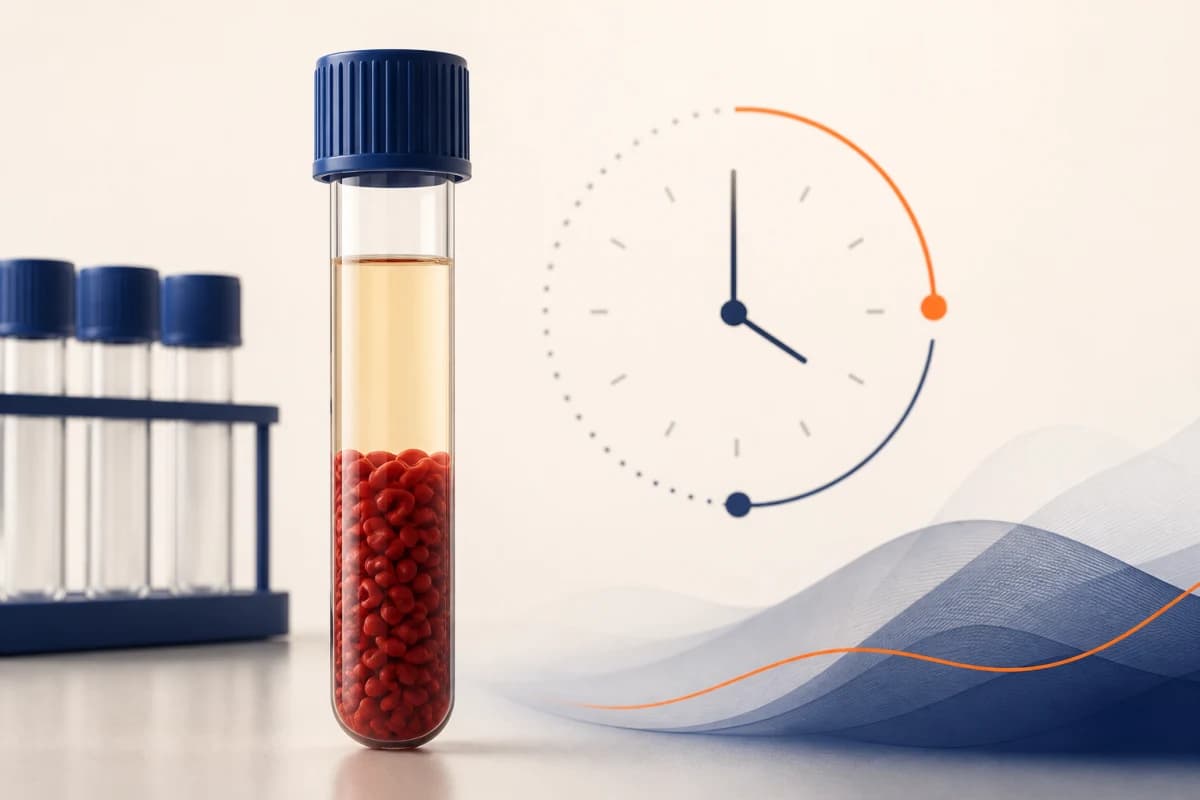
ESR is a nonspecific blood test that measures how far red blood cells settle in a tube over a stated interval, traditionally one hour. A faster result can support the possibility of inflammation, but ESR cannot identify its cause or location, and a normal result does not rule inflammation out. Read the result against the reporting laboratory's own interval and method, then consider age, sex, pregnancy, anaemia, medicines, symptoms, other tests and the trend.See reference 1,See reference 2,See reference 3,See reference 4
Six points that prevent most ESR mistakes
- ESR is an inflammation signal, not a diagnosis. A high result cannot tell you which condition is present or where it is.See reference 1,See reference 2,See reference 3
- Use the reference interval on your own report. Age, sex, pregnancy, anaemia and the testing method can change responsible interpretation.See reference 1,See reference 2,See reference 3,See reference 4
- Westergren is the reference method, but laboratories also use modified and alternate methods. Results are not automatically interchangeable across methods.See reference 4
- A high ESR may occur with infection, inflammatory or autoimmune disease, kidney disease or some cancers, but these are possibilities rather than conclusions.See reference 1,See reference 3
- A low ESR usually has little meaning by itself and can occur with some blood-cell, heart, kidney or liver conditions. A normal result does not guarantee that inflammation is absent.See reference 1,See reference 3
- ESR alone does not require fasting or special preparation. Other tests collected at the same visit may have different instructions.See reference 1,See reference 2,See reference 3
What the ESR blood test measures and what it does not
Erythrocyte means red blood cell. In an ESR test, a blood sample is placed in a tall, thin tube and the laboratory observes how quickly the red cells settle. Inflammation can make red cells stick together in heavier clumps, which settle faster than individual cells.See reference 1,See reference 2,See reference 3
Results are commonly reported as millimeters per hour (mm/hr). The traditional Westergren-style result is the distance settled during a one-hour readout, but the exact method and reporting system are laboratory-specific.See reference 2,See reference 4
ESR is a physicochemical sedimentation phenomenon rather than a measurement of one precisely defined analyte. It can support an inflammation assessment, but it does not show the cause, location or exact severity of a problem, and it cannot diagnose a condition on its own.See reference 1,See reference 3,See reference 4
Westergren, modified and alternate ESR methods
- Method or label
- Traditional Westergren method
- What it describes
- The reference or gold-standard method used for ESR method comparison
- Why it matters when reading results
- Its result is conventionally read as millimeters of settling after one hourSee reference 2,See reference 4
- Method or label
- Modified Westergren method
- What it describes
- A Westergren-based procedure with a change to the tube, diluent, sample or reading time
- Why it matters when reading results
- The laboratory should validate and communicate how the result relates to the reference methodSee reference 4
- Method or label
- Alternate automated method
- What it describes
- A method using a different measurement principle, such as centrifugation or photometric rheology
- Why it matters when reading results
- The result and reference interval may not be numerically interchangeable with a Westergren resultSee reference 4
- Method or label
- Your laboratory report
- What it describes
- The value, unit, reference interval and sometimes method supplied by the reporting laboratory
- Why it matters when reading results
- Use this information first, especially when comparing results over time or between laboratoriesSee reference 1,See reference 2,See reference 4
Why there is no single normal ESR range
A result outside a laboratory's reference interval is a prompt for context, not a diagnosis. Expected ESR values vary with age and sex, and pregnancy, anaemia and other conditions can shift the result. Method-specific reference intervals also matter because alternate methods can differ from the Westergren reference method.See reference 1,See reference 2,See reference 3,See reference 4
For that reason, a universal adult range, age formula or 'optimal' longevity target would be misleading. Record the exact result and unit, read the interval printed on the same report, and ask whether the laboratory method changed before comparing it with an older result.See reference 1,See reference 2,See reference 4
Preparation, sample and test risks
An ESR by itself does not require fasting or special preparation. If your clinician ordered other blood tests at the same time, follow the combined instructions because those tests may require fasting or another preparation step.See reference 1,See reference 2,See reference 3
A health professional usually collects ESR from a vein and sends the blood to a laboratory. The usual risks are brief needle discomfort and a small bruise or tenderness at the collection site.See reference 1,See reference 2,See reference 3
Context that can shift ESR or its interpretation
- Context
- Age and sex
- What the evidence says
- Both can affect expected ESR results and the reference interval used by a laboratory
- Practical reading rule
- Use the interval on the report rather than importing a range from another sourceSee reference 1,See reference 2,See reference 4
- Context
- Pregnancy
- What the evidence says
- Pregnancy can raise ESR
- Practical reading rule
- Tell the clinician or laboratory that you are pregnant before interpreting an unexpected resultSee reference 1,See reference 2,See reference 3
- Context
- Anaemia or anemia
- What the evidence says
- Anaemia can raise ESR and make an isolated result harder to interpret
- Practical reading rule
- Read ESR alongside the rest of the clinical and blood-count contextSee reference 2,See reference 3
- Context
- Menstrual cycle, obesity, alcohol use and exercise
- What the evidence says
- These can affect ESR results
- Practical reading rule
- Mention relevant timing and habits when discussing an unexpected valueSee reference 1
- Context
- Medicines, supplements, kidney or thyroid problems, infection, injury and some cancers
- What the evidence says
- These can affect the result or its interpretation
- Practical reading rule
- Provide the full medicine and health context; do not assign one cause from ESR aloneSee reference 1,See reference 2
- Context
- Polycythaemia, sickle cell disease, leukocytosis, heart failure and some kidney or liver problems
- What the evidence says
- These are reported contexts for a low ESR
- Practical reading rule
- A low result is not a general health score and usually needs no action by itselfSee reference 1,See reference 3
What a high ESR can mean
A high ESR means red blood cells settled faster than expected for that report. It may occur with an infection, an inflammatory or autoimmune illness, kidney disease or some cancers. Pregnancy, anaemia, age, medicines and other conditions can also contribute to a higher result.See reference 1,See reference 2,See reference 3
A high value does not tell you which possibility is responsible, where inflammation is located, or how urgent the situation is. Your clinician will combine the result with symptoms, examination, medical history, other tests and, when useful, results over time.See reference 1,See reference 2,See reference 3
What a low ESR can mean
A low ESR means red blood cells settled more slowly than expected. A low value is often not important by itself, but it can be seen with conditions such as polycythaemia, sickle cell disease, a very high white blood cell count, heart failure or some kidney and liver problems.See reference 1,See reference 3
Low, normal and high are report comparisons, not a complete picture of health. Inflammation can still be present when ESR is normal, so symptoms and other findings should not be dismissed because the number is low.See reference 1,See reference 2,See reference 3
ESR and CRP: related but different tests
- Test
- ESR
- What it contributes
- An indirect, method-dependent sedimentation signal that may support an inflammation assessment
- What not to assume
- It does not identify a cause, location or diagnosis by itselfSee reference 1,See reference 3,See reference 4
- Test
- CRP
- What it contributes
- A separate inflammation test that is commonly ordered with ESR to provide more information
- What not to assume
- CRP is a separate inflammation test that is commonly ordered with ESRSee reference 1,See reference 3
- Test
- The clinical picture
- What it contributes
- Symptoms, history, examination, other tests and trends give the result meaning
- What not to assume
- No single inflammation marker can safely replace clinical assessmentSee reference 1,See reference 2,See reference 3
What to do after an unexpected ESR result
Start with the exact value, unit, laboratory interval and method on the report. Note whether you are pregnant, have anaemia, recently had an infection or injury, take medicines or supplements, or have symptoms that prompted the test. These details can change how the result should be read.See reference 1,See reference 2,See reference 3,See reference 4
A clinician may decide that a repeat ESR, CRP or other testing is useful, especially when monitoring an established condition. Before comparing results, check whether the method, laboratory or clinical context changed. Do not repeat tests simply to chase a number without understanding the clinical question.See reference 1,See reference 2,See reference 3,See reference 4
When symptoms matter more than the number
ESR cannot diagnose or exclude a serious condition. Seek prompt medical care for severe or rapidly worsening symptoms, and follow the care team's advice for a known inflammatory illness. Do not delay assessment because ESR is normal, and do not start, stop or choose treatment from an ESR result alone.See reference 1,See reference 2,See reference 3
Common ESR misconceptions
- Assumption
- A high ESR proves an infection
- What is safer to say
- A high ESR is compatible with several inflammatory and non-inflammatory contexts
- Why
- ESR cannot identify the cause or location by itselfSee reference 1,See reference 3
- Assumption
- A normal ESR rules out inflammation
- What is safer to say
- Inflammation can be present with a normal ESR
- Why
- MedlinePlus explicitly describes this limitationSee reference 1
- Assumption
- A low ESR means the person is healthy
- What is safer to say
- A low ESR means slower settling and is usually not a diagnosis
- Why
- Low results have several possible blood, heart, kidney and liver contextsSee reference 1,See reference 3
- Assumption
- One normal range applies to everyone
- What is safer to say
- Use the reporting laboratory's interval and method
- Why
- Age, sex, pregnancy, anaemia and method can change interpretationSee reference 1,See reference 2,See reference 3,See reference 4
- Assumption
- Every ESR method produces an interchangeable number
- What is safer to say
- Ask whether the test used Westergren, a modified method or an alternate analyser
- Why
- ICSH recommends validation and communication for modified and alternate methodsSee reference 4
- Assumption
- ESR always requires fasting
- What is safer to say
- ESR alone has no special preparation; combined tests may differ
- Why
- Official patient guidance says no fasting is needed for ESR aloneSee reference 1,See reference 2,See reference 3
- Assumption
- The number tells you which treatment to take
- What is safer to say
- Treatment depends on the clinical cause and assessment
- Why
- ESR is a nonspecific signal, not a treatment prescriptionSee reference 1,See reference 2,See reference 3
Where ESR evidence needs restraint
- Limit
- ESR is nonspecific
- Practical consequence
- A high result supports a broad possibility of inflammation but does not name the cause or locationSee reference 1,See reference 2,See reference 3
- Limit
- Age, sex, pregnancy, anaemia and other conditions can shift results
- Practical consequence
- Do not use a universal range or interpret an isolated number without contextSee reference 1,See reference 2,See reference 3
- Limit
- Westergren is the reference method, but modified and alternate methods are common
- Practical consequence
- Check method and interval before comparing values across reportsSee reference 4
- Limit
- A trend is meaningful only in clinical and method context
- Practical consequence
- A change in symptoms, laboratory or method may matter more than a directionally changing numberSee reference 2,See reference 4
- Limit
- The sources do not establish one universal optimal ESR target
- Practical consequence
- Do not convert an educational result into a longevity score or self-treatment goalSee reference 1,See reference 2,See reference 4
A safe way to read an ESR result
- Write down the exact value, unit, reference interval and test method from the same report.See reference 1,See reference 2,See reference 4
- Add context such as age, sex, pregnancy, anaemia, recent infection or injury, medicines, supplements and symptoms.See reference 1,See reference 2,See reference 3
- Ask a clinician whether CRP, repeat testing or another investigation is appropriate for the reason the test was ordered.See reference 1,See reference 2,See reference 3
- Act on severe or rapidly worsening symptoms and professional advice, not on an ESR number alone.See reference 1,See reference 2,See reference 3
Put ESR beside the rest of your result
Use the interval and method on your own report, then bring the full result, symptoms, medicines and relevant context to a qualified health professional.
Explore biomarker contextESR questions people ask most
What is an ESR blood test?
ESR, or erythrocyte sedimentation rate, measures how quickly red blood cells settle in a tube. Faster settling can support the possibility of inflammation, but the test cannot diagnose a specific condition on its own.See reference 1,See reference 2,See reference 3
What is a normal ESR range?
There is no single range that safely applies to everyone. Age, sex, pregnancy, anaemia, the laboratory method and other factors can change the expected result, so use the interval printed on your report.See reference 1,See reference 2,See reference 3,See reference 4
What does a high ESR mean?
A high ESR means red blood cells settled faster than expected. It may occur with infection, inflammatory or autoimmune illness, kidney disease or some cancers, but it does not identify the cause or location by itself.See reference 1,See reference 3
What does a low ESR mean?
A low ESR means slower settling and is often not important by itself. It can occur with polycythaemia, sickle cell disease, a very high white blood cell count, heart failure or some kidney and liver problems.See reference 1,See reference 3
Can a normal ESR rule out inflammation?
No. MedlinePlus notes that a condition causing inflammation can still be present when ESR is normal. Symptoms and other tests remain important.See reference 1
Is ESR the same as CRP?
No. CRP is a separate inflammation test that is commonly ordered with ESR to provide additional information. Neither result should be treated as a diagnosis on its own.See reference 1,See reference 3
What is the Westergren method?
Westergren is the reference or gold-standard method for comparing ESR methods. Traditional reporting describes the distance red blood cells settle in a tube during a one-hour readout.See reference 2,See reference 4
Can I compare ESR results from different laboratories?
Only with care. Modified and alternate methods can differ from the Westergren reference method, so check the method and reference interval before treating values from different reports as one trend.See reference 4
Does pregnancy raise ESR?
Pregnancy can raise ESR. Tell the clinician interpreting the result that you are pregnant, and do not apply a non-pregnancy range without professional guidance.See reference 1,See reference 2,See reference 3
Can anaemia raise ESR?
Yes. Anaemia can raise ESR and make an isolated result harder to interpret. The type of anaemia and the rest of the clinical picture still matter.See reference 2,See reference 3
Do I need to fast for an ESR test?
Not for ESR alone. If other blood tests were ordered at the same time, follow their preparation instructions because they may require fasting.See reference 1,See reference 2,See reference 3
What should I do after an unexpected ESR result?
Review the exact value, unit, report interval, method, symptoms and relevant context with a qualified health professional. They may decide whether repeat ESR, CRP or other tests are appropriate.See reference 1,See reference 2,See reference 3,See reference 4
Is a high ESR an emergency?
The ESR number alone cannot determine urgency. Seek prompt care for severe or rapidly worsening symptoms, and do not delay assessment because ESR is normal or choose treatment from ESR alone.See reference 1,See reference 2,See reference 3
References
- 1. Erythrocyte Sedimentation Rate (ESR): MedlinePlus Medical Test
MedlinePlus, U.S. National Library of MedicineOfficial guidance
- 2. Sed rate (erythrocyte sedimentation rate)
Mayo ClinicOfficial guidance
- 3. Erythrocyte sedimentation rate (ESR) blood test explained
healthdirect AustraliaOfficial guidance
- 4. ICSH recommendations for modified and alternate methods measuring the erythrocyte sedimentation rate
International Council for Standardization in HaematologyGuideline
Editorial transparency
- Published by
- LongevityMate Editorial Team
- Published
- Updated
Medical disclaimer
This educational article does not diagnose or treat disease. Use your report's own reference interval and discuss symptoms, results, medicines and follow-up with a qualified health professional.