
The quick answer
TSH is the pituitary signal that tells the thyroid how hard to work
What does a TSH result mean?
Thyroid-stimulating hormone, also called thyrotropin or TSH, is released by the pituitary gland. In an intact feedback system, TSH usually rises when circulating thyroid hormone is too low and falls when thyroid hormone is too high. That makes TSH a sensitive first test for primary thyroid dysfunction—problems beginning in the thyroid gland itself.See reference 2,See reference 4
A TSH result does not diagnose the cause by itself. Interpret it against the range printed on the same report, then add free T4, symptoms, medicines, pregnancy or age, recent illness and the trend over time.
Six useful takeaways
Use your laboratory's range
There is no single correct interval for every assay, age or life stage.
mIU/L and µIU/mL are numerically equal
A value of 2.5 has the same magnitude in either of these common TSH units.
Fasting is usually unnecessary
Other tests collected at the same time may have different preparation rules.
Free T4 changes the interpretation
High, low and normal TSH patterns become more useful when paired with free T4.
Biotin can distort some assays
Tell the clinician and laboratory what supplements you take.
Pregnancy needs its own approach
Use pregnancy- and assay-appropriate reference information, not a general adult chart.
What it measures
TSH is one part of a feedback loop, not a thyroid hormone
The hypothalamus signals the pituitary, the pituitary releases TSH, and TSH prompts the thyroid to produce mainly thyroxine (T4) plus some triiodothyronine (T3). Circulating thyroid hormones feed back to the brain and pituitary. Small changes in free T4 can produce larger changes in TSH, which is why TSH is sensitive in primary thyroid disease.See reference 2,See reference 7
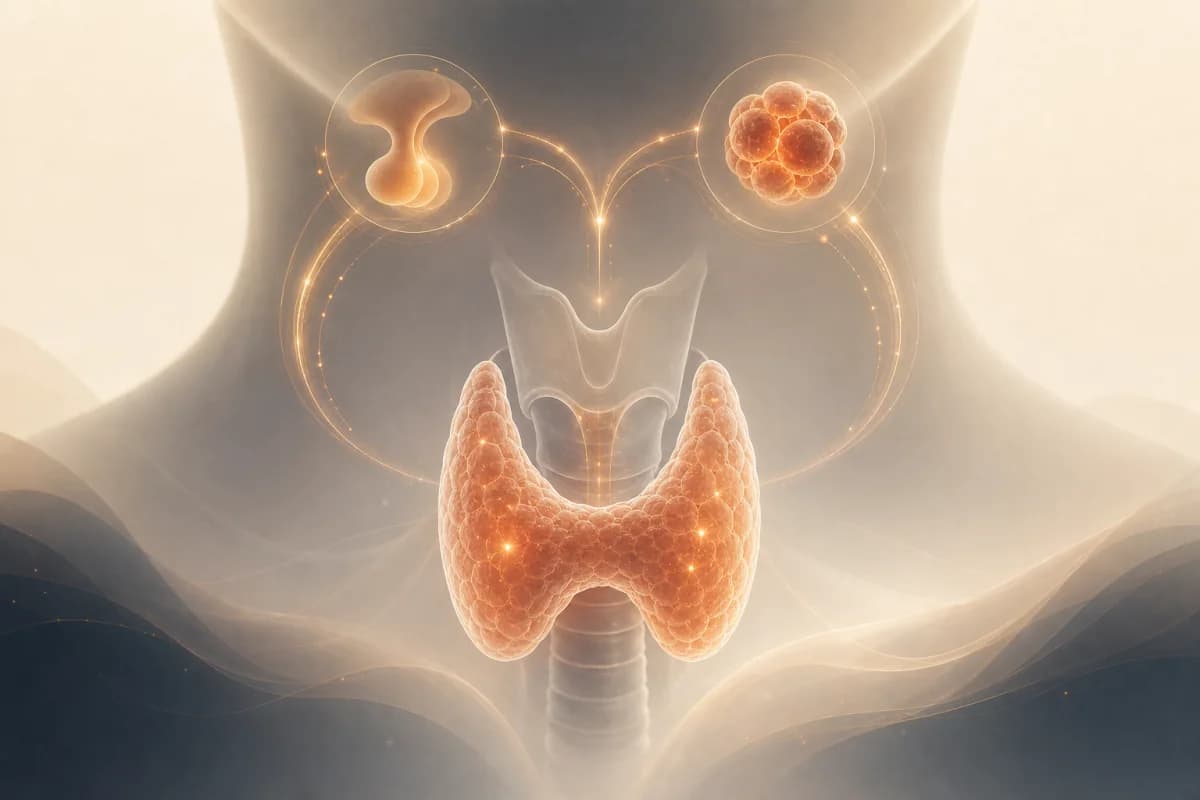
Step 1
Hypothalamus
Starts the control signal with TRH.
Step 2
Pituitary
Releases the TSH measured in blood.
Step 3
Thyroid
Produces T4 and T3 in response.
TSH can be misleading when the pituitary or hypothalamus is not responding normally. When central thyroid disease is suspected, guidance recommends measuring TSH and free T4 together rather than relying on TSH alone.See reference 2,See reference 3
Ranges and units
The report's own interval is the safest place to start
Many adult reports use an interval somewhere around 0.4 to 4 mIU/L, but the endpoints vary with assay, laboratory and reference population. A result just outside one interval could sit inside another. The report, not a wellness chart, should supply the comparison range.See reference 2,See reference 4,See reference 6
TSH is commonly reported as mIU/L or µIU/mL. These units are numerically equivalent: both numerator and denominator differ by a factor of 1,000. Do not convert either of them to thyroid-hormone units such as pmol/L or ng/dL.
Use your laboratory report
TSH and free T4 pattern explorer
Enter the limits printed on the same laboratory report. This tool does not apply a universal optimal range.
Enter a non-negative TSH result and valid lower and upper limits from one laboratory report.
General education only; not for pregnancy, children, dose changes or urgent symptoms.
What this explorer cannot tell you
This educational comparison cannot confirm thyroid disease, choose a treatment target or account for pregnancy, age, pituitary conditions, acute illness, medicines, biotin, assay interference or a changing result. Use the exact report and clinical context with a qualified clinician.
Your entries stay in this browser and are not sent to LongevityMate.
TSH with free T4
The paired pattern is more useful than either result alone
These combinations describe common biochemical patterns. They do not identify the cause, prove that a pattern will persist or replace review of medicines, illness, pregnancy and assay interference.See reference 2,See reference 3,See reference 4
| TSH compared with lab range | Free T4 compared with lab range | Pattern that may need confirmation |
|---|---|---|
| TSH:High | Free T4:Low | Possible pattern:Often fits primary hypothyroidism. |
| TSH:High | Free T4:Within range | Possible pattern:Can fit subclinical hypothyroidism if persistent. |
| TSH:High | Free T4:High | Possible pattern:Discordant: recent thyroid-medicine timing, assay interference or a less common cause may need review. |
| TSH:Low | Free T4:Low | Possible pattern:Discordant: illness, medicines, pituitary context, timing or assay issues may need review. |
| TSH:Low | Free T4:High | Possible pattern:Shows excess circulating thyroid hormone; causes include hyperthyroidism, thyroiditis or over-replacement. |
| TSH:Low | Free T4:Within range | Possible pattern:Can fit subclinical hyperthyroidism if persistent; free T3 may add context. |
| TSH:Within range | Free T4:Low | Possible pattern:Discordant: consider central, illness, medicine, timing or assay context. |
| TSH:Within range | Free T4:High | Possible pattern:Discordant: medicine timing, assay interference or a less common thyroid or pituitary explanation may need review. |
| TSH:Within range | Free T4:Within range | Possible pattern:Usually reassuring for primary thyroid function, but not an explanation for every symptom. |
These nine combinations summarize common and discordant patterns described in current thyroid-testing guidance; they do not assign a cause.See reference 2,See reference 3,See reference 4,See reference 13
What to do next
Verify the pattern before trying to change the number
Read the exact report
Confirm the unit, reference interval, collection date and whether the result was flagged by that laboratory.
Add the thyroid-hormone result
Free T4 changes the meaning of a high, low or apparently normal TSH. Free T3 can help when TSH is low.
Check the circumstances
Note pregnancy, acute illness, thyroid medicine timing, amiodarone, lithium, glucocorticoids and high-dose biotin.
Compare the trend
A prior result and a clinically timed repeat can separate a persistent pattern from recovery, variation or interference.
This verification sequence follows current laboratory and clinical guidance on paired testing, repeat confirmation, medicines, acute illness and assay interference.See reference 2,See reference 3,See reference 4,See reference 5
Which companion tests are commonly useful?
- High TSH: free T4; thyroid peroxidase antibodies may help identify autoimmune context.
- Low TSH: free T4 and free T3, plus medicine and pregnancy context.
- Suspected pituitary cause: TSH and free T4 together, with specialist evaluation when appropriate.
- Unexpected mismatch: repeat testing, assay review and interference checks may be more useful than adding every thyroid panel.
NICE recommends considering a single thyroid peroxidase antibody measurement in adults with TSH above the reference range; it does not recommend routinely repeating that antibody test.See reference 3
A “TSH with reflex to free T4” order means the laboratory automatically adds free T4 when TSH meets its preset rule. It can reduce unnecessary tests, but symptoms, pregnancy, pituitary concerns or another specific clinical question can require both tests from the start.See reference 3,See reference 4
Testing and preparation
Usually no fasting—but timing, illness and assay details matter
Sample
Serum or plasma from a routine blood draw, depending on the laboratory method.
Fasting
Usually not required for TSH alone. Follow instructions for other tests collected with it.
Time of day
TSH has a daily rhythm. Consistent timing can help when small changes are being compared.
Repeat timing
Depends on the question. Repeating too soon can capture the same temporary or unsettled state.
Specimen choice, preparation, timing and repeatability vary by assay and clinical purpose, so the reporting laboratory's instructions take priority.See reference 2,See reference 3,See reference 4,See reference 6,See reference 12
Before the blood draw
- Follow the laboratory's instructions.
- Record thyroid medicine and the time of the latest dose.
- Tell the clinician and laboratory about biotin-containing supplements.
- Mention pregnancy, fertility treatment and recent severe illness.
When a repeat can help
A repeat may confirm persistence after illness, an unexpected result or a treatment change. NICE says that when repeating thyroid tests because symptoms worsen or new symptoms appear, do not repeat sooner than six weeks. Treatment protocols and urgent situations can follow different timing.See reference 3
After a levothyroxine dose or brand change, the American Thyroid Association gives about 6 to 8 weeks as a common adult example before checking TSH. That is different from retesting an untreated symptom question, and pregnancy or specialist care may use another schedule.See reference 18
Biotin can interfere with some immunoassays and may produce falsely high or falsely low results depending on the test design. The safest advice is to disclose the product and dose, then follow assay-specific instructions from the clinician or laboratory rather than using one universal stop time.See reference 2,See reference 3,See reference 5,See reference 7
High and low results
The direction suggests a pattern; free T4 and context suggest why
A high TSH may occur with
- Autoimmune thyroiditis, including Hashimoto disease
- Previous thyroid surgery or radioactive iodine
- Too little absorbed thyroid hormone or missed doses
- Medicines such as lithium or amiodarone
- Iodine deficiency or iodine excess
- Recovery from illness or a temporary thyroid phase
- Assay interference or normal biological variation
A low TSH may occur with
- Graves disease or an autonomous thyroid nodule
- A temporary thyroiditis phase
- More thyroid hormone medicine than currently needed
- Early pregnancy-related stimulation
- Severe non-thyroid illness
- Medicines that suppress TSH secretion
- Pituitary context or assay interference
These are possible contexts—not diagnoses—and the paired free T4, history, examination and repeat pattern determine the next question.See reference 2,See reference 3,See reference 7,See reference 13,See reference 14
TSH itself usually does not cause symptoms. Symptoms come from the thyroid-hormone state or another condition. Seek prompt medical assessment for severe or worsening chest pain, marked breathing difficulty, palpitations or feeling faint; do not wait for an online interpretation.See reference 17
Treatment and change
Treat the cause and clinical state—not TSH as an isolated target
A high or low TSH does not point to one universal diet, supplement or medicine. Treatment depends on the paired free T4 result, persistence, cause, symptoms, pregnancy, age, heart and bone risk, and whether someone is already taking thyroid hormone.See reference 3,See reference 7
| Situation | What may be considered | Important boundary |
|---|---|---|
| Confirmed primary hypothyroidism | May be considered:Clinician-managed levothyroxine is standard replacement treatment. | Boundary:Dose and monitoring are individualized; absorption and medicine interactions matter. |
| Mild high TSH with free T4 in range | May be considered:Repeat confirmation, antibodies and individual treatment factors may guide watchful follow-up or treatment. | Boundary:Benefits are not uniform, particularly in older adults with mild subclinical results. |
| Confirmed excess thyroid hormone | May be considered:True hyperthyroidism may be treated with antithyroid medicine, radioactive iodine or surgery; temporary thyroiditis may need supportive care and monitoring. | Boundary:Treatment depends on the cause; antithyroid medicine does not treat hormone release from destructive thyroiditis. |
| Medicine-related result | May be considered:Review dose, adherence, administration timing, interactions and whether the medicine is still indicated. | Boundary:Do not stop or change prescription medicine from this page. |
| Iodine or supplement question | May be considered:Correct a proven deficiency or specific clinical need with qualified guidance. | Boundary:Extra iodine can worsen some thyroid conditions; biotin does not treat thyroid dysfunction. |
Treatment differs by confirmed cause. In particular, antithyroid medicines reduce new hormone production in true hyperthyroidism but do not treat hormone release from destructive thyroiditis.See reference 3,See reference 7,See reference 10,See reference 11,See reference 14,See reference 16
Excess iodine can alter thyroid function, and laboratory testing has found measurable T4 or T3 in some products marketed for thyroid support. That finding does not establish the contents of every current product, but it is a reason not to use a supplement as a self-directed response to one TSH result.See reference 14,See reference 15
In a randomized trial of 737 adults aged 65 or older with persistent subclinical hypothyroidism, levothyroxine lowered TSH but did not improve the trial's hypothyroid-symptom or tiredness scores at one year. A meta-analysis of 21 randomized trials in nonpregnant adults likewise found no improvement in general quality of life or thyroid-related symptoms. These findings do not apply to overt hypothyroidism, pregnancy or every younger person.See reference 10,See reference 11
Pregnancy, age and life stage
General adult reference information does not fit everyone
Pregnancy
Thyroid physiology changes by trimester. Use pregnancy- and assay-appropriate intervals and clinician-led decisions.
Older adults
TSH distributions tend to shift upward with age, so a small rise can mean something different than it does in a younger adult.
Children
Age-specific pediatric intervals and clinical context are required; adult charts are not appropriate.
The 2026 American Thyroid Association pregnancy guideline prioritizes laboratory- and trimester-specific TSH and free T4 intervals. When suitable local TSH intervals are unavailable, it conditionally suggests 0.1–4.0 mU/L for the first and second trimesters, based on low-certainty evidence. That fallback is not a universal pregnancy target and should not be used to adjust treatment without maternity or thyroid care.See reference 1
Pregnancy planning also matters because thyroid treatment and monitoring decisions can change before conception and early in pregnancy. If you are pregnant, trying to conceive or receiving fertility treatment, use the care team's reference information rather than the result explorer on this page.
In older people, healthy-population TSH distributions often rise with age. Age-aware interpretation may reduce unnecessary labels and treatment, while still taking persistent symptoms, free T4 and cardiovascular or frailty context seriously.See reference 9
Common mistakes
Six shortcuts that can make a TSH result misleading
Calling one number universally optimal
Reference intervals depend on the laboratory and population. Clinical targets answer a different question and may change with pregnancy, age and treatment.
Reading TSH without free T4
The same TSH direction can mean different things depending on free T4, medicine use, illness and whether the pituitary–thyroid system is intact.
Testing during an unrelated acute illness
Illness can temporarily disturb thyroid tests. NICE advises against testing during acute illness unless thyroid dysfunction is suspected as the cause.
Ignoring biotin and assay interference
Some laboratory methods can report falsely high or falsely low results. Tell the clinician and laboratory about supplements rather than guessing a washout time.
Changing thyroid medicine from a single result
Dose, adherence, absorption, medicine timing, symptoms and enough time to reach a new steady state all matter.
Assuming every symptom comes from the thyroid
Fatigue, weight change, palpitations, anxiety and hair changes have many possible causes. A thyroid result is one part of the investigation.
These mistakes reflect documented biological variation, testing limits, acute-illness effects, medicine timing and assay interference.See reference 2,See reference 3,See reference 5,See reference 7
Evidence and limitations
What TSH can—and cannot—tell you
| Claim | Evidence | Boundary |
|---|---|---|
| TSH is a sensitive first test for primary thyroid dysfunction. | Evidence:Guideline established | Boundary:It assumes an intact hypothalamic–pituitary–thyroid axis. |
| TSH and free T4 patterns help classify thyroid dysfunction. | Evidence:Clinically established | Boundary:Persistence and clinical context are still required. |
| One universal TSH interval is correct for everyone. | Evidence:Not supported | Boundary:Assay, age, pregnancy and population change interpretation. |
| Biotin can interfere with thyroid immunoassays. | Evidence:Method dependent | Boundary:Direction and size vary by assay and exposure. |
| Treating mild subclinical hypothyroidism improves symptoms for everyone. | Evidence:Not supported | Boundary:Trial evidence is neutral overall; populations and individual indications differ. |
| Routine screening benefits every asymptomatic nonpregnant adult. | Evidence:Uncertain | Boundary:The USPSTF finds evidence insufficient to balance benefits and harms. |
The evidence labels above summarize current guidelines, laboratory reviews, screening guidance and randomized treatment evidence.See reference 2,See reference 3,See reference 5,See reference 8,See reference 10,See reference 11
The USPSTF concludes that evidence is insufficient to recommend for or against screening asymptomatic, nonpregnant adults for thyroid dysfunction. This does not apply to people with symptoms, pregnancy, a thyroid history, relevant medicines or another clinical reason for testing.See reference 8
The American Thyroid Association's laboratory review emphasizes that different instruments can return meaningfully different results, reference intervals must match the method and TSH may take weeks or months to settle after an acute change. Trends are most useful when method and circumstances are comparable.See reference 2
The strongest interpretation connects four layers
First, verify the report and assay range. Second, pair TSH with free T4 and the prior trend. Third, check life stage, illness, medicines and interference. Fourth, decide whether the goal is diagnosis, treatment monitoring or investigation of symptoms.