
Quick answer
What does an AMH result tell you?
AMH is produced by small ovarian follicles and can provide information about ovarian reserve, meaning the approximate quantity of recruitable follicles. It is especially useful with other information when planning or anticipating ovarian stimulation response. A single AMH result is not an egg-quality test, a stand-alone fertility test, a prediction of time-to-pregnancy, a pregnancy or miscarriage test, or a reliable way to predict when menopause will occur. Age, assay, population, hormonal contraception and the reason for testing are essential context. Keep the original number, unit, laboratory interval and method together.See reference 1,See reference 2,See reference 3,See reference 4
What AMH measures
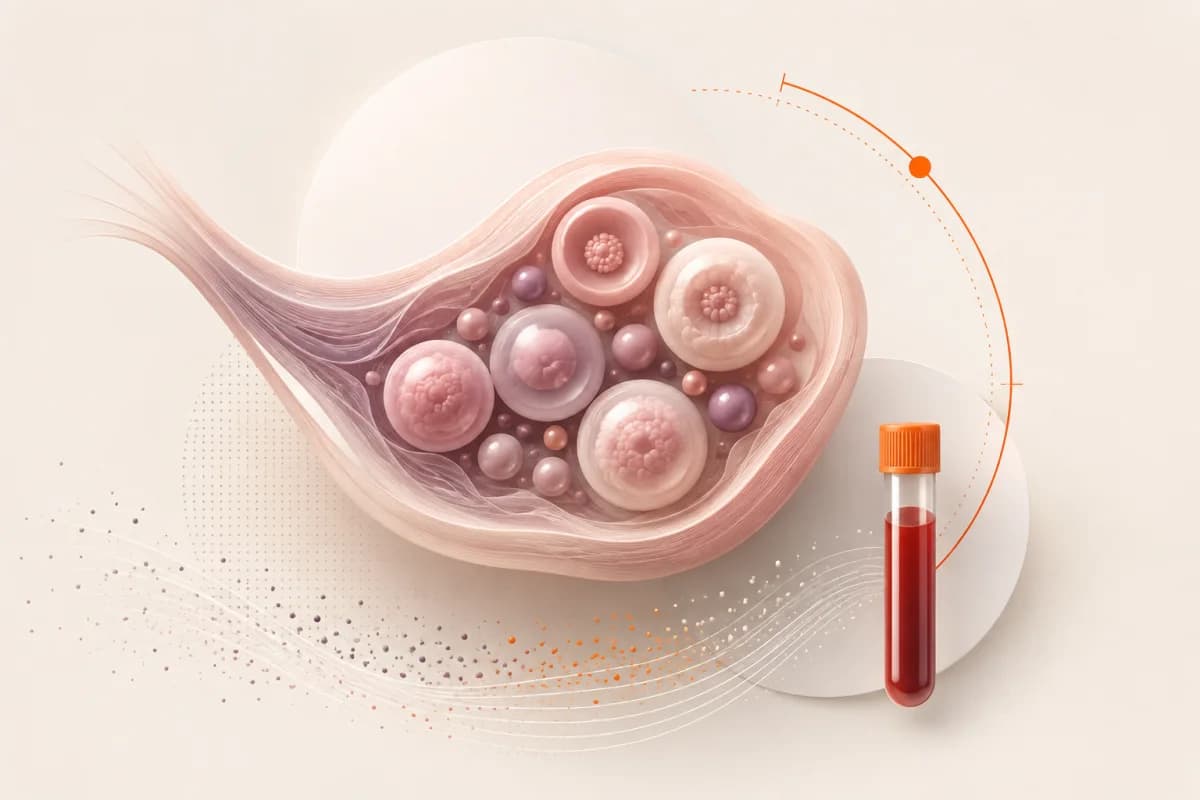
AMH is a hormone made by granulosa cells in small ovarian follicles. As the follicle pool changes with age, AMH usually changes too. This makes AMH a marker related to follicle quantity, not a direct count of eggs and not a direct test of whether an egg can produce a healthy pregnancy.See reference 1,See reference 2
AMH is often measured with an ovarian ultrasound measure called antral follicle count. Together, these tests can help estimate how many oocytes may be obtained after controlled ovarian stimulation. They are much less informative about reproductive potential than many people assume when age and the broader fertility assessment are left out.See reference 2
AMH can be measured at several points in a menstrual cycle, but it is not perfectly stable. The assay platform, calibration, sample timing, hormonal contraception and the population used to establish an interval can all affect the result. A number copied without the laboratory details is incomplete.See reference 2,See reference 3
Questions AMH can help with
- Question
- What is the likely ovarian reserve?
- What AMH may contribute
- AMH can add information about the quantity of small follicles and how that reserve compares with the laboratory's age and population context.
- Important limit
- It is an estimate, not a direct egg count, and people of the same age can have different results.See reference 1,See reference 2
- Question
- How might the ovaries respond to stimulation?
- What AMH may contribute
- AMH and antral follicle count are useful predictors of oocyte yield and risk of a low or high ovarian response during assisted reproduction.
- Important limit
- Predicting egg yield is not the same as predicting egg quality, embryo health, pregnancy or live birth.See reference 1,See reference 2
- Question
- Could polycystic ovarian morphology be part of an assessment?
- What AMH may contribute
- In adults, AMH may be used as an alternative to ultrasound for the polycystic ovarian morphology component in the 2023 PCOS guideline, when the full diagnostic framework is applied.
- Important limit
- AMH alone does not diagnose PCOS. Symptoms, ovulation, androgen findings and exclusion of other causes remain relevant.See reference 1,See reference 4
- Question
- How can a fertility team plan?
- What AMH may contribute
- The result can help a fertility team counsel about stimulation response and choose a monitored plan with other clinical information.
- Important limit
- It should not be used as a personal treatment dose, to deny treatment or to decide that pregnancy is or is not possible.See reference 1,See reference 2
What one AMH result cannot predict reliably
- Claim people often make
- Egg quality
- What the evidence supports
- AMH mainly reflects follicle quantity. Oocyte quality is a different concept and is strongly related to reproductive age and other factors.
- Why the shortcut fails
- More follicles does not mean every egg is healthy, and fewer follicles does not mean pregnancy is impossible.See reference 1,See reference 2
- Claim people often make
- Natural fertility or time-to-pregnancy
- What the evidence supports
- Ovarian reserve markers are poor independent predictors of reproductive potential and should not be treated as a fertility test in people without infertility.
- Why the shortcut fails
- Conception depends on ovulation, sperm, tubes, timing, age, health and chance, not AMH alone.See reference 2,See reference 3
- Claim people often make
- Whether pregnancy will occur
- What the evidence supports
- AMH cannot tell whether a person will become pregnant. It is a planning marker in some fertility-care settings, not a pregnancy test or guarantee.
- Why the shortcut fails
- A high or low value cannot replace a complete fertility evaluation or a pregnancy test.See reference 1,See reference 2,See reference 3
- Claim people often make
- When menopause will happen
- What the evidence supports
- AMH generally falls as ovarian reserve declines, but a single result cannot reliably predict the time until menopause.
- Why the shortcut fails
- Menopause timing varies between people, and a low result is not a calendar.See reference 1,See reference 3
- Claim people often make
- Miscarriage risk
- What the evidence supports
- AMH is not a validated stand-alone test for miscarriage risk or embryo health.
- Why the shortcut fails
- Do not use the result to predict an individual pregnancy outcome or to choose treatment without clinical assessment.See reference 2,See reference 3
Why age, assay and purpose change interpretation
- Context
- Age and life stage
- Why it matters
- AMH generally declines with age, while ovarian reserve varies among people of the same age.
- Practical boundary
- Interpret the value against the report's age context. Do not borrow a range from another person or website.See reference 1,See reference 2
- Context
- Assay and laboratory
- Why it matters
- Different AMH assays can produce results that are not directly interchangeable because calibration and analytical performance differ.
- Practical boundary
- Keep the assay name, laboratory interval, unit, decimal precision and collection date with the result, especially when comparing trends.See reference 2,See reference 3
- Context
- Hormonal contraception
- Why it matters
- Current hormonal contraceptive use can be associated with lower AMH, so the result may need cautious interpretation.
- Practical boundary
- Tell the clinician what contraception was used and when. Do not stop it to change a laboratory number without advice.See reference 2
- Context
- Reason for testing
- Why it matters
- A fertility-treatment planning question, a PCOS assessment and an early ovarian insufficiency question require different supporting information.
- Practical boundary
- The same number can have different implications in different clinical settings.See reference 1,See reference 2,See reference 4
Units, intervals and the original laboratory report
AMH is commonly reported in ng/mL or pmol/L. These are different units, and the numerical value cannot be compared directly between them. Because assays also differ, an online conversion or borrowed cut-off can create false precision. This guide therefore does not provide a conversion or a universal normal range.See reference 2,See reference 3
Keep the original value, unit, laboratory reference interval, assay or method if shown, collection date, age and relevant contraception or treatment context. If a result is near a laboratory boundary or does not fit the clinical question, ask the ordering clinician or laboratory how it should be interpreted rather than recalculating it from a different source.See reference 1,See reference 2,See reference 3
How an AMH result is usually used next
AMH is a blood test and usually needs no special preparation. The next step depends on why it was ordered. In fertility care, a clinician may combine it with age, history, antral follicle count, ovulation information and semen or tubal assessment. In a PCOS assessment, it is only one possible component of a broader diagnostic framework.See reference 1,See reference 2,See reference 4
A very low result should not be treated as proof that pregnancy cannot occur or as a reason to refuse fertility treatment. A higher result can be associated with a greater response to stimulation, but it does not make egg quality or pregnancy outcomes predictable. A clinician can explain what the value changes in the specific decision being made.See reference 1,See reference 2
AMH should not be used as a stand-alone primary diagnostic test for premature ovarian insufficiency. When that condition is considered, symptoms, menstrual history, follicle-stimulating hormone and the wider clinical context are important.See reference 5
Do not turn AMH into a personal forecast
An AMH result is educational context, not a diagnosis, treatment dose or promise about pregnancy. Discuss the original report with a qualified fertility or healthcare professional if you are trying to conceive, considering fertility preservation, have irregular or absent periods, are using hormonal contraception, or are worried about early ovarian insufficiency. Do not stop contraception or start a fertility supplement because of one result.See reference 1,See reference 2,See reference 3,See reference 4
Common AMH questions
Does AMH measure egg quality?
No. AMH is mainly related to the quantity of small ovarian follicles. Egg quality is different and cannot be inferred from a single AMH result.See reference 1,See reference 2
Can AMH tell me whether I will get pregnant naturally?
No. AMH is not a stand-alone natural fertility or time-to-pregnancy test. Ovarian reserve is only one part of reproductive potential, and age and other factors matter.See reference 1,See reference 2,See reference 3
Can AMH predict when I will reach menopause?
No reliable date can be calculated from one AMH result. AMH usually falls as ovarian reserve declines, but the result is not a menopause countdown.See reference 1,See reference 3
Can AMH diagnose PCOS by itself?
No. A high AMH can be part of the assessment, and the 2023 guideline allows AMH to help define polycystic ovarian morphology in adults in the right framework, but AMH alone does not diagnose PCOS.See reference 1,See reference 4
Does hormonal contraception affect AMH?
Current hormonal contraception can be associated with lower AMH. Tell the clinician what you use and do not stop it just to change the result without medical advice.See reference 2
Can I convert AMH from ng/mL to pmol/L online?
Do not rely on an online conversion as if it created a new laboratory result. Preserve the reported unit and assay because different methods and clinical intervals are not interchangeable. Ask the laboratory or clinician if a conversion is genuinely needed.See reference 2,See reference 3
References
- 1. Anti-Müllerian Hormone Test: MedlinePlus Medical Test
MedlinePlus, U.S. National Library of MedicineOfficial guidance
- 2. Testing and interpreting measures of ovarian reserve: a committee opinion
American Society for Reproductive MedicineGuideline
- 3. The Use of Antimüllerian Hormone in Women Not Seeking Fertility Care
American College of Obstetricians and GynecologistsGuideline
- 4. Recommendations from the 2023 International Evidence-based Guideline for the Assessment and Management of Polycystic Ovary Syndrome
American Society for Reproductive Medicine and international PCOS guideline groupGuideline
- 5. Evidence-based guideline: Premature Ovarian Insufficiency (2025)
American Society for Reproductive Medicine and international POI guideline groupGuideline
Editorial transparency
- Published by
- LongevityMate Editorial
- Published
- Updated
Medical disclaimer
This educational guide is not medical advice and does not diagnose, treat or predict fertility, pregnancy, miscarriage or menopause timing. A qualified healthcare professional should interpret AMH with age, clinical purpose, the complete laboratory report, unit, assay, reference interval, hormonal contraception, menstrual history and other fertility or endocrine information. Do not start, stop or change contraception, fertility treatment or supplements based on this guide.