
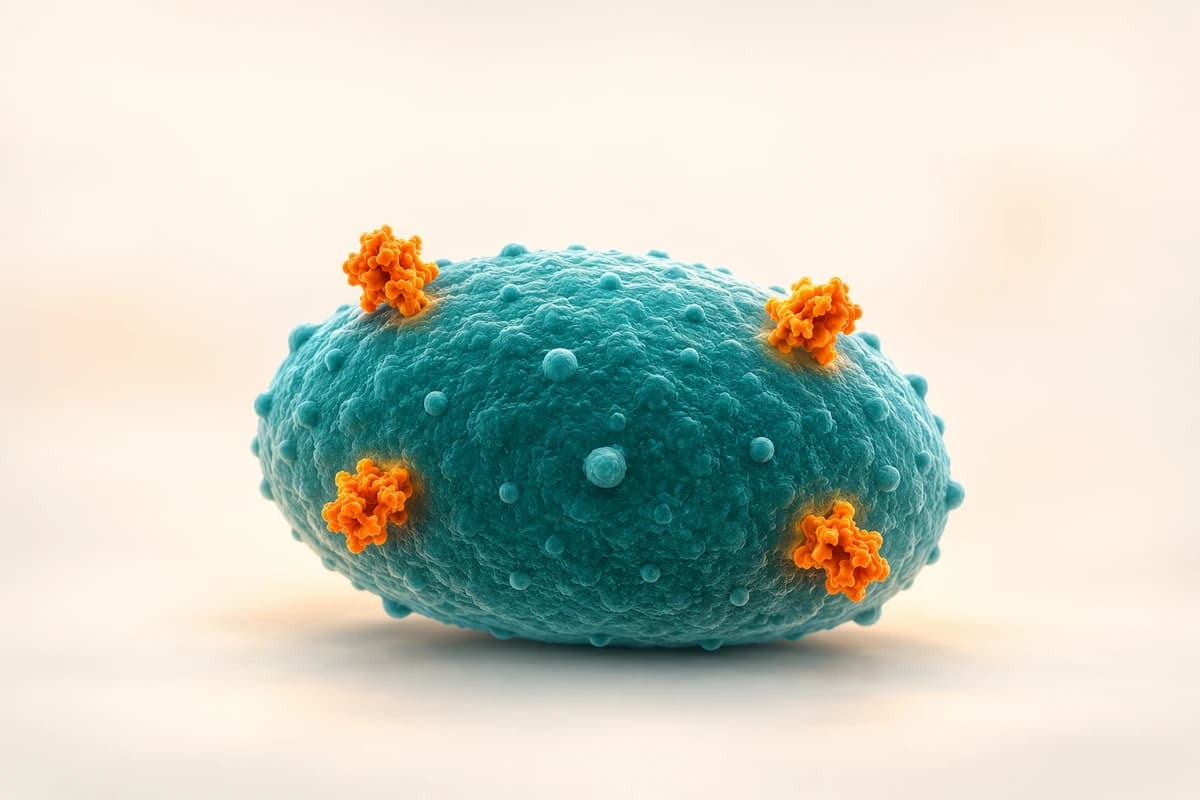
What C3 does in the complement system
Complement proteins help the body respond to unwanted material and clear cellular debris. During activation, C3 is split into smaller pieces. One, C3b, participates in reactions on cell surfaces. These reactions need careful control to protect the body’s own tissues.See reference 3
The artwork shows conceptual protein tags on a microbe-like surface. It illustrates part of complement activity, rather than antibodies, a literal molecular structure or a measured level of immune protection. A C3 concentration test does not directly count those surface tags.See reference 3
C3, C4 and function tests answer different questions
- Test
- C3 concentration
- Main question
- How much component C3 is present?
- What to avoid assuming
- A concentration is not the same as a complete pathway function testSee reference 1,See reference 2
- Test
- C4 concentration
- Main question
- How much of a different complement component is present?
- What to avoid assuming
- C4 is not another name for C3See reference 1
- Test
- CH50
- Main question
- How well does the classical complement pathway function in the assay?
- What to avoid assuming
- This is not a sum of C3 and C4 concentrationsSee reference 2
- Test
- AH50
- Main question
- How well does the alternative complement pathway function in the assay?
- What to avoid assuming
- Its purpose and interpretation differ from a C3 concentration aloneSee reference 2
Why a low result needs the pattern and the purpose
Several complement components may fall when they are used up during immune activity. The pattern can help investigate consumption, inherited deficiency or other explanations; one result cannot choose between them.See reference 2
For autoimmune assessment, a clinician considers complement alongside symptoms and other tests. A low C3 result alone does not establish lupus or provide a treatment plan.See reference 1
Normal and high values have limits too
Normal C3 does not prove that every complement protein or pathway works normally. ARUP describes functional defects despite normal protein concentrations. Function assays can therefore answer a different question.See reference 2
Inflammatory activity can increase complement levels. A higher C3 value is not an immune advantage or wellness goal. Ask what it contributes to this investigation.See reference 1
Keep comparable reports and the clinical context
Save the exact test name, collection date, value, units and laboratory interval. Reference intervals can differ between laboratories. If you are following a trend, ask whether the same method was used before interpreting a change as a change in your condition.See reference 4
Tell the clinician about recent illness and medicines. Complement-directed treatments are especially relevant to functional testing. The care team decides which assay, timing or additional tests fit the question; this page does not recommend stopping treatment or ordering a panel yourself.See reference 2
Keep the useful details
- Keep C3 concentration, C4 concentration and complement function separate on your records.See reference 1,See reference 2
- Ask whether the result is being used to investigate a new problem or monitor an established condition.See reference 1
- Keep uncertainty visible when one number does not explain the symptoms or other findings.See reference 4
Common questions
Does low C3 mean I have lupus?
No. C3 can contribute to a broader assessment, but several conditions can affect it. Diagnosis requires clinical evaluation and other evidence.See reference 1,See reference 2
Can C3 replace an antibody test?
No. Complement proteins and antibodies are different parts of the immune response. Tests are chosen for their specific question.See reference 1,See reference 3
Can I compare my C3 number with someone else’s?
A direct comparison can miss different units, methods, intervals and reasons for testing. Use your complete report with your clinician.See reference 4
Get the weekly longevity brief
The week's best longevity research in plain English. Free, every Tuesday.
See your blood results in context
If you already have blood test results, the paid LongevityMate app can help you view related markers together. It provides educational context, not a diagnosis or a replacement for your clinician.
Explore blood test analysisReferences
- 1. Complement blood test
MedlinePlusOfficial guidance
- 2. Complement deficiency testing
ARUP ConsultOfficial guidance
- 3. C3 gene: normal function
MedlinePlus GeneticsOfficial guidance
- 4. How to understand your lab results
MedlinePlusOfficial guidance
Editorial transparency
- Published by
- LongevityMate Editorial
- Published
- Updated
Medical disclaimer
General education only. This guide does not diagnose a condition, interpret your personal result, choose a treatment or recommend a supplement dose. Discuss testing, symptoms, medicines and supplements with a qualified health professional.