
What the sample can tell the care team
The common test is called fecal elastase-1, FE-1 or stool elastase. NIDDK describes it as the most commonly used stool test for EPI. The clinician also considers symptoms, medical history and tests for nutritional deficiencies; the stool measurement is one part of that assessment.See reference 2
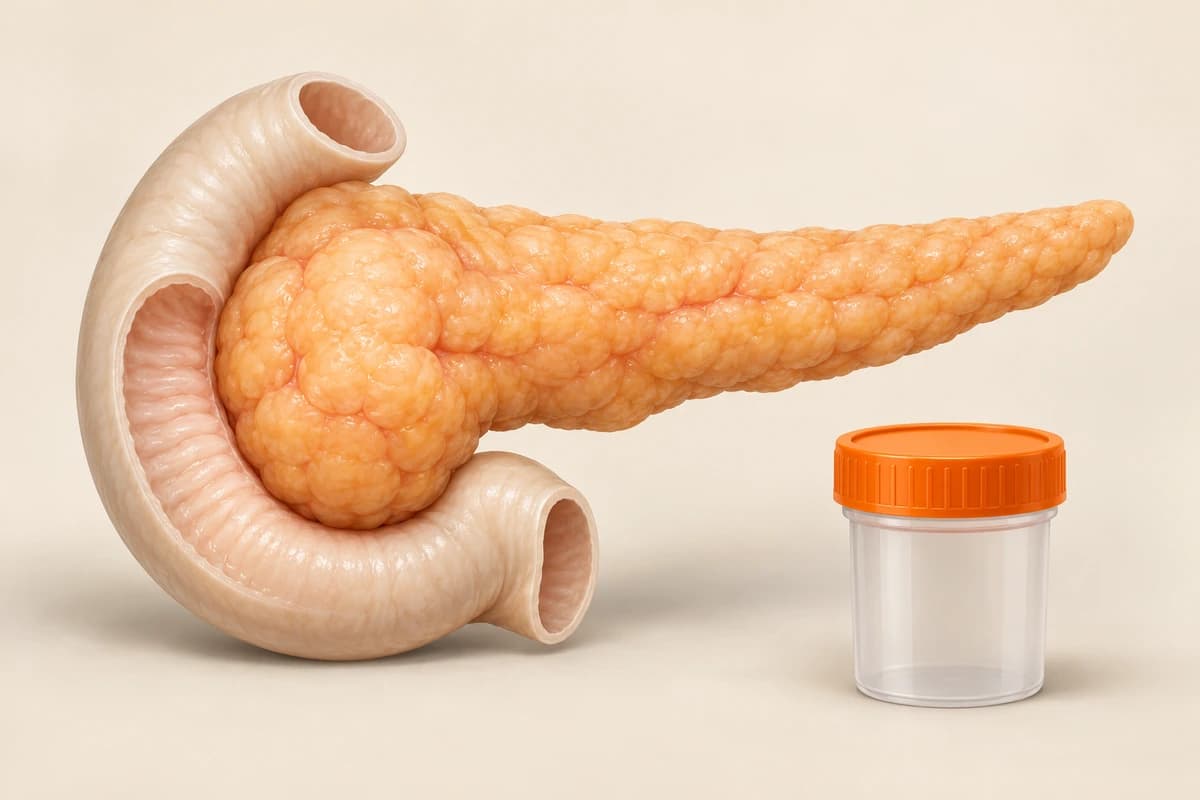
The illustration shows a simplified pancreas beside its curved duodenal connection and a closed stool-sample container. It represents the organ and sample type, rather than a scan, the size of a real organ or evidence of disease.
A watery sample can give a misleading low value
AGA advises a semisolid or solid stool specimen. The UK consensus explains that watery diarrhea can dilute the concentration and produce a falsely low result. Tell the laboratory and clinician about consistency; ask whether the sample meets their instructions. Any adjustment or repeat collection is for the testing team to decide.See reference 5
Collect the stool in the supplied container without mixing in urine, toilet water or toilet paper. Follow the laboratory’s collection and storage directions. A photograph of stool or a symptom description cannot replace the requested sample.See reference 1
Keep these questions separate
- Question
- Is pancreatic enzyme output inadequate?
- What helps answer it
- FE-1 alongside clinical history and nutritional assessment
- Important limit
- A normal result does not reliably exclude milder EPISee reference 1
- Question
- What caused the problem?
- What helps answer it
- Further investigation chosen for the symptoms and history
- Important limit
- FE-1 alone does not name the causeSee reference 2
- Question
- Is there a structural pancreatic problem?
- What helps answer it
- CT, MRI or endoscopic ultrasound may help investigate structure
- Important limit
- AGA says these scans do not themselves establish EPISee reference 3
- Question
- Did symptoms improve with enzymes?
- What helps answer it
- A treatment response may inform ongoing care
- Important limit
- AGA says an enzyme-treatment trial is unreliable for diagnosing EPISee reference 3
Use published cutoffs as context, not a self-diagnosis
AGA’s 2023 advice calls an FE-1 result below 100 μg/g good evidence of EPI, and 100–200 μg/g indeterminate. Those categories assume an appropriate specimen and a clinical investigation. They are not a diagnosis, cause or treatment decision for an individual reader.See reference 3
Terminology differs between sources: Mayo calls 100–200 μg/g suggestive of moderate insufficiency, while AGA calls that band indeterminate. Mayo also cautions that low concentrations are not diagnostic, especially when the clinical likelihood is low. This uncertainty supports clinical interpretation rather than choosing a label yourself.See reference 6
Keep your laboratory’s value, units, interval, date and sample details. A result inside the interval does not rule out every problem, and an outside result does not identify the disease. Ask how the test fits the symptoms and what remains uncertain.See reference 4
Confirm medicine instructions before collection
Source instructions differ: MedlinePlus says pancreatic enzymes may need to be withheld before collection, while AGA says FE-1 can be tested during pancreatic enzyme replacement therapy. Confirm the exact assay and instructions with the clinician and laboratory. Do not stop prescribed enzymes because of a general page.See reference 1,See reference 3
Keep the useful details
- Tell the testing team if the collected sample was watery.See reference 5
- Keep the original report and the sample circumstances together.See reference 4
- Ask about persistent symptoms even when the stool result appears normal.See reference 1
Common questions
Is this a blood elastase test?
This guide concerns pancreatic elastase in a stool sample, often called FE-1. Confirm the specimen and exact test name on your report.See reference 2
Does low stool elastase identify pancreatic cancer?
No. Elastase alone cannot establish the cause. Structural investigations answer a different question and are chosen by the care team.See reference 2,See reference 3
Does improvement after enzymes prove EPI?
No. AGA cautions that a therapeutic trial is unreliable as a diagnostic test.See reference 3
Get the weekly longevity brief
The week's best longevity research in plain English. Free, every Tuesday.
See your blood results in context
If you already have blood test results, the paid LongevityMate app can help you view related markers together. It provides educational context, not a diagnosis or a replacement for your clinician.
Explore blood test analysisReferences
- 1. Stool elastase test
MedlinePlusOfficial guidance
- 2. Diagnosis of exocrine pancreatic insufficiency
NIDDKOfficial guidance
- 3. Epidemiology, evaluation and management of exocrine pancreatic insufficiency: best practice advice
American Gastroenterological Association, 2023Official guidance
- 4. How to understand your lab results
MedlinePlusOfficial guidance
- 5. Consensus for the management of pancreatic exocrine insufficiency: UK practical guidelines
Phillips et al., BMJ Open Gastroenterology, 2021Official guidance
- 6. Pancreatic elastase, feces: interpretation and cautions
Mayo Clinic LaboratoriesOfficial guidance
Editorial transparency
- Published by
- LongevityMate Editorial
- Published
- Updated
Medical disclaimer
General education only. This guide does not diagnose a condition, interpret your personal result, choose a treatment or recommend a supplement dose. Discuss testing, symptoms, medicines and supplements with a qualified health professional.