
A transport protein, not a nutrition score
Prealbumin helps carry thyroid hormone and vitamin A through blood. Despite its name, the report is measuring a specific protein, rather than a combined score for dietary protein, albumin or muscle. Keep the exact test name with the result.See reference 1,See reference 3
ASPEN’s position paper says albumin and prealbumin mainly reflect inflammation and associated illness risk rather than protein-energy malnutrition. During inflammation, the liver changes protein production and proteins move between blood and tissues. A low concentration therefore cannot identify one cause.See reference 2
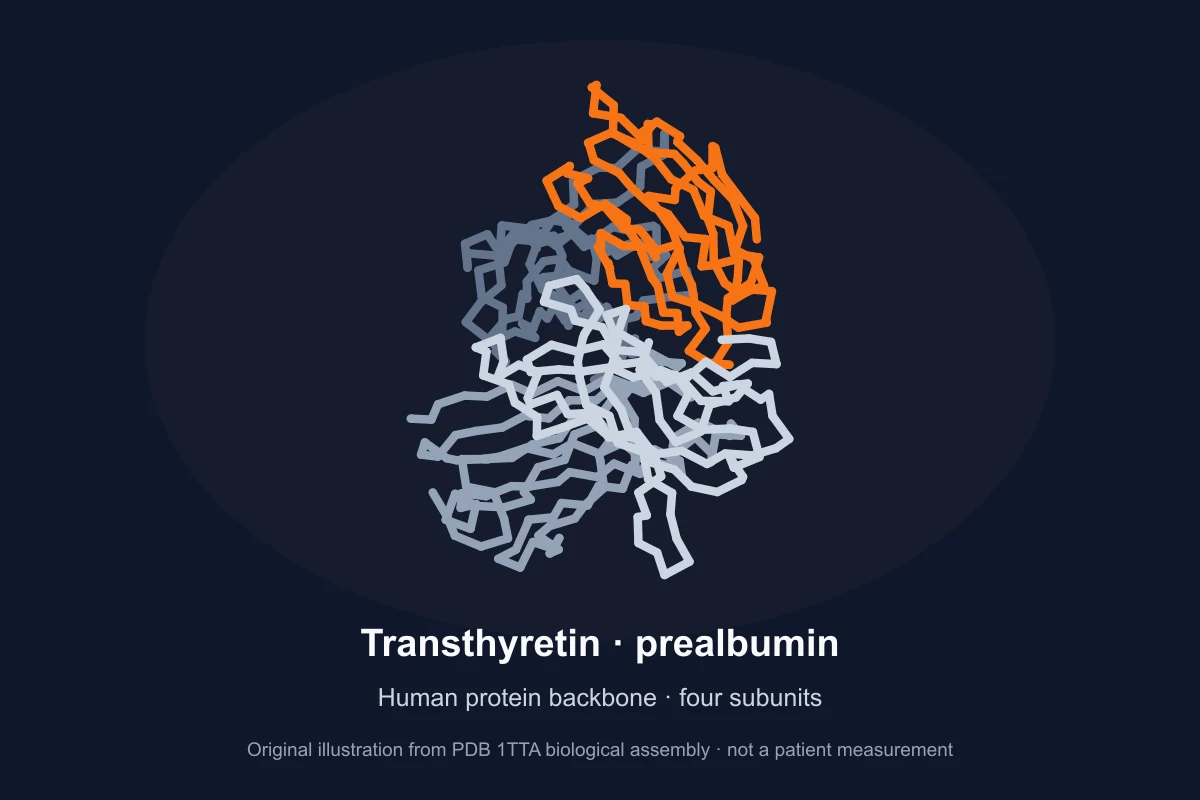
What the illustration shows
The original illustration follows the deposited backbone coordinates of normal human transthyretin, PDB 1TTA. Its four subunits are distinguished by colour. It explains the protein’s structure rather than showing a patient sample, a nutrition result or an abnormal protein deposit.See reference 4
What a result can and cannot establish
- Report finding
- Low prealbumin
- Useful context
- Inflammation, infection, injury, liver disease and nutrition problems can coexist
- Limit
- The number cannot distinguish these causes or diagnose malnutrition aloneSee reference 1,See reference 2
- Report finding
- High prealbumin
- Useful context
- Kidney disease and some medicines, including high-dose corticosteroids, can affect levels
- Limit
- Prealbumin is not a diagnostic test for these conditionsSee reference 1
- Report finding
- A result inside the laboratory range
- Useful context
- Compare it with the reason for testing and the wider assessment
- Limit
- An in-range value is not proof of adequate food intake or muscle massSee reference 2
Read the units and the laboratory’s own interval
As one laboratory example, OHSU lists 17.0–34.0 mg/dL. That is its stated interval, not a universal target or treatment threshold. Your report’s interval and the clinician’s interpretation take precedence over an example found online.See reference 3
A unit change can make the same concentration look ten times larger: 20 mg/dL equals 200 mg/L. Compare like units before discussing a trend; neither notation changes what the sample contains. This is unit arithmetic, not an interpretation of whether 20 is appropriate for you.See reference 3
Why nutrition assessment needs more than this test
Inflammation and malnutrition can occur together. Saying that prealbumin cannot diagnose malnutrition does not mean nutrition concerns should be ignored. ASPEN distinguishes illness-related risk from actual nutrition assessment; one blood protein cannot stand in for total body protein or muscle.See reference 2
Bring changes in food intake, unintentional weight change and the clinical reason for the test to a nutrition discussion. A qualified clinician or dietitian can assess those concerns alongside illness and examination findings rather than choosing a protein supplement from this number.See reference 1,See reference 2
A rising result does not identify what improved
If inflammation settles during recovery, prealbumin may rise at the same time that feeding improves. That does not separate the contribution of nutrition from recovery. A sequence of results is context for the care team, not proof that a specific food, powder or feeding change caused the rise.See reference 2
Preparation and useful report details
MedlinePlus says the prealbumin test itself needs no special preparation. Other tests collected with it may have instructions. Tell the collection team about medicines and supplements; do not stop prescribed treatment because of this guide.See reference 1
Keep the test name, date, original unit, laboratory interval, recent illness or injury, medicines and the reason for testing. Ask what question the result was intended to answer and what other evidence will guide follow-up.See reference 1,See reference 2
Common questions
Does low prealbumin mean I need more protein?
It cannot establish that by itself. Inflammation and illness can lower the level even when the number is being used during nutrition care. A nutrition assessment addresses the actual intake and clinical problem.See reference 1,See reference 2
Is prealbumin the same as albumin?
No. Prealbumin is also called transthyretin; albumin is a different blood protein. ASPEN cautions against using either as a stand-alone measure of nutrition or muscle.See reference 2,See reference 3
Is a higher prealbumin always better?
No. High values can be affected by disease or medicines. Raising the number is not a general wellness goal.See reference 1
Get the weekly longevity brief
The week's best longevity research in plain English. Free, every Tuesday.
See your blood results in context
If you already have blood test results, the paid LongevityMate app can help you view related markers together. It provides educational context, not a diagnosis or a replacement for your clinician.
Explore blood test analysisReferences
- 1. Prealbumin blood test
MedlinePlus, U.S. National Library of MedicineOfficial guidance
- 2. The use of visceral proteins as nutrition markers: an ASPEN position paper
Evans and colleagues; Nutrition in Clinical PracticeGuideline
- 3. Prealbumin: laboratory test directory
Oregon Health & Science UniversityOfficial guidance
- 4. Normal human transthyretin structure, PDB 1TTA; Hamilton and colleagues, J Biol Chem 1993;268:2416–2424
RCSB Protein Data BankObservational study
Editorial transparency
- Published by
- LongevityMate Editorial
- Review
- Editorial evidence review (AI-assisted)
- Published
- Updated
Medical disclaimer
General education only. AI-assisted editorial evidence review is not a qualified clinical assessment. This guide does not diagnose a condition, interpret a personal result, choose treatment or recommend a supplement dose. Discuss testing, symptoms, medicines and supplements with a qualified health professional.