
Start with the reason the test was ordered
NIAMS explains that diagnosing RA brings together the history of symptoms, joint examination, blood tests and sometimes imaging. No single test settles the diagnosis, especially early in the condition. Persistent joint swelling, stiffness or pain therefore needs clinical assessment even when a blood result looks reassuring.See reference 2
An RF test answers an antibody question. It does not show the shape of a joint or establish why a particular joint hurts. The clinician connects that laboratory finding to the pattern and duration of symptoms and examination findings.See reference 2
What the result can and cannot establish
- Finding
- RF positive
- Useful information
- RF was detected above the laboratory’s decision point
- Limit
- Other autoimmune conditions, some infections and people without RA can also have positive RFSee reference 1
- Finding
- RF negative
- Useful information
- The assay did not identify RF above its decision point
- Limit
- RA is still possible; a negative antibody is not a reason to dismiss symptomsSee reference 1
- Finding
- RF and anti-CCP results
- Useful information
- Different autoantibody findings used in an RA assessment
- Limit
- They need the clinical picture and do not replace examinationSee reference 3
- Finding
- CRP or ESR alongside RF
- Useful information
- Information about inflammation from a different type of measurement
- Limit
- Inflammation markers do not identify the cause on their ownSee reference 2
RF and anti-CCP are related, different tests
ARUP describes RF and anti-cyclic citrullinated peptide antibodies (anti-CCP) as established serologic markers used in RA assessment. ‘Serologic’ means testing blood for antibodies. Testing negative for these antibodies is sometimes called seronegative disease; it does not make symptoms imaginary or remove the need to consider other explanations.See reference 3
RA classification considers joint involvement, antibody findings, inflammation and symptom duration together. A classification system supports a consistent description of disease; copying its antibody component alone is not a personal diagnosis. Ask which information is already available and which question remains open.See reference 3
Keep the laboratory’s units and interval
Your report may give a numeric value with units or describe RF as positive or negative. Use the interval and method on that report. Laboratories can use different methods and reference ranges, so a number from another laboratory or a general internet cutoff may not be comparable.See reference 4
An outside-range result may occur in a healthy person, and an inside-range result does not guarantee good health. Keep the original value, test date, units and laboratory details together, particularly when discussing changes over time.See reference 4
A blood sample, with a conceptual illustration
RF testing uses a blood sample. MedlinePlus says the RF test itself usually needs no special preparation, but other tests taken at the same visit may have instructions. Confirm those with the testing team. The draw can cause brief discomfort or a small bruise.See reference 1
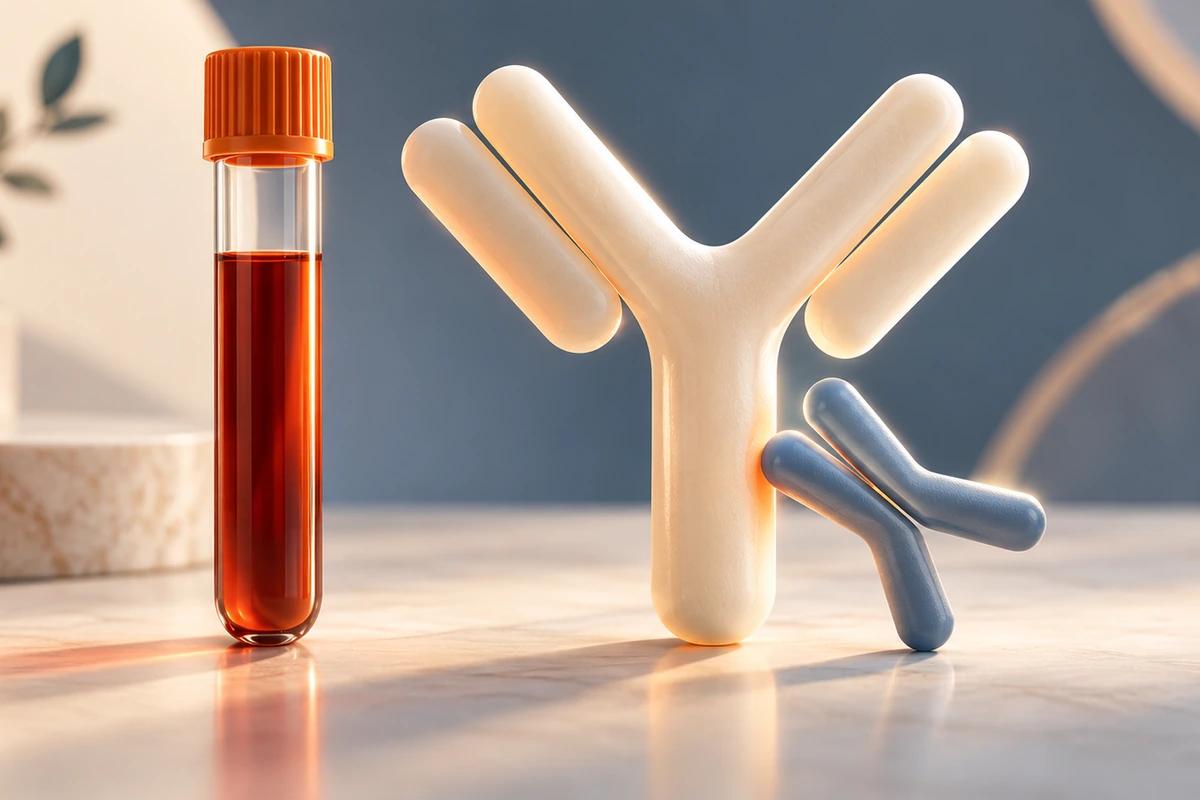
The guide’s image uses simplified antibody shapes beside a blood tube to represent autoantibody recognition. It is an illustration, not a molecular model, a patient’s specimen or proof of an abnormal result.
Keep the useful details
- Bring the symptom history as well as the blood report.See reference 2
- Ask how RF fits any anti-CCP and inflammation tests already taken.See reference 3
- Use your own laboratory’s units and interval.See reference 4
Common questions
Does a positive RF mean I have rheumatoid arthritis?
No. RF can support the assessment, but a positive result alone does not establish RA.See reference 1
Does a negative RF rule it out?
No. NIAMS notes that not everyone with RA has positive RF. Symptoms and examination still matter.See reference 2
Is RF the same as CRP?
No. RF is an antibody test; CRP is an inflammation marker. They answer different questions within a clinical assessment.See reference 3
Get the weekly longevity brief
The week's best longevity research in plain English. Free, every Tuesday.
See your blood results in context
If you already have blood test results, the paid LongevityMate app can help you view related markers together. It provides educational context, not a diagnosis or a replacement for your clinician.
Explore blood test analysisReferences
- 1. Rheumatoid factor (RF) test
MedlinePlusOfficial guidance
- 2. Rheumatoid arthritis: diagnosis, treatment and steps to take
NIAMSOfficial guidance
- 3. Rheumatoid arthritis: laboratory testing
ARUP ConsultOfficial guidance
- 4. How to understand your lab results
MedlinePlusOfficial guidance
Editorial transparency
- Published by
- LongevityMate Editorial
- Published
- Updated
Medical disclaimer
General education only. This guide does not diagnose a condition, interpret your personal result, choose a treatment or recommend a supplement dose. Discuss testing, symptoms, medicines and supplements with a qualified health professional.