
Three similar names, different results
- Report label
- Total T4 or TT4
- What it describes
- Bound and free thyroxine together.
- Important distinction
- The amount of transport protein can change the total.See reference 1,See reference 2
- Report label
- Free T4 or FT4
- What it describes
- Thyroxine not attached to a carrier protein.
- Important distinction
- It is a different measurement, not the same number with a shorter name.See reference 1,See reference 2
- Report label
- Free T4 index or FTI
- What it describes
- An estimate using total hormone and a binding-related measurement.
- Important distinction
- An index is not a directly measured free T4 concentration.See reference 1,See reference 2
Why the total can change when free hormone does not
Most circulating T4 travels attached to proteins. Changes in those carriers can change the bound amount and therefore the total. Pregnancy and estrogen-containing medicines can increase binding proteins. An isolated high total T4 in that setting does not, by itself, establish that the thyroid is overactive.See reference 1
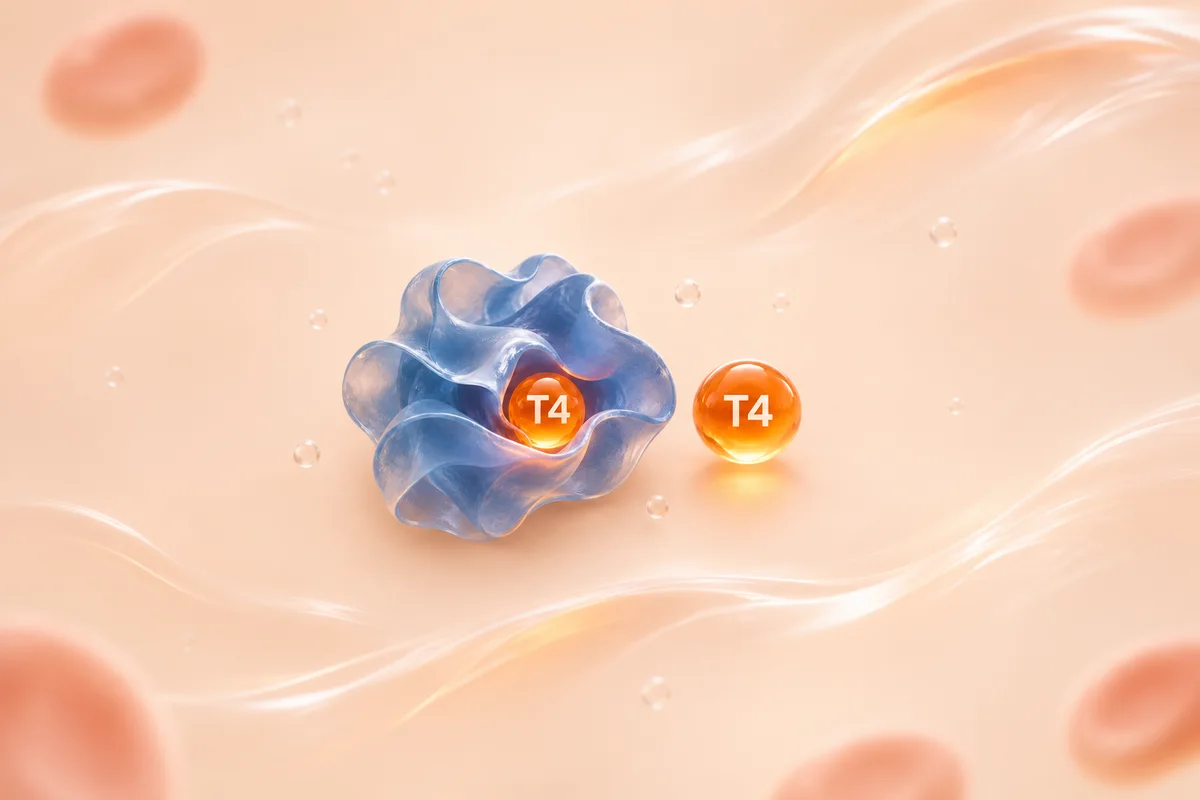
The illustration compares a bound T4 token with a free token. It is a conceptual explanation of binding, not a molecular structure or a picture of their relative abundance. The practical question is whether the result reflects hormone production, a carrier change, a testing issue or a combination.See reference 1,See reference 3
What a high or low flag can tell you
A result above or below the reporting laboratory’s interval means that total concentration differs from its comparison range. Thyroid disease is one possible explanation, but illness, medicines and binding-protein differences can also matter. A clinician can compare the pattern with TSH, an appropriate free-hormone test and the clinical history.See reference 1,See reference 2
Pregnancy needs pregnancy-appropriate interpretation. Do not apply an unrelated adult internet interval to a pregnancy result. Likewise, a result being inside an interval does not answer every thyroid question, particularly if other findings disagree.See reference 1,See reference 2,See reference 3
Keep the unit and method attached to the number
Total T4 may be reported in micrograms per decilitre (µg/dL) or nanomoles per litre (nmol/L). Those numerical scales are different. Free T4 can use other concentration units, so copying its range beside a total T4 number is not a valid comparison.See reference 2,See reference 4
Thyroid immunoassays can be affected by biotin and other interfering substances, and results can differ by method. Tell the testing team about medicines and supplements. If results do not fit together, the laboratory may help investigate; changing thyroid treatment yourself is not the way to resolve a suspected test interference.See reference 2,See reference 3
Common questions
Do I need to fast for total T4?
The T4 test itself usually needs no special preparation. Other tests collected with it may have different requirements. Follow the instructions for your appointment, and do not stop prescribed medicines without advice.See reference 2
Can I convert total T4 into free T4?
No unit conversion can separate the bound and unbound portions of a total measurement. Ask which result was actually measured and whether a different thyroid test is needed for the clinical question.See reference 1,See reference 2
What should I ask about an unexpected result?
Ask whether binding proteins, pregnancy, a medicine, supplement or assay interference could affect the result, and how it fits with TSH and any free-hormone result. Keep the full report and previous dates available.See reference 1,See reference 2,See reference 3
Get the weekly longevity brief
The week's best longevity research in plain English. Free, every Tuesday.
See your blood results in context
If you already have blood test results, the paid LongevityMate app can help you view related markers together. It provides educational context, not a diagnosis or a replacement for your clinician.
Explore blood test analysisReferences
- 1. Thyroid Function Tests
American Thyroid AssociationOfficial guidance
- 2. Thyroxine (T4) Test
MedlinePlus, U.S. National Library of MedicineOfficial guidance
- 3. Analytical Considerations in the Evaluation of Thyroid Function
ARUP ConsultOfficial guidance
- 4. International System of Units (SI) Conversion
Mayo Clinic LaboratoriesOfficial guidance
Editorial transparency
- Published by
- LongevityMate Editorial
- Reviewed by
- Editorial evidence review (AI-assisted)
- Published
- Updated
Medical disclaimer
General education only. This guide does not diagnose a condition, interpret your personal result, choose a treatment or recommend a supplement dose. A qualified health professional can interpret the full report in context.