
Urine glucose, blood glucose and HbA1c answer different questions
- Test
- Urine glucose
- What is measured
- Glucose detected in a urine sample
- Important limit
- It does not directly report the glucose concentration in bloodSee reference 1,See reference 4
- Test
- Blood glucose
- What is measured
- Glucose in the collected blood sample
- Important limit
- Preparation and interpretation depend on the test orderedSee reference 2
- Test
- HbA1c
- What is measured
- Glucose attached to haemoglobin over roughly the preceding three months
- Important limit
- It is a different blood test, not a urine-strip resultSee reference 2
Why glucose can appear in urine
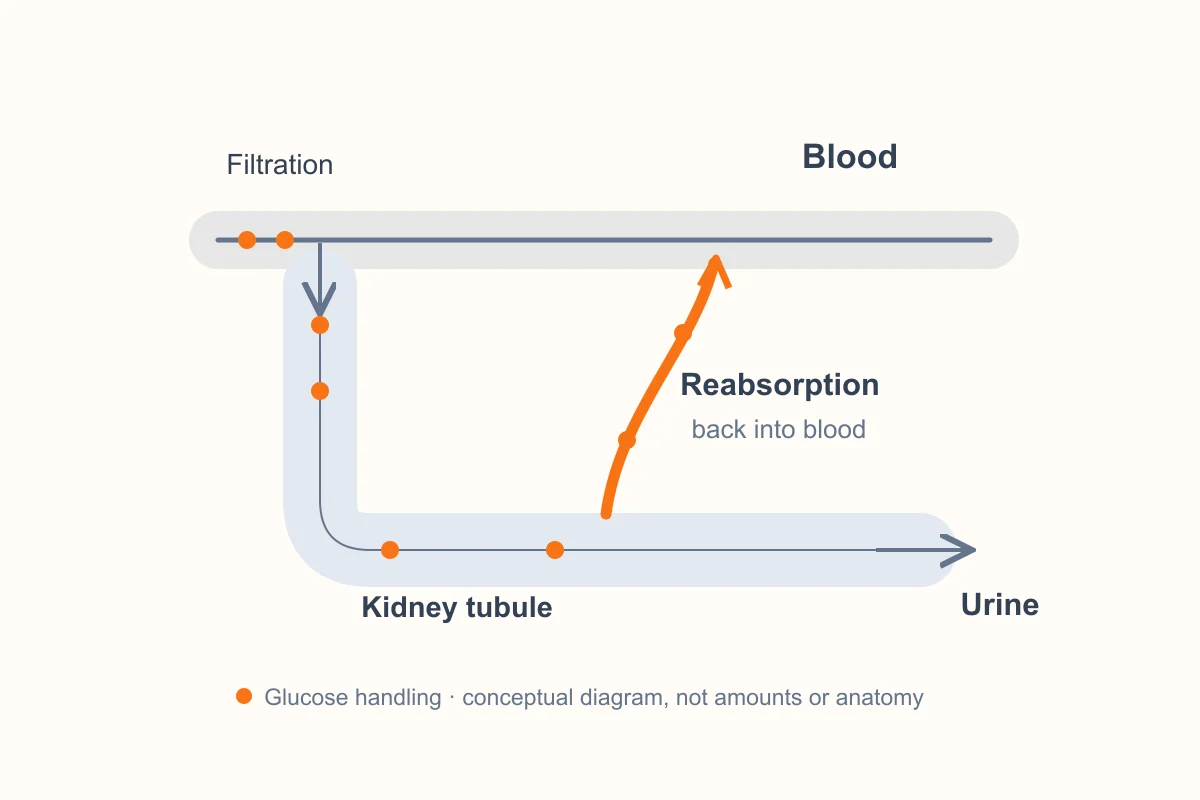
Normally, the kidneys return most filtered glucose to the blood, leaving little or none detectable in urine. Glucose can spill into urine when blood levels are high. Some less common kidney conditions can cause glucose loss even when blood glucose is not high.See reference 1
Mayo Clinic Laboratories notes that urine glucose has limited value for routine diabetes screening or management. An unexpected high urine result may lead to more specific blood testing; it does not establish which explanation applies to a reader.See reference 4
SGLT2 medicines change the meaning of a positive result
SGLT2 inhibitors increase glucose excretion in urine. The empagliflozin prescribing label explicitly warns that this leads to positive urine glucose tests and makes urine glucose unsuitable for monitoring glucose control in people taking these medicines.See reference 3
That can be a real medicine effect rather than a faulty strip. It also means that the amount of urine glucose cannot tell you whether a prescribed treatment is working adequately. Discuss the result and the intended monitoring method with the prescriber; do not change medicine from a strip result.See reference 3
Read the test method, not a borrowed colour chart
Different methods have different detection and reporting characteristics. Mayo’s example uses a glucose-specific enzymatic strip read by a reflectance instrument, with “negative” as its reference description. Its cautions include method-specific false negatives; those details cannot be applied to every home strip.See reference 4
Keep the exact wording, unit if supplied and the laboratory’s own explanation. A urine result in mg/dL still refers to urine. Applying a blood-glucose diagnostic threshold to it would compare different samples.See reference 2,See reference 4
Preparation and collection
Special preparation is usually unnecessary, but follow the collection service’s instructions. Tell it about medicines and supplements, including vitamin C; do not stop treatment without advice. Use the supplied clean-catch instructions when requested and return the closed sample as directed.See reference 1
Some glucose in urine can occur during pregnancy, but a urine result alone cannot determine whether gestational diabetes is present. The pregnancy-care team uses the appropriate assessment and blood-testing pathway.See reference 1,See reference 2
What to keep with the result
Record the sample date, whether it was a home or laboratory test, the result wording, the reason for testing and current medicines. If blood glucose or HbA1c was also measured, keep each result under its own test name. Ask what the combination means and whether a confirmatory test is needed.See reference 1,See reference 2,See reference 3
Common questions
Does glucose in urine always mean diabetes?
No. Medicines and kidney handling can change urinary glucose. The result needs context and, when appropriate, blood testing.See reference 1,See reference 3
Does a negative urine strip exclude diabetes?
No. Blood glucose can be high despite a normal urine glucose result.See reference 1
Can urine glucose monitor an SGLT2 medicine?
The prescribing label advises using other methods for glucose control because the medicine itself increases urinary glucose.See reference 3
Is urine glucose the same as a urine ketone test?
No. A urine glucose measurement detects glucose. It cannot substitute for a separately ordered ketone test or another urine measurement.See reference 1,See reference 4
Get the weekly longevity brief
The week's best longevity research in plain English. Free, every Tuesday.
See your blood results in context
If you already have blood test results, the paid LongevityMate app can help you view related markers together. It provides educational context, not a diagnosis or a replacement for your clinician.
Explore blood test analysisReferences
- 1. Glucose in urine test
MedlinePlus, U.S. National Library of MedicineOfficial guidance
- 2. Diabetes tests
MedlinePlus, U.S. National Library of MedicineOfficial guidance
- 3. Empagliflozin prescribing label: positive urine glucose test
DailyMed, U.S. National Library of MedicineOfficial guidance
- 4. GLUR1: glucose, random, urine
Mayo Clinic LaboratoriesOfficial guidance
Editorial transparency
- Published by
- LongevityMate Editorial
- Review
- Editorial evidence review (AI-assisted)
- Published
- Updated
Medical disclaimer
General education only. AI-assisted editorial evidence review is not a qualified clinical assessment. This guide does not diagnose a condition, interpret a personal result, choose treatment or recommend a supplement dose. Discuss testing, symptoms, medicines and supplements with a qualified health professional.