
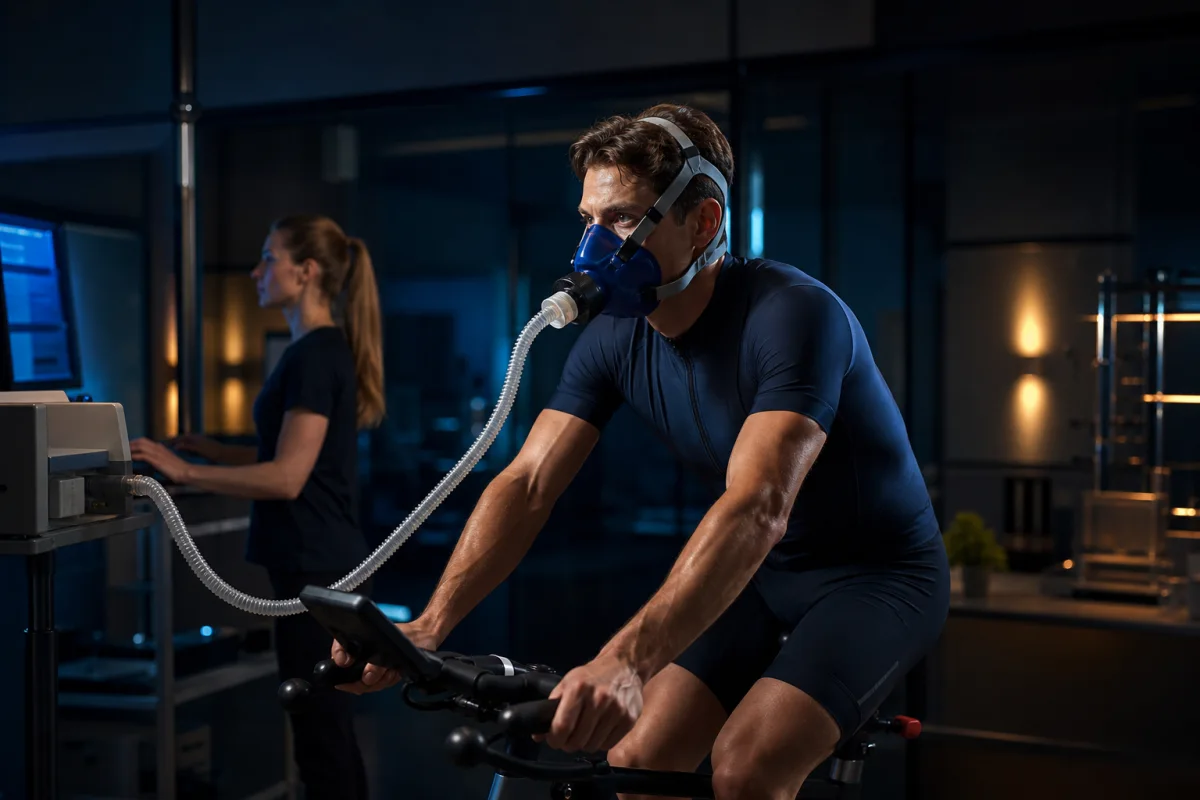
The 10 rules to remember
- Choose the test for the decision you need to make.See reference 1
- A measured laboratory value is not interchangeable with a wearable estimate.See reference 2
- Use the same mode and protocol when tracking change.See reference 3
- Arrive rested, hydrated and familiar with the equipment.See reference 4
- Do not conceal chest symptoms, fainting or relevant medical history.See reference 5
- A true maximal test should end because maximal effort or a clinical stop criterion is reached.See reference 6
- Interpret the result with age, sex, protocol and health context.See reference 7
- Small changes can reflect ordinary measurement variation.See reference 8
- Retest after a meaningful training block, not every week.See reference 9
- Fitness is modifiable; the score is feedback, not identity.See reference 10
First principles: what this tool can actually change
VO₂ equals cardiac output multiplied by the difference in oxygen content between arterial and venous blood. A maximal test stresses delivery by the heart and lungs and extraction by working muscle.See reference 1,See reference 2
Cardiorespiratory fitness is consistently associated with lower mortality and disease risk, but this observational relationship does not make a single test a longevity guarantee.See reference 2,See reference 3
Exercise mode matters: runners often score higher on a treadmill and cyclists on a cycle because familiar muscle mass and technique affect the achieved maximum.See reference 3,See reference 4
A practical protocol
- Stage
- Clinical CPET
- What to do
- Breath-by-breath gas analysis with ECG or clinical monitoring
- Why it matters
- Symptoms, unexplained breathlessness, clinical decisionsSee reference 2
- Stage
- Performance lab
- What to do
- Gas analysis with sport-specific ramp
- Why it matters
- Training zones and performance trackingSee reference 3
- Stage
- Validated field test
- What to do
- Timed distance, shuttle or submaximal protocol
- Why it matters
- Low-cost repeatable estimateSee reference 4
- Stage
- Wearable estimate
- What to do
- Algorithm from pace, power and heart rate
- Why it matters
- Convenient trend onlySee reference 5
Timing and frequency
- When
- 24 hours before
- Action
- Avoid unusually hard or long trainingSee reference 5
- When
- 2-4 hours before
- Action
- Follow lab instructions; avoid a heavy mealSee reference 6
- When
- Test day
- Action
- Keep caffeine, medication and hydration decisions consistentSee reference 7
- When
- Retest
- Action
- Usually after 8-12 weeks of consistent trainingSee reference 8
What to measure
- Signal
- Measured VO₂max
- How
- Gas exchange during maximal exercise
- Interpretation
- Best physiological measurementSee reference 8
- Signal
- VO₂peak
- How
- Highest value reached when a clear plateau is absent
- Interpretation
- Common and still usefulSee reference 9
- Signal
- METs
- How
- VO₂ divided by 3.5 mL/kg/min
- Interpretation
- Clinical exercise capacitySee reference 10
- Signal
- Relative VO₂
- How
- mL/kg/min
- Interpretation
- Affected by body massSee reference 1
What the evidence supports
Testing can establish a baseline, reveal whether training changes fitness and help prescribe intensity when the protocol is appropriate.See reference 1,See reference 4
Clinical CPET can separate cardiovascular, pulmonary and peripheral contributors to exercise limitation, but interpretation belongs with a qualified clinician.See reference 2,See reference 5
A field test may be the better choice when the goal is simple population-level fitness tracking and maximal testing adds cost without changing action.See reference 3,See reference 6
Evidence strength by claim
- Claim
- The protocol changes its immediate target
- Confidence
- Moderate to strong
- Important boundary
- Depends on correct technique and populationSee reference 1,See reference 2
- Claim
- It improves a clinical or functional outcome
- Confidence
- Variable
- Important boundary
- Effect size and relevance differSee reference 3,See reference 4
- Claim
- It prevents major disease
- Confidence
- Usually limited
- Important boundary
- Surrogate outcomes are not clinical eventsSee reference 5,See reference 6
- Claim
- It extends human lifespan
- Confidence
- Not established
- Important boundary
- Association is not proof of causationSee reference 7,See reference 8,See reference 9,See reference 10
Limitations and common overclaims
Values vary with protocol, calibration, motivation, altitude, heat, illness and body-mass changes.See reference 5,See reference 7
Reference percentiles differ between populations and laboratories; an internet chart cannot replace the lab's method-specific interpretation.See reference 6,See reference 8
Wearable estimates can be directionally helpful but should not be presented as equivalent to breath-by-breath measurement.See reference 7,See reference 9
How to make it stick
Choose the smallest version you can repeat under normal conditions. Consistency creates a useful signal; a heroic one-off session does not.See reference 1,See reference 2
Change one variable at a time and write down the protocol. Otherwise an apparent improvement may simply reflect different timing, equipment or conditions.See reference 3,See reference 4
Review the result after a pre-defined period. Continue only when the benefit is meaningful, the burden is acceptable and no safety signal has appeared.See reference 5,See reference 6
Troubleshooting
- Problem
- Results vary widely
- Likely issue
- Technique or conditions changed
- Better next step
- Standardize and average repeated observationsSee reference 2,See reference 3
- Problem
- No meaningful benefit
- Likely issue
- Dose, adherence or target may be wrong
- Better next step
- Verify the protocol before escalatingSee reference 4,See reference 5
- Problem
- Symptoms appear
- Likely issue
- The intervention may be unsuitable
- Better next step
- Stop and use appropriate clinical adviceSee reference 6,See reference 7
- Problem
- Tracking creates anxiety
- Likely issue
- Measurement has replaced the goal
- Better next step
- Reduce frequency and focus on functionSee reference 8,See reference 9,See reference 10
Safety and when to stop
Do not perform an unsupervised maximal field test if you have exertional chest pressure, unexplained fainting, unstable heart or lung disease, an acute illness, or a clinician has told you to avoid maximal exercise. Stop immediately for chest pressure, faintness, severe unusual breathlessness, loss of coordination or sustained palpitations.See reference 1,See reference 5,See reference 9
Who is most likely to benefit
This tool is most useful when it solves a defined problem, is feasible to repeat and changes a decision. It is less useful when collected or performed only because a score or influencer made it seem mandatory.See reference 2,See reference 4
People with symptoms, diagnosed disease, pregnancy, recent surgery or complex medicines should adapt the protocol with an appropriate health professional.See reference 5,See reference 7
The foundation remains sleep, physical activity, nutrition, tobacco avoidance and evidence-based medical care. Add this tool only where it improves that foundation.See reference 8,See reference 10
Track five things
- The exact protocol, equipment and timing.See reference 1
- The outcome the tool is meant to change.See reference 2
- Symptoms and adverse effects.See reference 3
- Adherence and practical burden.See reference 4
- Whether the result changes a real decision.See reference 5
Frequently asked questions
What is a good VO₂max?
Use age-, sex- and protocol-specific reference data; a single universal cutoff is misleading.See reference 3
Is a wearable VO₂max accurate?
It is an estimate. Trends may help, but accuracy varies by device, activity and user.See reference 4
Treadmill or bike?
Use the mode most relevant to you and repeat the same mode later.See reference 5
How often should I test?
After a meaningful training block—often 8-12 weeks—is more useful than frequent testing.See reference 6
Can VO₂max predict lifespan?
It is strongly associated with outcomes, but it does not predict an individual's lifespan.See reference 7
Can beginners do the test?
Many can, but health screening and an appropriate protocol matter.See reference 8
Does body weight change the result?
Relative VO₂ is divided by body mass, so weight changes can move it without the same change in absolute oxygen use.See reference 9
How do I improve it?
Regular aerobic volume plus appropriately dosed intervals is the best-supported approach.See reference 10
Connect the protocol to your wider health picture
LongevityMate helps organize measurements, habits, symptoms and trends so one tool stays in context instead of becoming the whole plan.
See how LongevityMate worksGet the weekly longevity brief
The week's best longevity research in plain English. Free, every Tuesday.
References
- 1. Cardiorespiratory fitness as a clinical vital sign
American Heart AssociationOfficial guidance
- 2. Cardiorespiratory fitness and health outcomes: overview of meta-analyses
British Journal of Sports MedicineSystematic review
- 3. Objectively assessed cardiorespiratory fitness and all-cause mortality
Mayo Clinic ProceedingsMeta-analysis
- 4. Cardiorespiratory fitness and mortality dose-response meta-analysis
British Journal of Sports MedicineMeta-analysis
- 5. ACSM's Guidelines for Exercise Testing and Prescription
American College of Sports MedicineGuideline
- 6. Clinical recommendations for cardiopulmonary exercise testing
European Respiratory JournalOfficial guidance
- 7. Cardiopulmonary exercise testing in clinical practice
European Heart JournalOfficial guidance
- 8. Validity of wearable cardiorespiratory fitness estimates
Sports MedicineSystematic review
- 9. Cooper 12-minute run test validity
Journal of Sports Medicine and Physical FitnessSystematic review
- 10. WHO guidelines on physical activity and sedentary behaviour
World Health OrganizationGuideline
Editorial transparency
- Published by
- LongevityMate Editorial Team
- Published
- Updated
Medical disclaimer
This guide provides general health education. It does not diagnose a condition, prescribe treatment, replace individualized medical or dental care, or guarantee a health or longevity outcome.