
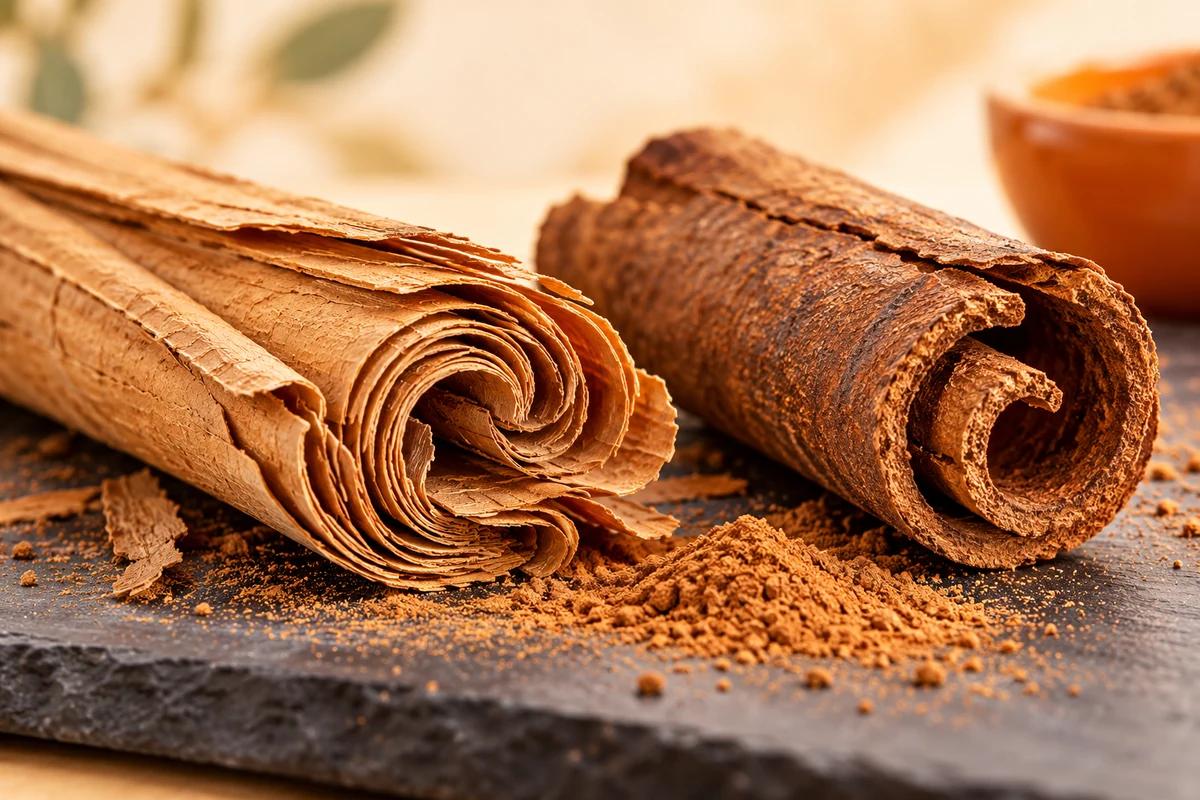
Ceylon and cassia need separate identification
Ceylon cinnamon usually refers to Cinnamomum verum. Different cassia species can also carry the cinnamon name. A review by pharmacopeial and botanical experts found that inadequately identified study products make clinical findings hard to transfer between preparations.See reference 2
The illustration contrasts thin, layered Ceylon-style quills with a thicker cassia-style curl. It is an explanation of appearance, not a laboratory identification or coumarin test. A ground powder or capsule cannot be verified by the artwork; the botanical label and quality evidence still matter.
What the main claims still need
- Claim
- Glucose control
- Human evidence
- Reviews report small changes in selected glycemic measures
- Limit
- Mixed studies do not establish a diabetes treatment or prevention programmeSee reference 1,See reference 3
- Claim
- Continuous glucose measurements
- Human evidence
- A small crossover trial found differences over short intervention periods
- Limit
- Many sensor readings do not turn a small trial into a large participant sampleSee reference 4
- Claim
- One species is universally effective
- Human evidence
- Species and preparation are often poorly reported
- Limit
- Results cannot be confidently transferred to an unidentified productSee reference 2
- Claim
- All cinnamon products have the same safety
- Human evidence
- Cassia can contain substantially more coumarin than Ceylon
- Limit
- Concentrated exposure and liver-related vulnerability require careSee reference 5
A pooled glucose signal has practical limits
A 2023 umbrella review combined findings from eleven previous meta-analyses and reported small improvements in some glucose-related outcomes. An umbrella review can include overlapping original trials; eleven reviews do not mean eleven independent sets of participants.See reference 3
A statistically detectable average does not decide whether a particular capsule meaningfully helps a particular person. The identity of the preparation, background treatment, trial quality and size of the effect remain relevant. Do not turn a pooled biomarker change into a medicine-replacement claim.See reference 3
Thousands of readings still came from eighteen people
The 2024 crossover study involved eighteen adults with obesity and prediabetes, using two four-week periods with a washout between them. The research amount was 4 g/day. Its continuous glucose monitors generated many measurements, but repeated readings from one person are not independent participants.See reference 4
The study reported lower glucose during the cinnamon period. Its short duration and selected population do not establish durable diabetes prevention, reduced complications or a suitable long-term dose. The research amount is reported to identify the experiment, not to prescribe intake.See reference 4
Coumarin is a species and exposure question
The German Federal Institute for Risk Assessment explains that cassia cinnamon generally contains more coumarin, while Ceylon has much lower levels. Coumarin can cause liver damage in susceptible people. Concentrated products and repeated exposure deserve a different assessment from a small culinary use.See reference 5
A Ceylon label alone does not prove that a batch was correctly identified or tested. Ask for the botanical species, preparation, actual amount per serving and quality information connected to the product. This guide does not convert an untested coumarin assumption into a personal safe serving.
Food use and supplement clearance are separate
NCCIH describes gastrointestinal problems and allergic reactions with larger or prolonged use and cautions about cassia and liver concerns. Pregnancy and breastfeeding safety also depends on the exposure; customary food amounts do not establish clearance for concentrated supplements.See reference 1
Take the full product and medicine list to a qualified professional when considering a combination or a clinical use. This guide does not adjust glucose-lowering medicines, investigate a liver result or choose a supplement during pregnancy. A theoretical interaction should not be described as a proven clinical event.
A useful evidence comparison has four parts
Identify the species and preparation. Check the actual amount and serving size. Find the study cited for the advertised outcome. Then ask whether its population and duration match the claim. If species identity is missing, the comparison has an important gap before the outcome is even considered.See reference 2
For example, a trial headline about a short-term glucose measure cannot support a guarantee about lifelong diabetes prevention. Nor does a picture of thin quills certify a capsule’s contents. Separate product identity, outcome evidence and batch quality so each claim can be checked.
Keep the useful details
- Keep Ceylon and cassia visible in product and study descriptions.See reference 2
- Count participants rather than repeated glucose readings.See reference 4
- Treat coumarin content as a quality question, not a visual judgement.See reference 5
Common questions
Are Ceylon and cassia the same supplement?
They are different botanical preparations; an unspecified cinnamon result should not automatically be transferred between them.See reference 2
Does cinnamon replace diabetes medicine?
The cited research does not establish a medicine-replacement plan.
Was the sensor trial a study of thousands of people?
No. It involved eighteen participants with repeated glucose measurements.See reference 4
Can a picture identify the coumarin content?
No. That requires appropriate product identity and analytical evidence.
Does culinary use establish concentrated supplement safety?
No. Preparation, amount, duration and individual circumstances change the assessment.See reference 1
Get the weekly longevity brief
The week's best longevity research in plain English. Free, every Tuesday.
References
- 1. Cinnamon: evidence and safety
National Center for Complementary and Integrative HealthOfficial guidance
- 2. Cinnamon and cassia nomenclature: transferability of clinical data
Oketch-Rabah et al., 2018; Clinical Pharmacology & TherapeuticsEvidence review
- 3. Cinnamon and glycemic control: umbrella review of meta-analyses
2023; Diabetology & Metabolic SyndromeMeta-analysis
- 4. Cinnamon and continuous glucose measurements: randomized crossover trial
2024; American Journal of Clinical NutritionRandomized trial
- 5. Coumarin in cinnamon and other foods: questions and answers
German Federal Institute for Risk AssessmentOfficial guidance
Editorial transparency
- Published by
- LongevityMate Editorial
- Published
- Updated
Medical disclaimer
Educational information about published research and product labels. This guide does not diagnose a condition, choose a supplement or dose, change a medicine, or replace advice from a qualified healthcare professional.