
The evidence in ten clear points
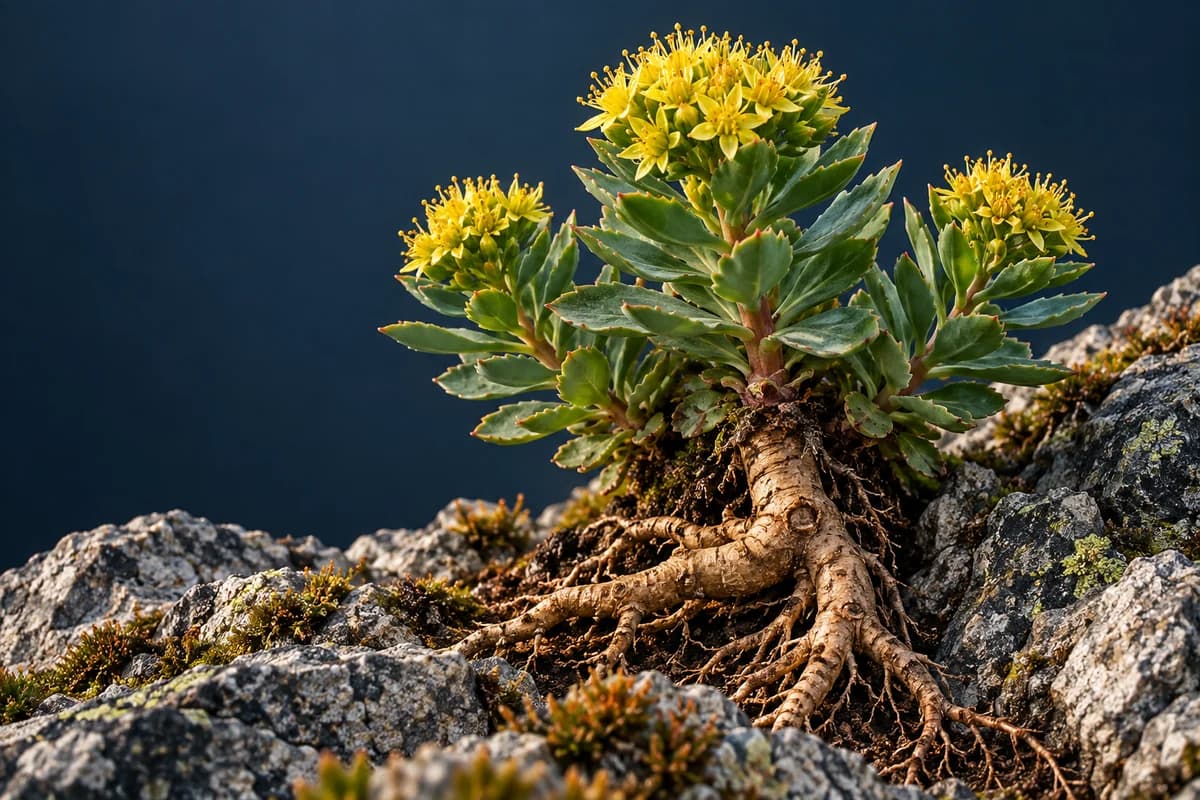
- Rhodiola rosea is one botanical species also called golden root, rose root, arctic root or roseroot.See reference 1,See reference 2
- NCCIH concludes that reliable evidence is insufficient for any health-related purpose.See reference 1
- Most human research is low-to-moderate quality, so positive individual trials should not be treated as settled evidence.See reference 1
- A 2023 exercise review included 13 randomized studies with 263 participants and found heterogeneous results plus unclear or high risk of bias in most studies.See reference 3
- Acute and chronic studies cannot be combined casually because timing, training protocols and outcomes differ.See reference 3
- The exact species, plant part, extraction method and chemical profile define the tested product; class-wide 'rhodiola' claims are unsafe.See reference 2,See reference 3
- An EU traditional-use monograph is not equivalent to modern proof of efficacy for stress, depression, fatigue or athletic performance.See reference 2
- NCCIH lists dizziness, headache, insomnia, dry mouth and excessive saliva as possible side effects.See reference 1
- A reported interaction with losartan and broader uncertainty around herb–medicine interactions justify a medication review.See reference 1
- Pregnancy and breastfeeding safety is poorly known, and consumer products may differ from research extracts.See reference 1,See reference 4
A rhodiola product is defined by more than its front label
- Identity check
- Species
- What to look for
- Full Latin name Rhodiola rosea L.
- Why it matters
- Other Rhodiola species or mixed botanical material cannot inherit the same evidence.See reference 1,See reference 2
- Identity check
- Plant part
- What to look for
- Rhizome and root, stated clearly
- Why it matters
- Leaves, aerial parts and roots are not interchangeable materials.See reference 2
- Identity check
- Extract
- What to look for
- Extraction solvent or ratio and amount per serving
- Why it matters
- A dry herb weight and a concentrated extract are not the same exposure.See reference 2,See reference 3
- Identity check
- Chemical markers
- What to look for
- Transparent amounts and test method for claimed markers such as rosavins or salidroside
- Why it matters
- A marker helps identity but does not guarantee clinical equivalence or efficacy.See reference 2,See reference 4
- Identity check
- Lot quality
- What to look for
- Independent identity, contaminant and strength testing tied to the batch
- Why it matters
- The word 'standardized' alone does not guarantee consistency.See reference 4
What the current evidence says by goal
- Goal
- Everyday stress or burnout
- Evidence signal
- Promoted use with some small human studies
- Decision boundary
- NCCIH still finds evidence insufficient; do not treat work stress, anxiety or burnout as one proven indication.See reference 1
- Goal
- Fatigue
- Evidence signal
- Traditional use and limited trials exist
- Decision boundary
- Persistent fatigue can reflect sleep, anemia, thyroid, infection, medicines, depression or other conditions and needs cause-focused assessment.See reference 1,See reference 2
- Goal
- Low mood or depression
- Evidence signal
- Some studies and traditional claims exist
- Decision boundary
- Rhodiola is not a substitute for diagnosis or evidence-based mental-health care, especially when symptoms are severe.See reference 1
- Goal
- Exercise performance
- Evidence signal
- A 2023 review reported mixed positive signals across acute and chronic studies
- Decision boundary
- Only 263 participants were included; protocols were heterogeneous and most studies had unclear or high bias risk.See reference 3
- Goal
- Healthy aging or longevity
- Evidence signal
- No reliable human outcome evidence establishes longer life or disease prevention
- Decision boundary
- Adaptogen language and mechanisms do not prove a longevity benefit.See reference 1
Traditional use is a different evidence claim
The European Medicines Agency finalized a revised EU herbal monograph and assessment for Rhodiola rosea rhizome and root in 2024. A traditional-use registration can rely on a long history of use and plausibility for a defined preparation when clinical evidence is not sufficient for a well-established-use claim.See reference 2
EMA's adult-use and two-week advice conditions apply to its defined ethanol dry extract of Rhodiola rosea L. root and rhizome. They should not be transferred automatically to every commercial rhodiola product, species, plant part, extract or dose.See reference 2
That regulatory status should not be described as proof that rhodiola treats depression, cures fatigue, improves every workout or extends life.See reference 1,See reference 2,See reference 3
Why there is no single evidence-based consumer dose
- Variable
- Extract identity
- What changes
- Species, plant part, solvent, ratio and marker profile
- Why copying a number can fail
- The same milligram number can represent different material.See reference 2,See reference 3
- Variable
- Goal
- What changes
- Fatigue, stress, mood and exercise studies use different outcomes
- Why copying a number can fail
- A studied amount for one outcome is not validated for another.See reference 1,See reference 3
- Variable
- Timing
- What changes
- Acute pre-exercise and multiweek protocols test different questions
- Why copying a number can fail
- Combining them creates a false 'standard dose.'See reference 3
- Variable
- Duration
- What changes
- NCCIH describes possible safety for up to 12 weeks
- Why copying a number can fail
- This is not proof of benefit or evidence for indefinite use.See reference 1
- Variable
- Individual context
- What changes
- Medicines, sleep, blood pressure, mood, pregnancy and illness change risk
- Why copying a number can fail
- A label serving is not a personal medical recommendation.See reference 1,See reference 4
What the evidence does not resolve about safety and interactions
- Situation
- Insomnia, agitation or sensitivity to stimulating products
- Known evidence
- Insomnia is a reported side effect
- Boundary
- The evidence does not establish a safe timing or continuation rule for someone whose sleep worsens.See reference 1
- Situation
- Losartan or blood-pressure treatment
- Known evidence
- NCCIH reports a losartan interaction and herb–medicine evidence is incomplete
- Boundary
- A professional interaction review would require the exact product and medicine list; this page cannot resolve it.See reference 1
- Situation
- Depression, bipolar-spectrum symptoms or psychiatric medicines
- Known evidence
- Mood symptoms can be serious and unsupervised combinations may complicate care
- Boundary
- Trials do not establish rhodiola as self-treatment or prove safety with psychiatric medicines.See reference 1,See reference 4
- Situation
- Pregnancy or breastfeeding
- Known evidence
- Safety is poorly known
- Boundary
- Human safety is not established, so the evidence cannot support a routine-use recommendation.See reference 1
- Situation
- Children and adolescents
- Known evidence
- EMA's defined preparation is for adults over 18, and many supplements have not been adequately tested in children
- Boundary
- The EMA adult condition and available evidence do not establish use or safety for anyone under 18.See reference 2,See reference 4
- Situation
- Upcoming surgery or complex illness
- Known evidence
- Supplements can interact with medicines and perioperative care
- Boundary
- The cited evidence does not answer perioperative interaction or safety questions.See reference 4
- Situation
- Dizziness, headache, insomnia, dry mouth or excess saliva
- Known evidence
- These are reported possible adverse effects
- Boundary
- The sources describe possible effects but do not provide an individual stop or triage rule.See reference 1
A practical product-quality check
- Check
- Botanical identity
- Prefer
- Rhodiola rosea L. with root/rhizome stated
- Red flag
- Only 'adaptogen blend' or 'rhodiola complex.'See reference 2,See reference 4
- Check
- Amount and extract
- Prefer
- Milligrams per serving plus extract ratio or solvent
- Red flag
- A front-label equivalent with no underlying extract details.See reference 2,See reference 3
- Check
- Testing
- Prefer
- A verifiable batch certificate covering identity, microbes, heavy metals and strength
- Red flag
- A generic quality logo with no lot-level evidence.See reference 4
- Check
- Other active ingredients
- Prefer
- A complete formula that allows interaction review
- Red flag
- Caffeine or multiple stimulating herbs hidden in a proprietary blend.See reference 1,See reference 4
- Check
- Marketing
- Prefer
- Modest wording that acknowledges uncertainty
- Red flag
- Claims to treat depression, cure fatigue or guarantee performance.See reference 1,See reference 3,See reference 4
Frequently asked questions
Is Rhodiola rosea proven for stress?
No. Some studies exist, but NCCIH concludes that reliable evidence is insufficient for any health purpose. Stress, burnout, anxiety and depression should not be collapsed into one claim.See reference 1
Does rhodiola improve exercise performance?
A 2023 review found some positive signals, but only 13 studies with 263 participants were included, protocols varied and most studies had unclear or high risk of bias. The result is promising, not definitive.See reference 3
What dose of rhodiola should I take?
There is no single evidence-based consumer dose across products and goals. Species, root/rhizome material, extract ratio, timing and outcome all change the meaning of a milligram amount.See reference 1,See reference 2,See reference 3
Can rhodiola cause insomnia?
Yes. NCCIH lists insomnia among possible side effects, alongside dizziness, headache, dry mouth and excessive saliva.See reference 1
Does rhodiola interact with medicines?
It may. NCCIH reports an interaction with losartan, and evidence for many other herb–medicine combinations is limited. The available sources do not establish safety for every product, medicine list or health context.See reference 1,See reference 4
Does an EMA monograph mean rhodiola is proven?
No. The monograph documents a defined European herbal regulatory assessment and traditional-use context. It does not prove every commercial product or broad health claim.See reference 2
Can I use rhodiola during pregnancy?
Safety in pregnancy and breastfeeding is poorly known. The available evidence does not establish a routine-use recommendation or personal suitability.See reference 1
Can children or teenagers take rhodiola?
Evidence does not establish use or safety for children or teenagers. EMA's adult condition applies to its defined ethanol root-and-rhizome preparation, not every retail product, and NCCIH notes that many supplements have not been adequately tested in children.See reference 2,See reference 4
Get the weekly longevity brief
The week's best longevity research in plain English. Free, every Tuesday.
References
- 1. Rhodiola: Usefulness and Safety
National Center for Complementary and Integrative HealthOfficial guidance
- 2. Rhodiolae roseae rhizoma et radix — European Union herbal monograph and assessment
European Medicines AgencyOfficial guidance
- 3. Rhodiola rosea supplementation on sports performance: a systematic review of randomized controlled trials
Phytotherapy ResearchSystematic review
- 4. Using Dietary Supplements Wisely
National Center for Complementary and Integrative HealthOfficial guidance
Editorial transparency
- Published by
- LongevityMate Editorial Team
- Published
- Updated
Medical disclaimer
Educational information, not diagnosis or a personal herbal treatment plan. Rhodiola products are not interchangeable, benefit evidence is uncertain, and insomnia, dizziness, headache, dry mouth, excess saliva and medicine interactions are possible. Evidence does not establish use or safety for anyone under 18, pregnancy, breastfeeding, complex illness, psychiatric-medicine combinations, blood-pressure-treatment combinations or perioperative use. EMA's adult-use condition applies only to its defined ethanol root-and-rhizome preparation.