
What taurine is
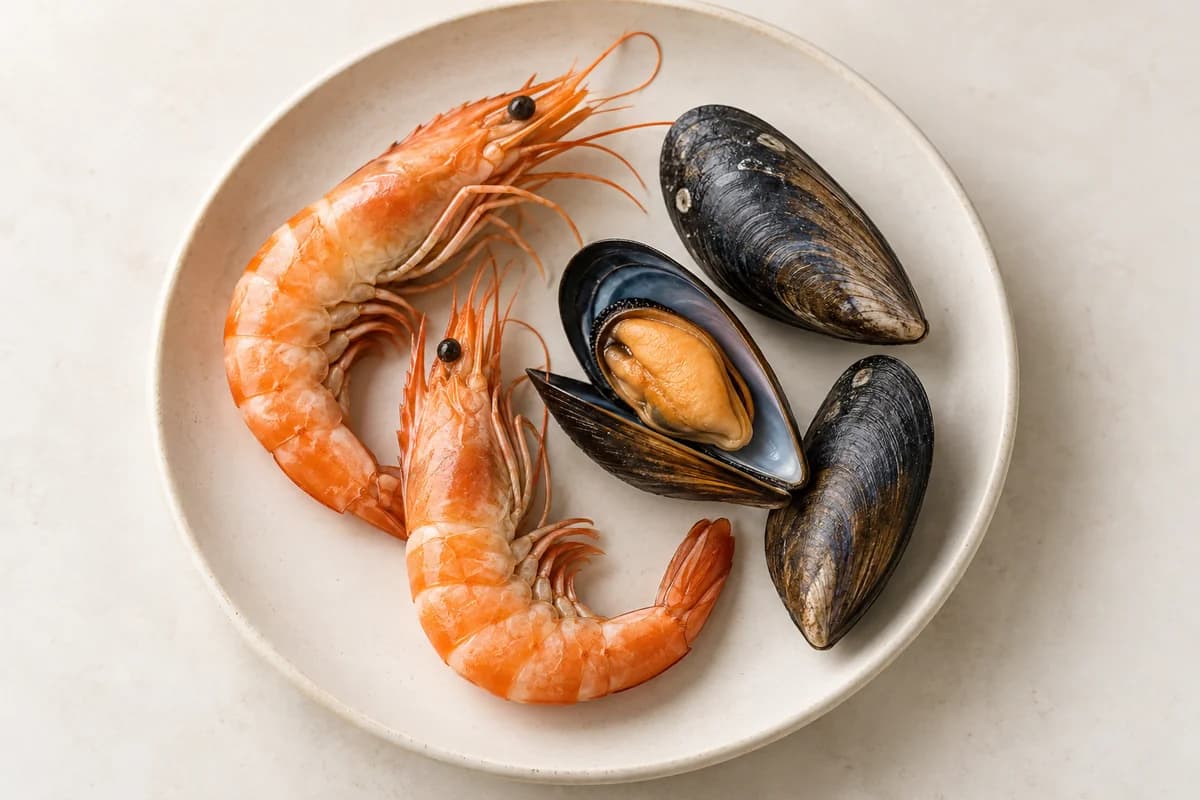
Taurine supports functions including bile-acid handling and fluid balance. It occurs in protein-rich foods such as meat and fish. Shellfish, including mussels and shrimp, are dietary sources; their presence in the illustration is not a measured dose or a supplement recommendation.See reference 1,See reference 8
An ingredient’s role in the body is different from evidence that extra intake improves health. A food, a single-ingredient product and an energy drink are also different exposures. Their other ingredients and amounts matter.See reference 1
The aging studies ask different questions
- Evidence
- 2023 animal experiments.
- What was reported
- Supplementation improved lifespan in mice and health-related outcomes in monkeys.
- What remains unproved
- No demonstrated human lifespan extension.See reference 2
- Evidence
- 2025 blood-level study.
- What was reported
- Taurine often stayed stable or increased with age in the studied cohorts.
- What remains unproved
- It was not a randomized supplement-efficacy trial.See reference 3,See reference 4
- Evidence
- 2016 randomized human trial.
- What was reported
- Blood pressure and vascular measures improved over 12 weeks in a selected population.
- What remains unproved
- Not a lifespan, mortality or general healthy-adult outcome.See reference 6
- Evidence
- 2026 healthcare-worker protocol.
- What was reported
- A six-month trial plan specifies metabolic and aging-related measurements.
- What remains unproved
- A protocol supplies no completed efficacy results.See reference 5
Why the newer biomarker finding matters
The 2023 paper linked lower circulating taurine with age and some health outcomes, alongside its animal experiments. It called for human trials. The 2025 study examined multiple human cohorts, primates and mice and found that blood taurine did not consistently fall with age.See reference 2,See reference 3
NIH concluded that circulating taurine was unlikely to be a good universal aging biomarker. That challenges a simple “low taurine means older” rule. It does not, by itself, prove that supplementation can never help a specific outcome; that requires an appropriate intervention trial.See reference 3,See reference 4
Human outcomes need their own evidence
A 2016 placebo-controlled trial randomized 120 people described as having prehypertension. Blood-pressure and vascular measures improved during 12 weeks. This is evidence for that study’s population and outcomes, not a reason to self-treat blood pressure or infer longer life.See reference 6
A 2026 open-label trial in 220 people with decompensated cirrhosis found no significant overall fatigue benefit from added taurine. A post-hoc subgroup signal was considered hypothesis-generating by the authors. Disease-specific findings cannot be turned into a general fatigue claim.See reference 7
A published plan is not a positive trial
The 2026 healthcare-worker publication describes a randomized trial designed to follow glucose control and other measurements for six months. It is a protocol. Planned outcomes, including an aging-related score, are not evidence that those outcomes improved.See reference 5
Even a change in such a score would need interpretation distinct from longer survival or fewer illnesses. This guide gives no longevity dose and does not extrapolate a mouse dose to a person.See reference 2,See reference 5
Separate taurine from an energy-drink mixture
Energy drinks may contain caffeine, sugar and herbal ingredients as well as taurine. Mayo notes that sleep problems and nervousness are often related to caffeine. Experience with the mixture cannot establish either the benefits or risks of taurine alone.See reference 1
Short trials in selected adults do not establish safety for every person or long-term combination. The healthcare-worker protocol excludes groups including pregnancy and advanced kidney disease. Exclusion means the trial cannot settle safety for those groups, not that it proves harm.See reference 5
If you use medicines, have kidney disease, are pregnant or breastfeeding, or are considering a product for a child, obtain qualified advice on the exact product. A normal cellular role and an aging headline do not answer that safety question.See reference 1,See reference 5
Keep the question attached to the evidence
- Was this a blood-level association, an animal experiment or a human intervention?See reference 2,See reference 3,See reference 6
- Was it a completed trial or only the published protocol?See reference 5
- Did it measure lifespan, a specific symptom or an intermediate marker?See reference 2,See reference 6,See reference 7
Common questions
Did the 2025 study disprove taurine supplements?
It questioned taurine as a universal aging biomarker. It was not a randomized treatment trial, so it cannot answer all supplement-efficacy questions.See reference 3,See reference 4
Has taurine been shown to extend human life?
The animal paper called for human trials. The human studies summarized here do not demonstrate human lifespan extension.See reference 2,See reference 5,See reference 6,See reference 7
Does a taurine-containing energy drink test taurine alone?
No. Caffeine and other ingredients change the exposure. Effects of the whole drink cannot simply be assigned to taurine.See reference 1
Get the weekly longevity brief
The week's best longevity research in plain English. Free, every Tuesday.
References
- 1. Taurine in energy drinks: What is it?
Mayo ClinicOfficial guidance
- 2. Taurine deficiency as a driver of aging (animal experiments and human associations)
ScienceResearch source (study or protocol)
- 3. Is taurine an aging biomarker?
ScienceObservational study
- 4. NIH researchers conclude taurine unlikely to be a good aging biomarker
National Institutes of HealthOfficial guidance
- 5. Effects of taurine supplementation on metabolic health and biological aging in healthcare workers: trial protocol, not completed results
PLOS OneResearch source (study or protocol)
- 6. Taurine Supplementation Lowers Blood Pressure and Improves Vascular Function in Prehypertension: Randomized, Double-Blind, Placebo-Controlled Study
HypertensionRandomized trial
- 7. A randomized controlled trial of L-taurine for fatigue in decompensated cirrhosis
Hepatology CommunicationsRandomized trial
- 8. The potential protective effects of taurine on coronary heart disease
AtherosclerosisResearch source (study or protocol)
Editorial transparency
- Published by
- LongevityMate Editorial
- Published
- Updated
Medical disclaimer
General education only. This guide does not diagnose a condition, interpret your personal result, choose a treatment or recommend a supplement dose. Discuss testing, symptoms, medicines and supplements with a qualified health professional.