
Start with the complete test name
- Report name
- DHEA or unconjugated DHEA
- What is being measured
- The steroid without an attached sulfate group.
- Comparison boundary
- Use the DHEA method and its own interval.See reference 1,See reference 2
- Report name
- DHEA-S or DHEAS
- What is being measured
- The sulfate form of DHEA.
- Comparison boundary
- A DHEA-S range cannot be applied to unconjugated DHEA.See reference 1,See reference 3
- Report name
- A report labelled free DHEA
- What is being measured
- Check what the performing laboratory means by the label.
- Comparison boundary
- Ask whether it means unconjugated DHEA or a separately measured unbound fraction.See reference 1,See reference 2
What question can the test help answer?
Clinicians may use DHEA with other steroid measurements when investigating androgen excess or selected adrenal disorders. Mayo describes a supporting role in congenital adrenal hyperplasia assessment, rather than a stand-alone primary diagnostic test. The other results and clinical findings determine what a raised value means.See reference 1
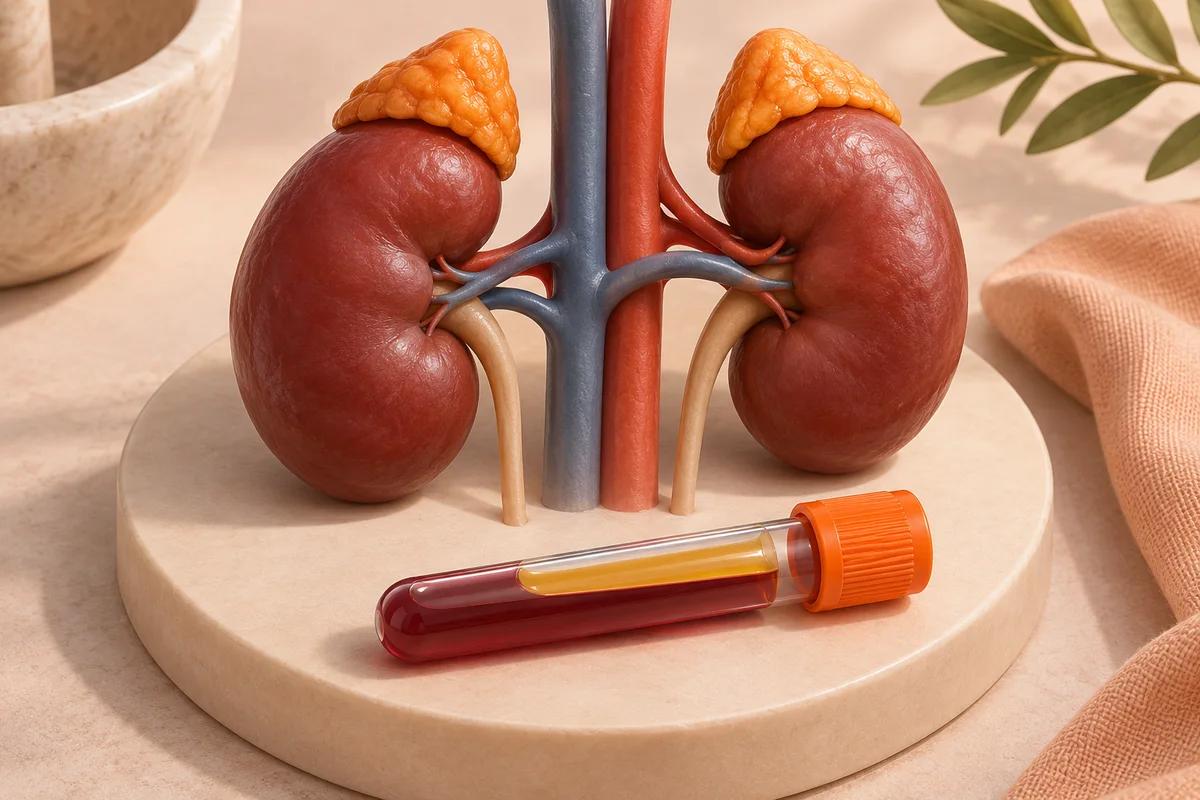
The adrenal glands sit above the kidneys, as shown in the conceptual teaching model. Labcorp also describes production in the testes. The image identifies biological context; gland appearance and sample colour do not reveal the concentration.See reference 2
Age and the laboratory change the comparison
DHEA changes across development and declines with age. A laboratory’s age-specific interval is a comparison for its assay, not a universal hormone target. A high or low flag does not identify the cause of symptoms or establish that a hormone treatment would help.See reference 1,See reference 2,See reference 5
Keep the numerical unit as well as the name. For example, 2 ng/mL and 200 ng/dL express the same concentration of the same analyte: one decilitre contains 100 millilitres. This arithmetic does not convert DHEA into DHEA-S or make their intervals comparable.See reference 1,See reference 2
Lower with age does not mean better when raised
The Mayo catalogue notes that the relationship between these concentrations and general well-being is not fully established. A lower age-related value is therefore not, by itself, a diagnosis of a deficiency that needs replacement.See reference 1
The Endocrine Society’s guideline for women recommends against routine DHEA use because evidence for benefit and long-term safety is limited. That is a population-specific recommendation, not proof that every possible clinical use has the same evidence. This guide offers no supplement dose or monitoring target.See reference 4
Prepare for the ordered assay
Follow the performing laboratory’s instructions for this exact test and any other tests collected at the visit. Tell the ordering team about DHEA-containing products and prescribed hormones. Do not use preparation instructions for a DHEA-S test as proof that an unconjugated DHEA collection has identical requirements.See reference 1,See reference 2,See reference 3
For a useful discussion, bring the full test name, collection date, age-related interval, unit, method if available, previous reports and product list. Ask whether the result fits the reason for testing and which earlier result is genuinely comparable.See reference 1,See reference 2,See reference 5
Common questions
Can I replace this result with a DHEA-S number?
No. They measure related but different forms. Ask the laboratory which analyte was ordered before comparing either the number or its reference interval.See reference 1,See reference 2,See reference 3
Does a normal result rule out an adrenal disorder?
A single laboratory result does not exclude every adrenal disorder. Testing is interpreted with the specific question, symptoms and other investigations.See reference 1,See reference 5
Should I take DHEA to reach a younger range?
These sources do not establish a younger-age range as a treatment goal. Discuss the clinical purpose with the responsible professional rather than choosing a supplement from the flag.See reference 1,See reference 4
Get the weekly longevity brief
The week's best longevity research in plain English. Free, every Tuesday.
See your blood results in context
If you already have blood test results, the paid LongevityMate app can help you view related markers together. It provides educational context, not a diagnosis or a replacement for your clinician.
Explore blood test analysisReferences
- 1. Dehydroepiandrosterone (DHEA), Serum
Mayo Clinic LaboratoriesOfficial guidance
- 2. DHEA by Ionify LC-MS/MS, test 004389
LabcorpOfficial guidance
- 3. DHEA Sulfate Test
MedlinePlus, U.S. National Library of MedicineOfficial guidance
- 4. Androgen Therapy in Women: A Reappraisal
Endocrine SocietyGuideline
- 5. How to Understand Your Lab Results
MedlinePlus, U.S. National Library of MedicineOfficial guidance
Editorial transparency
- Published by
- LongevityMate Editorial
- Reviewed by
- Editorial evidence review (AI-assisted)
- Published
- Updated
Medical disclaimer
General education only. This guide does not diagnose a condition, interpret your personal result, choose treatment or recommend a medicine or supplement dose. A qualified health professional can interpret the full report in context.